

Disclosure: I own shares of Stride (LRN).
TL;DR
I think investors are misinterpreting Stride’s abrupt CEO change. The company suffered two major failures this past year: the troubled LMS rollout and the loss of Lone Star, a customer representing 5% of revenue, following years of efficacy concerns. This raises questions about process and accountability within the organization. Did Stride ultimately outgrow some of the systems that may have worked when the company was smaller? Since 2020 revenue has more than doubled. New CEO Bob Knowling’s background suggests the Stride Board may have brought in an experienced turnaround expert to diagnose and fix organizational issues. I find the 15% stock decline following the management change surprising and unwarranted. Potentially a buying opportunity. Following the announcement of the Lone Star loss I had contemplated selling my shares given a lack of confidence in management’s commitment to efficacy. Knowling’s appointment makes me more comfortable holding shares for a bit longer.
New CEO: A “Turnaround Guy”
This Saturday I came across an interesting book titled You Can Get There From Here: My Journey From Struggle to Success. It’s effectively a modern-day Horatio Alger story. It’s about a man who grew up in poverty, worked since childhood, experienced racism, and rose through corporate America to the rank of CEO. In the book the man speaks about his experiences with turnarounds at various companies like Ameritech and US West. Not with arrogance but rather with humility. He describes luck, opportunity, and mentorship as key in his journey.
The Stride Board of Directors just appointed the author, Bob Knowling, as the new CEO of Stride.
Following his appointment the stock declined by 15%.
Ouch.
Investors I spoke with following the company’s August 4th Q4 conference call didn’t know what to make of the new CEO’s comments. Had investors read the autobiography they might have.
Knowling on the call provided the obligatory comments every edtech leader seemingly makes about the market opportunity and the importance of efficacy. Unfortunately, he also suggested that applications at this point are tracking slightly below last year. Obviously that’s a lot to digest. What does this really mean for the company? Has the post-pandemic enrollment tailwind at virtual schools abated? What will the company do now? How will management accelerate growth?
To be clear, I have no idea what growth rate we will see in the virtual school industry for the next year or three. I’m not sure anyone does. I was surprised post-pandemic at how the market expanded following the opening of the economy and the end of lockdowns. I think that there’s a sizeable addressable market that virtual schools can penetrate. This will likely require further product innovation on the part of market participants. Within the next five years for example, I think that operators may develop AI-native virtual schools with a completely reimagined instructional model. For all I know maybe Stride launches this as another offering in its portfolio.
Here’s what I do know though.
If Knowling proves to be the person he described in his autobiography, he’s the perfect person to lead this company right now. He’s the anti-John McClane - the right person at the right place at the right time.
I can only speculate why the management change happened. After reading the autobiography my guess is that the Stride Board appointed Knowling because after two notable failures this past year the Board wanted a turnaround expert to come in, diagnose why those failures occurred, and fix processes that may have worked for a $1B but not a $2.5B revenue generating company.
If I’m right, investors wildly overreacted to the change in leadership. That potentially represents a buy opportunity.
Why Did the Stock Fall More Than 15% Following the Management Transition Announcement?
On July 30th Stride issued a press release that new CEO Robert Knowling had replaced former CEO James Rhyu. The stock immediately declined by 15% following the announcement. After approaching $100/share before the announcement, it has since hovered slightly above $80/share.
Professional investors are pretty strange. They are the best and the brightest that the world has to offer. They also tend not to have operating experience and at times come up with incredibly bizarre theories about management and Board decisions.
Some investors told me that the change in management reflected concerns about the upcoming fall enrollment. One of the sell-side analysts on Stride’s August 4th conference call asked management this question directly.
The thesis regarding fall enrollments assumes that boards myopically change leadership on the basis of a given year’s financial results, rather than long-term strategy and operational health. Proponents of this theory also demonstrated their ignorance of the Stride business model. It’s still too early for management to know how fall enrollments may materialize. While it may seem odd, a great deal of application volume gets processed over the last two weeks of August and September.
The announcement of the departure didn’t exactly follow the traditional playbook of most publicly traded companies. Was it the announcement itself or the way that the company handled the transition that irked investors so?
Rhyu served at the company for thirteen years, joining in 2013 as the CFO. With that tenure, it perhaps would have been a bit more palatable to investors for Rhyu to announce his retirement after a difficult year, take on a role as a senior advisor, and have a board member step up as an interim CEO while a formal executive search process unfolded. Rhyu in this scenario would have participated in the Q4 conference call briefly at the beginning, thanked investors, and expressed full confidence in the future of the company. That’s obviously not what we got. The decision to go a different route may have cost me and other investors 15%.
By conventional metrics, under former CEO Rhyu the company saw impressive financial performance. Promoted in 2021 from his role as CFO, Rhyu oversaw rapid post-pandemic growth. Under his five year tenure revenue increased by over 60%. Operating margin expanded to 18% from 10%.
Would the company have witnessed a similar performance with a different CEO post-pandemic? No idea.
Big picture though, under his leadership the company became substantially larger and more profitable. That’s enough to at minimum characterize his tenure as a success.
Winston Churchill defended the free world and won World War II. Then the British public replaced him in 1945. Go figure.
Rhyu clearly did a good job taking the existing Stride model and scaling it. Perhaps that’s why investors had such a difficult time understanding the change. The challenges of this past year could conceivably be chalked up simply to bad luck. I wouldn’t say that, but others might.
Overall I think that the Stride Board likely did the right thing.
Companies have different phases of growth requiring different leadership at each stage.
Over the past five years Stride became a much larger company. Perhaps without all of the processes underneath the organization maturing at the same rate.
Someone needs to come in, identify why the issues of the past year occurred, and establish new processes to ensure reporting up the chain of command and accountability.
Stride’s Twin Disasters Raise Questions About Process and Accountability
Stride saw not one but two operational issues this year that resulted in meaningful stock price declines.
At the beginning of the academic year, the public witnessed the disastrous implementation of Stride’s new learning management system. Management estimated that the challenge contributed to the loss of 10,000 to 15,000 enrollments. More broadly though, the problems damaged the user experience of students and families. Social media contains numerous postings of outraged stakeholders. The good news? It could have been worse. Much worse. The situation stabilized by December.
Management deserves criticism for rolling out the software seemingly to ALL schools rather than engaging in a phased rollout. Technology migrations usually happen in a phased manner. This approach limits risk, as it allows stakeholders to fix bugs before launching the new technology to everyone all at once.
Management teams make mistakes from time to time. This was a big one though.
My question: how did an implementation affecting the company’s core instructional platform get this far without safeguards?
The LMS issue pales in comparison to the second problem, the closure of Lone Star Online Academy given efficacy issues. I’ve written about this extensively. Here and here.
Lone Star received an “F” rating from the Texas Education Agency every year since it opened in 2021. CFO Donna Blackman on the Q4 call acknowledged that there had been “performance issues with that school.” After only five years of operations Lone Star grew to $140M of annual revenue representing close to 5% of Stride’s total revenue and enrollments. How could this happen? How could this happen? How could enrollments continue to grow at Lone Star despite the weak efficacy? This was a slow moving freight train heading for a crash. For years.
On the surface, these two issues appear to be completely different. One was technology. The other was efficacy.
But they do raise interesting questions. Are there issues with organizational design? Culture? Accountability? Internal reporting?
I don’t know why the Board changed leadership, but if I had to wager, I suspect those questions were part of the discussion.
The LMS Migration - Unanswered Questions
Technology implementations fail. Management teams make mistakes. It happens.
But a learning management system isn’t a backend system. It’s at the core of instructional delivery. If the system doesn’t work, the offering doesn’t work.
Here are the questions that the public still doesn’t have answers to:
Why did Stride implement the new system for all customers all at once? Why not roll it out in stages over the course of a year or two?
Who was accountable for the implementation?
What did the testing process look like?
What metrics did management review?
Who had the authority to say it wasn’t working and stop the rollout?
When did senior management understand how serious the problems were?
Did employees at the company know there were issues before the launch? Did they have a process by which they could alert senior leadership to the issues? Did lower-level employees express fear about raising these issues?
When was the Board informed?
What was the contingency plan?
Why didn’t the processes surrounding the implementation prevent a failure from becoming this large?
How Did Lone Star Become the Second-Largest Customer Despite Its Weak Outcomes?
How did a company with its prior track record allow a school with performance problems to represent 5% of revenue?
The situation at Lone Star was far more concerning given the company’s twenty year history. Efficacy became the paramount issue for management in the 2010s.
Academic outcomes received considerable scrutiny. Regulators, school boards, authorizers and the media focused on efficacy.
Agora Cyber Charter School in Pennsylvania was K12’s largest customer and represented 14% of company revenue in fiscal 2015. Agora subsequently moved away from K12’s fully managed model. Revenue associated with the school declined substantially. An article published by the New York Times back in 2011 captured concerns leveled against the school and K12.
“Nearly 60 percent of its students are behind grade level in math. Nearly 50 percent trail in reading. A third do not graduate on time. And hundreds of children, from kindergartners to seniors, withdraw within months after they enroll.”
It’s not an exaggeration to say that Nate Davis, who served as Chairman and CEO during the 2010s, may have saved the company. Not just stabilized it, but saved it.
Younger folks may not know that the 1990s-2000s saw the rise and fall of Edison Schools, a publicly held charter school company whose market cap once exceeded a billion dollars. The company collapsed amid a litany of issues, chief among them questions of efficacy. The precedent had been set. The decline of Stride/K12 from efficacy concerns was a real possibility.
I would encourage current investors to read Stride’s 2015 Q1 earnings call transcript given similarities to the business today. Davis said:
“... I can’t ever lose sight of the fact that the company’s reputation was at risk based on what we were before”.
“...while I am happy to fix that, some of the outcomes we’ve got to continue to prove it. I am not claiming success completed yet, I am claiming progress. And I think we still have to improve that. So that balance is always going to be delicate and yes it gets in a way some times when we swing the pendulum too far toward academics.”
“While our maniacal focus on the quality of education we provide has contributed to slower growth in our managed schools, we believe it will improve our corporate reputation and provide what our charter boards have asked of us. I’m very proud of my team and a turnaround is now happening in this area.”
An education business works best when growth and outcomes are aligned. Criticisms regarding the education sector occur when the perception or reality suggests that growth and efficacy are not aligned.
Good operators know that academic performance affects the durability of the business model.
So it’s all the more puzzling that Lone Star grew enrollments so quickly all the while receiving weak efficacy scores.
I bought the stock under the theory that management had implemented processes years ago to ensure that something like a sudden closure of Lone Star wouldn’t happen. My greatest fear in owning the stock was waking up one day to a headline that would cause the stock to tank. Well, mission accomplished. I read about Lone Star while standing in the supermarket checkout line. Crisis averted.
The Lone Star fiasco makes me question whether the company still has processes to ensure efficacy and whether they worked as intended.
Here are the questions on Lone Star that are still unanswered.
What metrics does management monitor regarding the efficacy of the schools that it manages?
Did Stride have any control over the growth of the school? Did the client determine growth?
To what extent did management work with the school to identify and fix the problems?
Stride’s customer in Texas, Texas Virtual Academy at Hallsville (TVAH), used an alternative education accountability mechanism. That school received “B” ratings. Lone Star presumably had the same type of students and the same processes to manage the school and received “F” ratings. Perhaps Lone Star was not the type of customer that Stride should have signed? Perhaps Stride should have fired the customer when it saw the accountability rating?
Who owned the remediation plan? Did one even exist?
Was senior management aware of the issue?
Was the Board aware? What did the Board know exactly? Bob Knowling was on the Board. Did he know about this over the past five years? He’s served on the Board since 2018.
Did anyone ever say, ‘We have a school that continues to receive terrible academic ratings, and perhaps we shouldn’t keep allowing enrollment to grow until we fix it’?
The questions on the 2026 Q4 earnings call moved toward how many students Stride might recapture elsewhere in Texas and what the financial effect would be. That’s obviously relevant for a financial model.
But from an investment perspective, it’s secondary and completely misses the point.
Was Lone Star an acceptable risk? Or was it a process failure?
If the process worked exactly as designed and Lone Star was just an unfortunate outcome, fine. That’s not a company I want to own, but fine.
If nobody had clear accountability, problems weren’t escalated quickly enough, and senior management didn’t have sufficient visibility, then a turnaround expert coming in, identifying gaps, and correcting processes makes a lot more sense.
Bob Knowling’s Autobiography - Clues for Stride Leadership
It’s reductive to sum up someone’s entire career in two words. But Knowling is a ‘turnaround guy.’ Turnarounds and fixing organizations are recurring themes throughout his book; at one point he recounts someone referring to him as a ‘celebrated turnaround guy.’
Knowling doesn’t characterize himself as a visionary in his book. Definitely someone who enjoys pressure.
As he wrote in the first chapter:
I want the basketball with the game on the line. I want the bat in my hands with two outs and two on in the bottom of the ninth. I want to have the baton in my hands at the beginning of the race. I want the tough job assignments that no one else wants. They are tests of your character and are real-life experiences that can be more valuable than reading case studies in a library because these challenges will shape you. They give you the knowledge, competence, and confidence to step up the next time, maybe to an even bigger challenge.
There’s an interesting passage in the book where Knowling describes a playbook that he employed at US West. I’ve copied and pasted it below because he may go through the same exercise at Stride, and it’s important for investors to ask him about the application of this process.
30-60-90–day Plan
I knew I needed to fix the organization’s structure and address the processes, and that change needed to happen quickly. Every time I’ve taken on a new assignment, I approach the task with a 30-60-90–day game plan. The first 30 days I spend diagnosing the system. The 60-day time frame is for launching the strategic initiatives that are going to turn the company around. The 90-day goal is to align the rewards and the consequences with the proper incentives to drive performance improvement.
All through the 30-60-90–day time frame, people are being assessed, quick wins are celebrated, and I broadcast the vision and values I want everyone to understand and embrace.
My first intervention was built around what I called “Focus: Customer.” I will share how that came about a little later. Every metric we had that focused on how we performed for our customers was on the table. We started with baseline data on everything.
This is a lot like what a doctor does. You don’t just go into a doctor’s office and say, “Doctor, I’m not feeling well,” and expect him to start administering treatment. He first must go through a series of procedures to determine what is wrong.
At US West, I found a long list of problems. We were there to deliver service, but we had a lot of different customers. Of those customers, which ones had the highest leverage for the business and which ones would have the most material impact if we fixed their problems? In theory, I needed to fix the problems for all customers, but when you have a burning platform, you have to make hard choices until you can eliminate the crisis.
Q4 Comments Aligned with This Turnaround Narrative
Reading the Q4 conference call transcript in isolation doesn’t help investors understand what may happen at the company. Doing it in conjunction with his autobiography tells the story.
First of all, Knowling signaled that changes are afoot.
For example:
“I’m known for building strong teams and I get quite deep in the details as that is my comfort zone.”
He’s not going to be a figurehead. He’s presenting himself as a detail-oriented operator rather than merely a strategist.
Also, he builds teams. That includes replacing leaders and firing underperformers. But it doesn’t mean arbitrary mass layoffs. He gives people chances.
One of the best and most memorable parts of the book revolves around a man named Joe Devich, who apparently looked like a young Steven Seagal, including a ponytail that Knowling despised. In the book, Knowling tells Joe:
“I have seen your actions. You are a despicable person”. He then says: “… Joe, you have to understand something. I’m not the brightest bulb on the string, but you aren’t going to be able to bullshit me. You are a bad guy, and I really don’t want bad guys in my organization. You don’t care about people. You step on people. You grandstand. It’s all about you. My job is to make our company successful. We are basically on the front line of every dollar of revenue that comes into this business, and I need people who are winners. People who are team players. I don’t need grandstanders.”
This story is critically important because Knowling also wrote that Joe “would become one of the most important people in my career… Joe transformed himself, and every time I changed companies, he came along.”
I’m including this story for three reasons.
First, Knowling clearly has a sense of humor. Enough to include this exchange in his book.
Second, this sort of story never finds its way into a LinkedIn profile or corporate biography, yet it tells you far more about how someone actually manages people.
Third, Knowling doesn’t come across as someone who engages in mass layoffs and considers the resulting EBITDA increase a success. He’s a coach, but a demanding one. He’s willing to tell people directly what they need to change and then give them an opportunity to change it. This is a manager who can light a fire under an organization.
Stride may go through a complete re-examination where employees will be tested as perhaps they haven’t in quite some time.
Here’s what Knowling said about efficacy in the Q4 call:
“I grew to truly understand the importance of driving student outcomes. I believe this is the ultimate measure of educational success. Investments in curriculum, technology and support must translate into meaningful academic achievement. Educators, institutions, and policymakers expect this from Stride and this will be one of my top priorities.”
“To grow our market share, in large part, we must improve student outcomes. This includes better leveraging our suite of products and services, such as our live and AI tutoring platforms, and our Tallo career and digital curriculum platforms. We have done a nice job over the years of adding capabilities, but I believe that there is even more we can do to extend our suite of products and help students to reach their goals.”
What his comments mean tactically, I’m not quite entirely sure.
Does the company have the right internal efficacy metrics for its existing offerings? For new program and school launches? For M&A? Has efficacy been deprioritized when evaluating parts of the business?
Following the Lone Star debacle, my confidence in management’s commitment to efficacy declined. Perhaps evaporated. If they allowed Lone Star to grow to 5% of revenue and then blow up, what else could we see emerge?
This business simply doesn’t work if regulators, school boards and families come to believe that the company is anything less than fully devoted to student outcomes. It’s mission critical for the CEO to make it clear that efficacy is at the core of the entire company.
So Knowling’s comments are encouraging. I expect efficacy to once again become a paramount issue for the company. Which I like.
Conclusion - Investors Misread the CEO Change
This brings me back to the 15% decline in the stock following the management change.
On the one hand, I don’t understand why investors reacted negatively to the change. Haven’t they followed what happened this year? Aren’t they aware of the issues that emerged? Where have they been?
On the other hand, I get it.
A Federal Reserve Bank of New York study (from more than 20 years ago for what it’s worth) examining 872 CEO turnovers from 1979-1995 found that equity volatility increases following management changes. It increases the most following forced departures. The authors argue that a forced CEO change can signal to investors that existing company policies are inadequate and meaningful changes may be required. Investors also face uncertainty regarding the new CEO’s strategy and ability to execute it.
Ideally, ideally the CEO transition could have been handled a bit differently. In the scheme of things though, investors years from now are likely not going to remember a 15% decline because of messaging. Traders with shorter time horizons might, but not investors.
Today it appears that investors see the unexpected transition as evidence of a problem that hasn’t yet been disclosed.
I completely disagree with this.
The Board already saw two major problems. They probably didn’t want to wait for a third.
Through that lens, the choice of Knowling makes sense.
We are now in Knowling’s first thirty days as CEO of Stride. If he’s following anything resembling the playbook described in his autobiography, he’s currently ‘diagnosing the system.’ I wish him well. Him and the employees of Stride.
Valuation
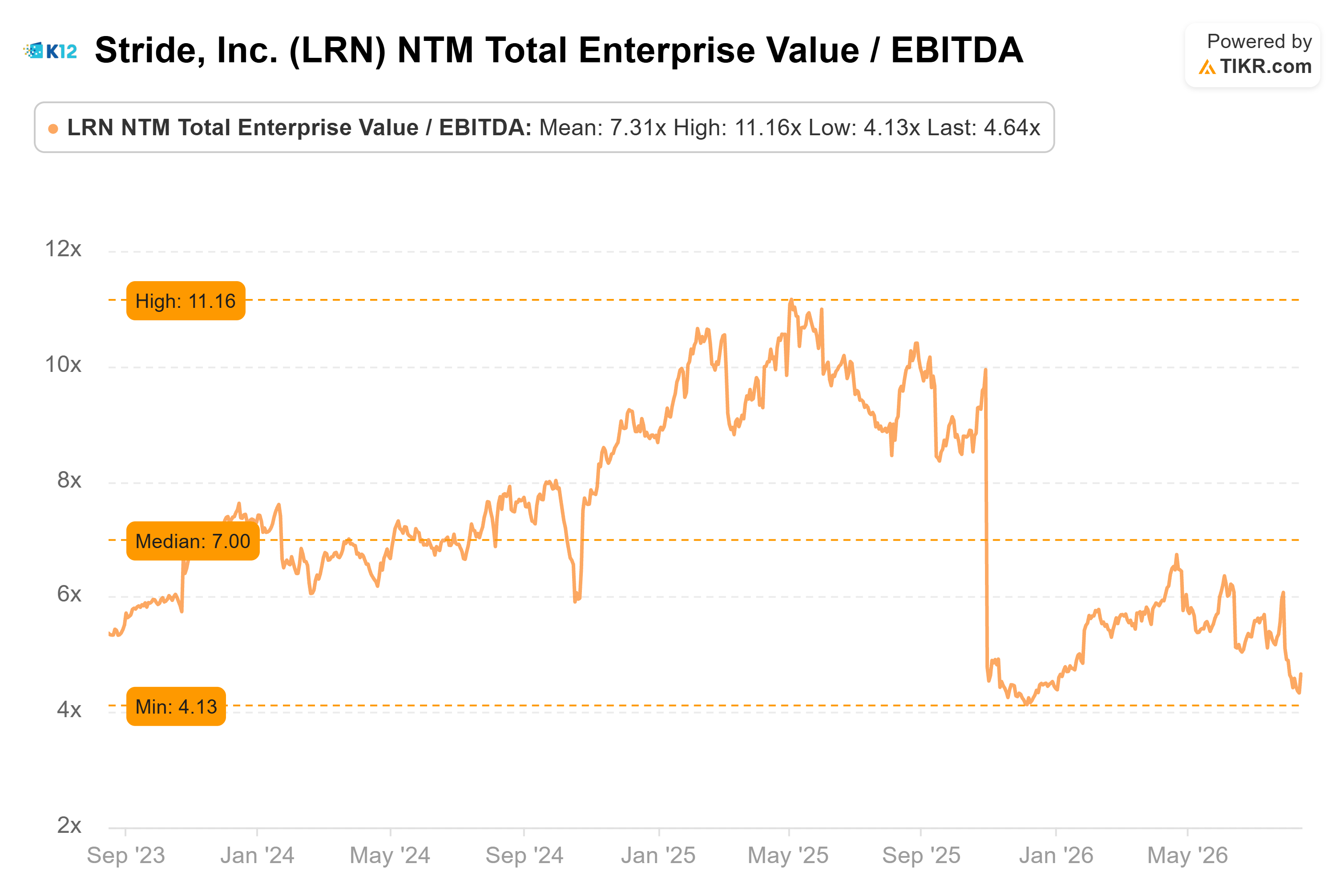
Consensus estimates have Stride growing topline at 2% YoY for fiscal 2027. This comes after seeing revenue growth of 18% in fiscal 2025 and 4.7% in fiscal 2026.
Stride trades at trough valuation, near 4x EV/EBITDA.
Education stocks tend to have a relationship between revenue growth and EV/EBITDA. So if management can accelerate revenue growth we could potentially see the valuation multiple expand.
Disclaimer: I own shares of Stride (LRN). This article reflects my personal opinions and analysis and is provided for informational purposes only. It isn’t investment advice or a recommendation to buy or sell any security. I may be wrong. Readers should conduct their own research and make investment decisions based on their own circumstances.
Book disclosure: I read Bob Knowling’s autobiography, You Can Get There From Here, but not cover to cover. I skimmed portions that were less relevant to his business.