

TLDR
I’m providing my high-level thoughts on Stride’s Q1 earnings release and conference call. This piece is intended for EdTech industry professionals who want to understand what’s happening with Stride. Observations from a former operator in the K-12 virtual school space.
Stride’s CEO Bob Knowling called the first quarter enrollment results “disappointing“. Maybe that’s the headline for the quarter. The stock was down as much as 5% today.
But I actually rather liked what I heard on the call. Knowling is dramatically reorganizing the business. Over the past year, Stride dealt with twin disasters: a challenged learning management system implementation and the loss of a large customer because of weak academic outcomes. Preventing those twin issues from turning into a trifecta remains management’s top priority in my opinion.
Knowling appears on track. I’m not disappointed.
That being said, I am deeply concerned about the lack of verbiage in the conference call regarding artificial intelligence. I understand that the company needs to fix the problems of today before solving the problems of tomorrow. The CEO absolutely needs to lay out his vision for operating in a world where AI has commoditized curriculum. Presumably he’s aware of that.
Big Picture - Q1 Traction on Introducing Organizational Accountability
Stride fall enrollments was down 2.5% YoY. Management guidance suggests slight revenue growth for the year, in-line with the consensus estimate.
For many, this is the entire story of the Q1 print. The fall enrollment cycle effectively sets the financial trajectory for the year.
Okay, so fall enrollments weren’t great. It’s a vestige of last year’s twin disaster.
With fall enrollments no longer the primary focal point, here are the three questions industry stakeholders need answered.
how will CEO Bob Knowling fix the company to ensure that last year’s twin disasters never happen again?
does evidence exist that the pandemic tailwinds benefitting Stride enrollments and the industry have abated?
how has the company positioned itself to ensure durability given the threat of AI substitution?
CEO Knowling only addressed the first question on the Q1 earnings call.
For now, that’s enough. I like what he’s doing. I own the stock. I’m not selling my shares today.
Here’s why.
Why I Liked Stride’s Earnings Conference Call
Knowling started his prepared remarks by saying:
Our first quarter enrollment results were lower than we anticipated. The results are disappointing to me…
Kudos to whoever internally wrote the prepared remarks.
It was a brilliant way to open the call because it tells you quite a bit about how Knowling is approaching the job.
He could have started the call by saying that the results met sell-side consensus expectations. He could have deflected and said that after a difficult year with two disasters management stabilized the business. That he was proud of the leadership team and the overall commitment of the Stride staff.
He didn’t say any of those things.
Instead, he’s a public company CEO who used the word “disappoint” in a sentence. The company has a problem. He provided a game plan to fix the problem.
These are the most important words on the call:
In my first months as CEO, we have begun a strategic reassessment of how we organize and operate the business. As part of that work, we’ve already moved to simplify the organization, bringing related teams together and clarifying accountability around our highest priorities. These actions are intended to sharpen our focus and direct both financial and leadership resources towards the areas with the greatest potential impact and return. And that work is ongoing, but we have not waited to begin making the changes needed to improve execution and strengthen the business.
That’s what I wanted to hear. Simplification. Accountability. Sharpened focus.
Remember, the prior management team allowed the implementation of a new LMS across ALL of their schools in one summer. Allowed for the enrollment growth at the Texas Lone Star school despite the school receiving the worst efficacy score that Texas had to offer.
I use the word “allow” because I’m convinced that the twin disasters didn’t happen because of intentional decisions on the part of management. Rather, there likely was a lack of ownership of these issues. Whose job was it internally to tell marketing to stop enrolling students at Lone Star? Who owned that decision? That’s presumably why Knowling likely used the word “clarifying accountability”.
Clearer accountability, changes to the organizational structure, and new leadership should reduce the likelihood that problems like these happen again.
Knowling Implementing His Documented Playbook
Loyal readers might recall my August piece Stride (LRN): What Investors Missed About the CEO Transition - It’s a Turnaround Situation. I wrote about how Knowling provided a playbook for a turnaround in his autobiography, You Can Get There From Here. He’s following the 30-60-90 day playbook per his prepared remarks.
First 30 Days - Diagnose the System
Knowling said he has spent his first months meeting with district partners and school leaders and listening to people closest to students and families. Out of that work, he identified three areas requiring improvement:
student outcomes
the student and parent experience
getting more from Stride’s existing portfolio of capabilities.
60 Days - Launch Strategic Initiatives
Then the changes started.
Stride is reassessing its product portfolio, shifting resources toward initiatives that demonstrate impact and halting work where management doesn’t see a clear path to better outcomes or meaningful value.
On the student experience side, Knowling hired a new chief information officer and consolidated all IT development and operational functions under her leadership. Hopefully no more tech issues.
90 Days - Establish Accountability
This is where Stride is today. Knowling ended his prepared remarks by saying:
I intend to lead Stride by staying close to what students, families and school partners are experiencing, focusing our resources on the areas of greatest impact and being very clear about where we need to improve and holding myself and my team accountable for making progress.
Continued Technology Issues Affecting Enrollments
Knowling pointed to further tech issues that affected enrollments.
Stride developed a platform called Launchpad to serve as an overlay to its LMS. While its initial rollout went well, the company made additional enhancements heading into the fall enrollment season which created what Knowling described as a “poor user experience.” Families had difficulty navigating schedules, retrieving assignments and accessing classes.
Knowling didn’t say when management first became aware of these problems. Was it before or after his appointment as CEO? But the challenges raise the same issues as the LMS implementation.
How does Stride implement technology?
Who owns the customer experience?
How are products tested before being deployed?
Who has the authority to stop a rollout?
How quickly are problems escalated?
Who is accountable when something goes wrong?
Knowling appears to be addressing those questions with his newly appointed CIO.
AI Not Mentioned On the Earnings Call
The only aspect to the call that concerns me was the absence of Knowling articulating a strategy in the context of AI.
The most important industry event in virtual schooling is happening this week in Atlanta. Hosted by the Community Advancing Digital Learning. It’s the DLAC conference. I’m not there. But my former colleagues (and more importantly Substack subscribers) are. As are much of the leadership of virtual schools.
The number one issue discussed at the DLAC conference? The threat of AI displacing curriculum vendors.
One former colleague sent me an email describing what he’s hearing. He gave me permission to publish an excerpt.
lotta talk about how virtual schools can build their own curriculum with AI… schools were talking among themselves about how much improved AI has already come to building curriculum, but the next iteration (18-24 months) they believe will be good enough to not need a Stride or Pearson for curriculum build. Of course, what will the token cost be, do you have the right people to work with AI to build it, the editorial review, the accessibility review. Those processes need to be worked out.
That’s anecdotal. But I’ve heard this sentiment from more than one person.
Here’s an example of the sort of sessions being held:
EdTech vendor StrongMind presented an AI-powered course-authoring platform. The premise: course development that historically required a lot of people, money and time can be done much faster and much more cheaply.

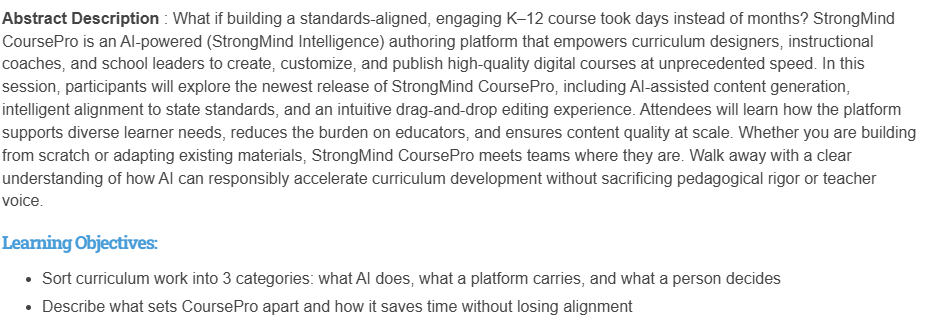
Obviously, I’m concerned about Stride customer attrition given the ease with which customers can create and implement their own curriculum.
I’ll give Knowling a pass on describing the AI threat because he has a lot on his plate right now. He’s only been around for three months. He has to fix the company as it exists today before he can fix the company as it might exist tomorrow.
AI has attacked one of the core sources of differentiation for the large virtual-school operators: proprietary digital curriculum.
The historical moat for the industry contained curriculum, compliance, school operations, and marketing/brand. Take away proprietary curriculum and a strong value proposition still exists. Just not as strong as before.
Customers will always come and go in this industry. That’s not new. The question is the degree to which AI will accelerate customers seeking a departure.
Just this past month Pearson customer Massachusetts Connections Academy issued RFPs that apparently seek to supplant Pearson. Read the RFP here for the LMS. Here for enrollment and marketing support. I’m told that this is for three thousand students.
I have no idea if they’re issuing RFPs to seek pricing concessions from Pearson or if they’re genuinely interested in finding a new vendor. To be clear, I’m not saying that Pearson is losing this customer. Customers issue RFPs for all sorts of reasons. One reason obviously is because they want to in-source capabilities. I’d be curious to hear if and how AI is playing into the conversation.
Stride needs to invest as much as possible in next generation technologies. Management needs to articulate their approach. I truly hope that they address this in their next earnings conference call.
Valuation
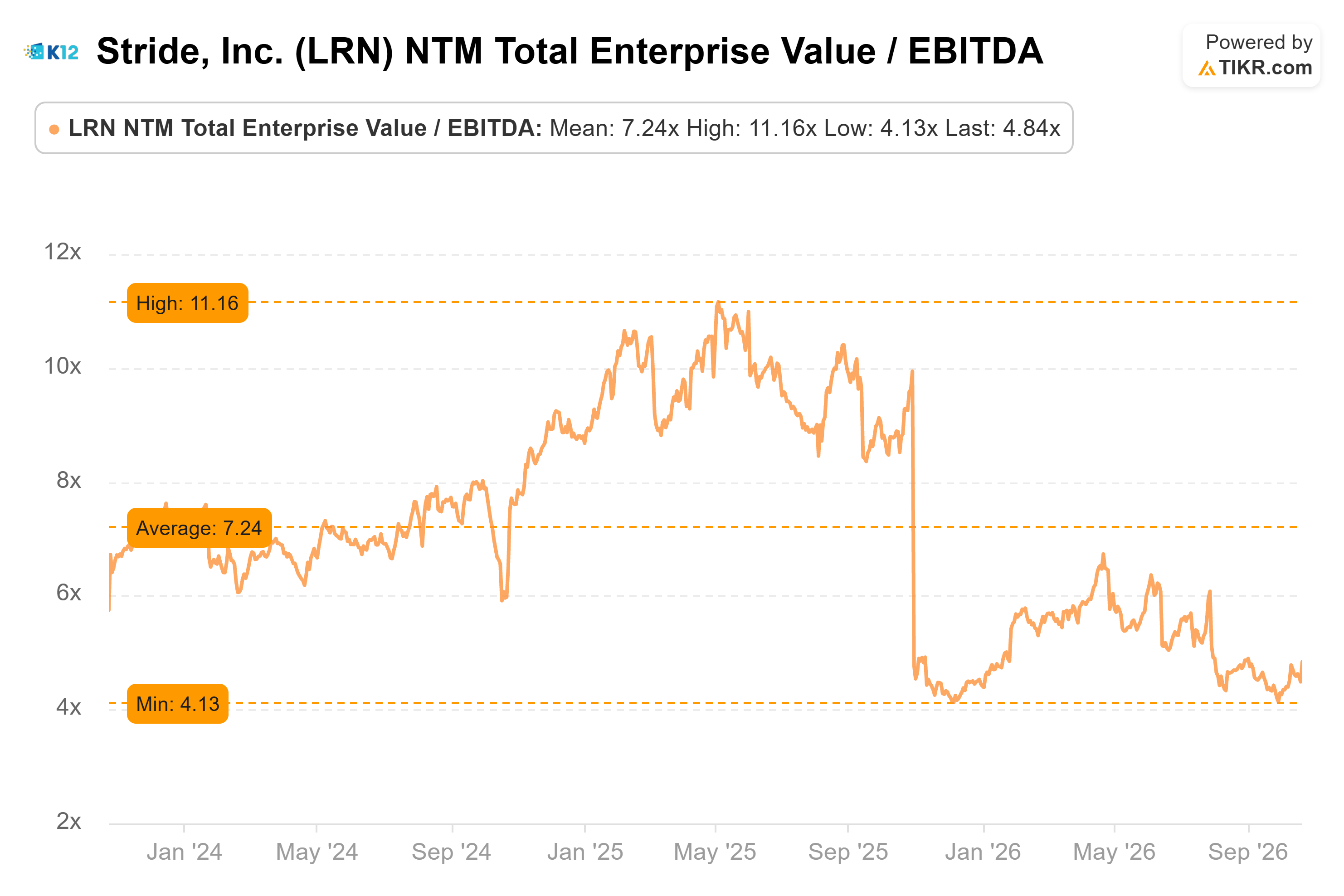
Stride stock trades at 4.8x EBITDA.
My original investment thesis was that fixing the LMS could see the valuation potentially rise, possibly near the 7x range it traded at two years ago. I don’t think that’s happening anytime soon. Revenue growth has decelerated materially over the past two years. Enrollments have declined. Clearly the company still has execution issues from the challenged LMS implementation.
Meanwhile, Stride appears to have a durable business generating substantial cash flow in an overall market that could continue to grow.
The likely catalyst for the stock to rise over the next four quarters includes meeting/exceeding quarterly revenue and EBITDA expectations. Historically management guided conservatively and beat each successive quarter. We don’t know if that’s the case here though as we really don’t know CEO Knowling’s philosophy as it relates to establishing financial targets.
Future Catalysts?
Some might suggest that the next catalyst for Stride lies in fall fiscal 2028 enrollments.
But I think that we’ll see some activity before then.
The CEO isn’t afraid of change. He’s already used the word “simplification”.
So I see a strong likelihood for portfolio rationalization.
Likelihood is a strong word. I’ll use the word hope. I’m hoping he sells the MedCerts and bootcamp business. Those businesses are shrinking (collectively, I don’t know individual company growth rates) and don’t appear central to Knowling’s current priorities. More importantly, they would likely be better off with another EdTech provider that can provide better financial resources to grow those businesses. Selling would be a win for the employees of these presumably neglected companies.
Stride has over $450M in net cash. Stride has established a Capital Allocation Committee. That presents the possibility of larger buybacks, acquisitions, or some combination. What about taking on some debt to fund buybacks?
Concluding Thoughts - Not Disappointing
Knowling described the enrollment results as disappointing.
I didn’t find the call disappointing.
I still don’t know what the normalized growth rate of the virtual-school market looks like after the pandemic.
I also don’t know how management intends to protect the durability of the business if AI lowers the cost of creating and maintaining digital curriculum.
I expect leadership to address them soon.
The Almighty created heaven and earth in six days and rested on the seventh. So six months sounds about right for the new leadership team at Stride.
The Mission Critical Investor is a free newsletter. Please consider subscribing if you found this piece interesting.
Every new subscriber helps grow the audience and makes it easier to justify the time invested in writing these articles.
Disclosure: I own shares of Stride (LRN). This article reflects my personal opinions and analysis and is provided for informational purposes only. It isn’t investment advice or a recommendation to buy or sell any security. Readers should conduct their own research and make investment decisions based on their own circumstances.
Great analysis, as always, Ariel. Two thoughts I’d add:
1. There’s a lot of discussion these days about moats in software and curriculum. While AI will undoubtedly commoditize basic curriculum creation, I’d argue that Stride’s moat is much deeper. It’s the entire operating system of curriculum, technology, school supports, and, importantly, access to public school funding. If anything, Stride should benefit significantly from AI-generated curriculum by reducing costs and improving quality.
2. The bigger threat may be ESAs, and I don't see enough discussion about their impact on this sector. Looking at national enrollment trends in online schools across states with and without ESAs, my read is that this is having a much bigger impact than the major providers currently realize. Online charter schools have served several important needs for families, including providing a more flexible learning environment without out-of-pocket costs. As ESAs expand, they introduce more competition for that same need, potentially accelerating the shift from online public schools toward in-person alternatives like microschools.
I’d be curious whether you’ve seen any of the large online school providers acknowledge the impact of publicly funded school choice programs on their business. I suspect this will become an increasingly important part of the story.
Appreciate you!
Amar