

Summary
Your institution competes with for-profits. The largest of them are listed on the New York Stock Exchange and Nasdaq. They are required to disclose their financials on a quarterly basis, which presents an opportunity for you to learn more about the competitive environment and emerging trends. Their quarterly earnings calls offer detailed disclosures about recruitment costs, enrollment trends, and management’s response.
I examine disclosures which can help inform the decisions of public and nonprofit leaders.
Here are the three key takeaways from the Q3 results of publicly traded companies.
Companies are starting to provide the concrete steps that they are taking to address changes in student acquisition. In Q2, management teams only began to acknowledge how LLMs affected the front-end of the enrollment funnel. In Q3, management explained to stakeholders what actions they undertook to adapt to the new normal in higher ed marketing.
Healthcare continues to serve as the key source of growth for the publicly traded postsecondary operators. Healthcare programs continue to attract students, even despite changes in digital recruitment. Lack of healthcare capacity and the value of licensure apparently outweigh student concerns regarding brand.
Investors are questioning the durability of earnings from the publicly traded postsecondary operators. Share prices and valuation multiples have fallen significantly, even as companies continue to report revenue growth. Investors are questioning what earnings and cash flow will look like over the long-term.
Why should a public or nonprofit university care about for-profit earnings calls?
Because of required disclosure what nonprofit and state institutions don’t disclose. recruitment costs, enrollment trends by program, and management’s plan. You recruit through the same channels as for-profits. These disclosures are a free read on a shared competitive environment.
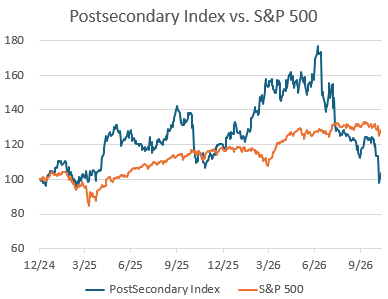
The stock price performance of postsecondary stocks tells us that many are questioning the durability and even viability of these institutions.
An equal-weighted portfolio of postsecondary stocks would have barely made any money since the start of the Trump Administration (which provided regulatory relief to the group). The stocks as of today have substantially underperformed the S&P 500. We’ve seen a 40% decline in the collective stock price from peak just five months ago.
What changed in higher education student recruitment?
The risk of AI affecting the student enrollment funnel finally materialized.
The success of the scaled postsecondary operators historically came from building the best processes and technology related to Internet lead acquisition. Successful institutions increased their enrollment base by improving their search rankings, buying keywords more effectively, and converting inquiries into enrollments.
Large for-profit operators built sophisticated operations around that process, particularly in serving working adults. Later on, state and nonprofit institutions gained market share from the for-profits by partnering with OPMs (online program management), who brought similar marketing technology, recruitment processes, and expertise.
AI has started to chip away at the traditional advantage of the large scaled operators. Google keyword costs and speed to contact a prospective learner once mattered. Now, the student journey begins with an LLM (large language model) generating an opinion on an institution’s brand, sector affiliation (nonprofit/for-profit), price of program, and comparable alternatives.
AI has also exposed negative institutional headlines and criticism.
That’s the context for Q3. The question has moved from “is this happening?” to “what are you doing about it?”
How are postsecondary operators responding to AI search?
Management teams are describing specific actions they’re taking given the change in the student journey. They are:
Monitoring AI search results: Tracking whether institutions and individual programs appear in LLM answers. How they’re described and whether they’re recommended.
Publishing evidence of institutional value: Creating evidence-backed claims about graduation rates, career outcomes, employer satisfaction, and ROI.
Expanding distribution beyond the institution’s website: Using evidence from third-party studies in social media and other sources that LLMs reference.
Optimizing websites/marketing content for AI search: Updating content to improve discoverability and how models represent programs.
Expanding direct recruitment channels: Management teams have pointed to using student referrals, social media, and relationships with hospitals, school districts, businesses, and other organizations.
Deepening employer partnerships. Expanding account management and outreach to help employees understand and use their education benefits.
Using AI to support admissions advisers.
Covista CEO Stephen Beard explained the connection between monitoring AI answers and developing content in his Q1 FY2027 prepared remarks:
We’re building on this foundation by further improving discoverability and positive sentiment of our institutions. We analyze tens of thousands of answers to measure how our institutions appear and how they’re described and whether they’re recommended all the way down to the program level. From there, we develop new content to ensure that the LLMs have the latest and greatest information about the quality and value of our programs.
He later described what that monitoring shows:
We’ve invested heavily in monitoring systems that allow us to test where our brands and programs show up in LLM search and also to be able to test whether they show up in a positive light. So where our brands are most authoritative, and we have obviously the most brand equity at Chamberlain, descriptions are about 90% positive for that institution in most LLM search, slightly below that for Walden, which is more of a fighter brand, but we view that as an incredible opportunity for upside at Walden given how well that institution performs on its own.
To be clear, Covista’s CEO said that AI and LLMs “hasn’t really resulted in any real headwinds from an inquiry, application, or new enrollment perspective.” Similarly, Strategic Education’s CEO said that they couldn’t identify an adverse impact from LLMs.
Meanwhile University of Phoenix’s management described a material search related enrollment headwind in its consumer channel which would affect revenue growth over the next year.
So the situation might be mixed. Or alternatively some management teams might be more transparent than others.
We do know that the cost of inquiries has increased. Not the overall cost of student acquisition though.
Scott Shaw, CEO of Lincoln, said that while cost per lead was up 20% YoY, overall cost per start is flat YoY. They are seeing improved conversion to offset the higher lead cost. Management nevertheless expected cost per start to be elevated YoY in the near term.
The CEO of Grand Canyon Education, which provides marketing and enrollment services to Grand Canyon University, also explained that while inquiry costs are rising, overall student acquisition costs aren’t.
The cost per acquisition is holding real steady. We are putting more into advertising, understanding that the new world is taking time, but we feel like we’re out in front of it as compared to most other people that are trying to make this adjustment, and we’re starting to understand what the future is going to be. So we’re excited, and we feel good about that. And we’re doing more with less from an enrollment counselor standpoint. And so we’re not hiring as rapidly as we would have in the past. And so we’re saving money on the enrollment counselor salary side. We’re spending more on the advertising side.
Why are healthcare programs still growing?
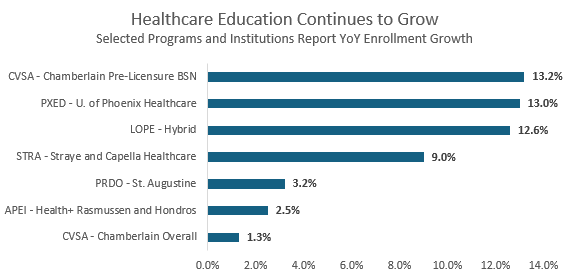
The chart combines selected institutions and program portfolios with different reporting periods and enrollment definitions.
Healthcare continues to serve as a key source of growth among the publicly traded postsecondary companies.
Chamberlain University, the largest nursing school in the country, saw pre-licensure BSN enrollment rise by 13.2%. Meanwhile, other healthcare focused institutions and programs saw gains above the overall company growth rates.
Why healthcare?
Two reasons.
First, the supply/demand imbalance. The healthcare industry will continue to see long-term secular growth given an aging population.
Secondly, the direct connection between a healthcare program and occupation. The learner is buying a route to a job or an increase in income within an existing job.
Pre-licensure nursing remains the most exciting opportunity within healthcare. Nursing schools turned away nearly 93K qualified applications in 2025 because they lacked faculty, clinical placements, facilities, or funding.
One of the more interesting comments this quarter came from Strategic Education regarding expansion into pre-licensure nursing. Its Capella University enrolled its first pre-licensure Bachelor of Science in Nursing cohort. Strayer University enrolled its first students in its Associate of Applied Science in Radiologic Technology program. Management said early demand exceeded its initial assumptions.
Regarding investment areas, management commented that:
We intend to also increase our growth investments in U.S. healthcare in 2027 with funding for new programs, clinical faculty, expanded clinical and instructional capacity. This will allow programs like pre-licensure nursing and radiologic technology to grow at the pace their demand supports.
These healthcare programs are a bit more protected than commoditized programs (like business). State boards of nursing require students to complete hundreds of hours of supervised patient care in hospitals and healthcare facilities before graduating. Competition exists for clinical placement. A shortage exists of nursing faculty.
Healthcare labor shortages, lack of capacity at traditional institutions, and licensure outcomes likely neutralizes skepticism regarding institutional brands.
Healthcare employers will hire credentialed graduates, regardless of the institution that they attend.
Why did valuations fall while revenue grew?
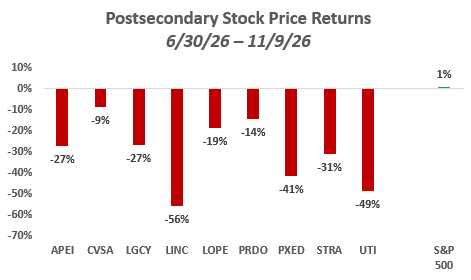
The publicly traded companies’ stock on average has declined by 30% since the end of Q2.
The latest results still show YoY revenue growth across much of the group. Current operating performance hasn’t deteriorated nearly as much as share prices.
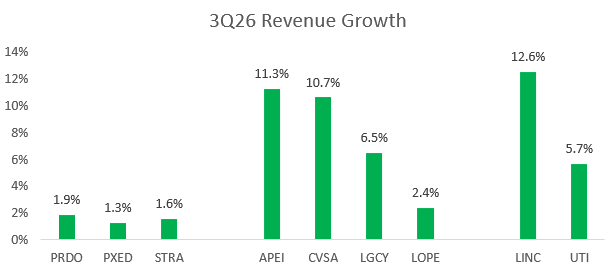
The disconnect between growth and stock price performance comes down to the perceived threat that LLMs represent, at least in my opinion. Anyone with access to Google (i.e. anyone) can type in queries that clearly demonstrate biases against certain types of institutions and particular brands.
Institutions may pursue channels other than Internet lead generation, such as employer partnerships. But an employee using tuition benefits can still ask ChatGPT which institution to attend. An employer relationship may reduce dependence on Google lead generation without removing AI from the student’s decision.
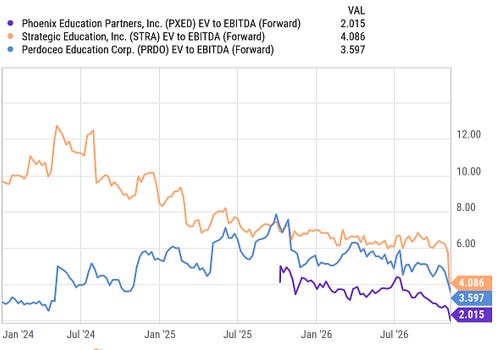
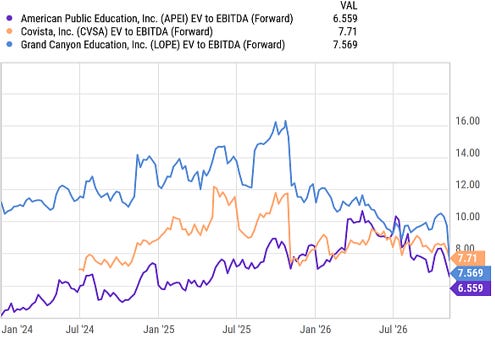
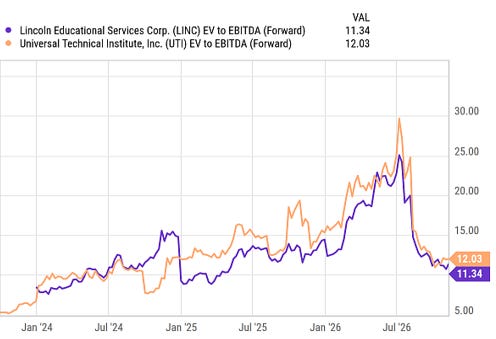
Below I provide the valuation multiples of the publicly traded postsecondary companies. I group these companies into three categories for this comparison: primarily online, healthcare-focused, and vocational.
What you can see is that overtime that valuation has compressed.
For the primarily online institutions, the valuation multiples now trade from 2-4x EBITDA.
Healthcare-focused operators appear to be converging around 6–8x.
Vocational operators trade near 11–12x, below their peak from only five months ago.
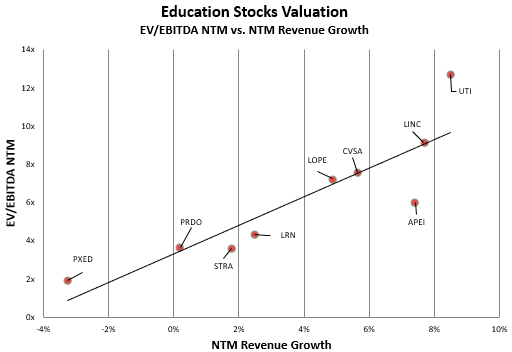
Expected growth helps explain the differences in valuation multiples. Companies with stronger expected revenue growth generally receive higher EBITDA multiples.
Overall, the sector has re-rated. Stocks still trade on a relative basis regarding their revenue growth and EBITDA multiple, as you can see from the chart below.
What happens when a student can compare prices in ten seconds?
Price can become the next pressure point. Institutions may lose the information asymmetry that used to protect pricing. Comparing programs once meant hunting for tuition, decoding fees, and reading transfer policies. A model can do this in a single answer/conversation. Models skew toward lower-priced programs.
NielsenIQ in September announced that its Agentic Commerce Tracker showed that 51% of consumers had used at least one AI-powered tool to support their shopping in the past month. We’ve seen a shift from early-adopters to mainstream use.
So perhaps it’s not surprising then that we are only now seeing in earnest changes in higher ed enrollment.
What does it mean when all student journeys incorporate AI?
What happens when students start to ask questions about price and value?
What happens when a prospective student asks an AI model whether a price premium is justified?
Will the student find the explanation convincing?
LLMs focus on the price of programs, with a bias toward lower price programs.
At what point do institutions have to adjust their pricing given pricing transparency?
I’m not suggesting that greater transparency means the cheapest institution wins. But it does put more pressure on institutions to explain and justify their pricing. The program, its delivery, or its price may need to change.
Public and nonprofit leaders face the same pressures as the management teams of the publicly traded companies. Which recruitment channels still work? Which programs justify their price?
Five questions for public and nonprofit higher education leaders
The disclosure of the publicly traded operators exposes questions that the rest of higher education will eventually have to answer.
What do AI models tell prospective students about your institution? Do they recommend your programs or your competitors? What evidence informs those answers?
How is AI changing the value of the education you sell? Which programs retain a compelling connection to employment, advancement, or licensure, and which need to change?
How are you changing your student acquisition model? Beyond adjusting digital content, where should you invest in employer partnerships, referrals, direct recruitment, and better conversion?
How can your institution benefit from the healthcare tailwind? Which student and employer needs can you serve?
How durable are your enrollment and financial results?
The questions this year related to LLM disruption. The questions for Q4 and next year might revolve around price. Particularly when a student can compare price across institutions in less than ten seconds in what might have taken hours. The publicly traded for-profits are being forced to answer first. Everyone else gets to watch, for now.
Are you rethinking your institution’s strategy?
I want to help.
Reach out to me at ariel@kolariconsulting.com.
If you found value in this article, please subscribe to this newsletter.
It’s free.
Subscribing tells me you found the content interesting and that I should write more about this topic.
Disclaimer: This article is for informational purposes only and doesn’t constitute investment advice. I own LOPE and UTI.
Frequently asked questions
Are AI search tools reducing university enrollment?
University of Phoenix reported a material search-related headwind in its consumer channel expected to affect revenue growth over the next year.
Has the cost of recruiting students gone up because of AI?
The cost of inquiries has gone up, but total acquisition cost has been flat. Lincoln Educational Services reported cost per lead up 20 percent year over year with cost per start flat, offset by better conversion. Grand Canyon Education reported steady acquisition cost with higher advertising spend and slower counselor hiring.
Which higher education programs are still growing in 2026?
Healthcare. Chamberlain University grew pre-licensure BSN enrollment 13.2%. Healthcare programs outgrew their parent companies. Nursing schools turned away nearly 93,000 qualified applications in 2025 for lack of faculty, clinical placements, facilities, or funding.
Why have for-profit education stocks fallen in 2026?
Shares fell over 40% from a peak five months earlier. Investors are questioning the durability of earnings given how language models now shape the start of the student journey.
What can a nonprofit university do about AI search visibility?
Measure it. Scaled operators now track whether their institution and each program appear in model answers, how they are described, and whether they are recommended, then publish outcome evidence and distribute it beyond their own website.