

TLDR
AI-native universities could operate at a substantially lower cost than traditional institutions. By automating administrative work and parts of instruction, they could serve more students with fewer employees per student, while offering more personalized learning. Lower costs would allow these institutions to charge substantially less than traditional institutions, pressuring competitors’ tuition. Established institutions can attempt to adopt the same technology, but capturing cost savings requires transformation across functions. Potential resistance from faculty, staff, and other stakeholders could make organizational change incredibly difficult.
If AI drives down higher ed pricing, the effects won’t be uniform. Strong brands, alumni networks, and employer relationships could protect pricing for some institutions. Online providers may capture significant cost savings while also facing the greatest pricing pressure. I advise universities to build parallel AI-native organizations with the autonomy to design instruction, staffing, and operations from scratch. As those organizations demonstrate lower costs and credible student outcomes, they can take over more of the university’s functions.
Can AI Finally Drive Down Tuition?
Prognosticators keep offering all sorts of forecasts about what AI will do to the world. If you listen to Elon Musk, we’re heading toward unmatched prosperity. If you prefer the words of Anthropic insiders, we’re on the path to humanity's end. What I’m offering in this article is a bit of both good and bad news, depending on where you sit in higher education. If you like the concept of lower debt and a better return on investment for students, you’ll enjoy reading this.
The rise of the Internet, the last great technological revolution, expanded access without changing the university pricing model. Institutions largely used online education to serve underserved populations, particularly working adults.
The AI revolution could prove much more meaningful in altering higher ed economics. By automating administrative work and changing how institutions deliver instruction, AI could reduce operating costs while potentially strengthening academic outcomes.
To understand why, start with what’s happened to higher-ed costs. According to Commonfund’s Higher Education Price Index, the price of the goods and services universities purchase from 1983 to 2025 rose 325%, compared with 224% for consumer prices. Faculty salaries rose 308%, whereas administrative salaries increased by 416%. These figures measure increases in input prices, not additional spending from hiring more employees or expanding campuses.
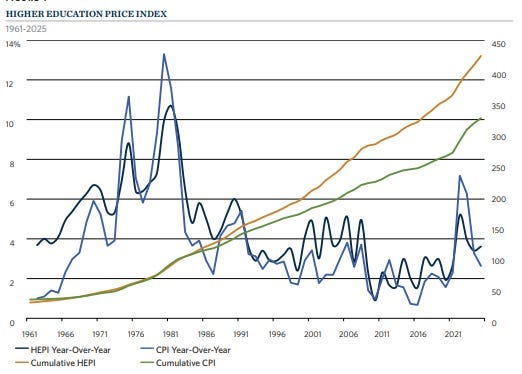
Why have those costs risen faster than inflation? A report by the Midwestern Higher Education Compact explains that universities face a productivity problem common to labor-intensive services. Compensation rises across the economy, and institutions have to compete for highly educated employees. But they haven’t consistently offset rising compensation by reducing the labor required to educate each student. Economists call this Baumol’s cost disease. When compensation rises without comparable productivity gains, the cost per student increases.
AI may finally give higher ed a way to boost labor productivity. It can eliminate much of the administrative hassle that faculty have to deal with, so they can spend more time on instruction. Administrators can theoretically increase student-to-faculty ratios without damaging instructional quality.
Unfortunately, creating efficiencies in a labor-intensive organization brings controversy. Cost reductions include changing job descriptions and reducing headcount. Established institutions must navigate labor disputes, faculty governance, and resistance to reorganization.
Incumbents and new entrants both have access to the tech. But incumbents have to actively reengineer their existing organizations to capture the savings.
What Is an AI-Native University?
AI-native universities are designed from inception around AI, with the technology at the center of instruction, administration, and the technology stack. They don’t have the constraints of traditional institutions. They get to start fresh.
The London School of Innovation (LSI) offers an early example of an AI-native school. It’s powered by over 150 AI agents. LSI claims that the “pedagogy, academic model, student support and operations were designed around AI from inception, then examined and approved through years of independent regulatory verification.”
To understand LSI's instructional model, I asked its AI chatbot to explain to me how the school works. This is what it told me.
At LSI, professors don’t give one-way lectures. Rather, they provide one-to-one support, review work, answer questions, and lead live discussions. The AI tutor adapts lessons, gives formative feedback, tracks progress, and runs simulations. Students connect with professors throughout their studies. They can ask questions, request review of AI-marked practice assignments, arrange one-to-one meetings, and join regular live events for discussion and debate. The AI handles personalized routine learning, freeing professors for deeper support.
I haven’t seen LSI’s student experience in action, so I have no idea what the above description looks like in practice.
I did have an opportunity to view a demo of another AI-native education platform this past month.
From what I saw, the platform in its current iteration can replicate an online institution’s administrative capabilities. The chatbot’s instruction and interaction with a student look a bit rudimentary. It’s a good start. It could benefit from a graphical interface. I imagine that at some point students will interact with a virtual professor avatar indistinguishable from a real human.
That it didn’t yet look like a formidable competitor to the traditional classroom environment made me think of Clayton Christensen’s The Innovator’s Dilemma. A simpler, cheaper offering can initially look inadequate to an incumbent’s customers. The incumbent has little incentive to invest in it. Then the offering improves and becomes good enough for a growing part of the market.
The demo looked remarkably similar to the pattern Christensen described. I imagine most university leadership may choose not to deploy existing AI chatbots, given the role they could play in instruction today. Meanwhile, instructional technologies will keep improving until they can compete with the look and feel of the traditional classroom.
What Can Be Automated
I initially thought about going function by function through a university and explaining what AI could automate. That would make this article too long. A specific job posting makes the point.
Below is an excerpt from an admissions officer job posting at Johns Hopkins University.
“Application file review – Read and score applications using the MD screening rubric to help Deans of Enrollment Management determine which applicants should be invited to interview.
Review academic prerequisite requirements for all interviewed applicants and develop/document any plans to resolve prerequisite deficiencies for admitted students.
Maintain the Office of admissions interview/committee meeting calendar, manage interview sign-ups in Slate, assign interviewers to applicants each week, and manage the interview day Zoom environment.”
A well-designed AI agent can automate much of the workflow described above.
By ingesting the university’s screening rubric, student applications, and historical enrollment data, an agent can review essays and transcripts, verify documents, score applicants against the rubric, and provide recommendations. It can manage calendars, assign interviewers, generate conference links, and handle follow-ups to all stakeholders. This includes creating email campaigns customized to a prospect’s unique characteristics.
I’m not suggesting that admissions officers disappear. Their work becomes higher-level, including managing AI agents and building relationships and trust with prospective students. An institution can process the same application volume with fewer employees. Alternatively, an understaffed institution can avoid hiring more. Because the remaining work requires greater judgment and interpersonal skills, these positions may also warrant higher compensation.
The same examination belongs in student support, financial aid administration, marketing, and other functions.
Universities are already deploying AI technologies. From my research, it seems many have focused on the low-hanging fruit: call center operations. Tech firm Forrester has predicted that half of current customer service jobs (not just in higher ed but across all industries) will be lost to AI by 2030.
There’s a difference, though, between focusing on certain functional areas and redesigning organizational processes across the institution.
Changes to Instruction
The most heavily debated question is how AI changes the traditional instructional model.
Academics are understandably concerned that administrators will use AI to cut labor costs, increase workloads, and weaken professional autonomy. In its report on AI and academic professions, the American Association of University Professors calls for protections against work intensification, deskilling, and job loss. It also asks that faculty have a meaningful say in technology decisions, alongside protections for academic freedom and the right to organize.
Admittedly, I had to look up the concept of educator deskilling. That’s the process by which professionals lose control over their work as their expertise is standardized and automated. Critics argue that algorithmic software strips educators of professional judgment, turning them into dashboard managers rather than autonomous instructors.
AI creates an opportunity to reimagine the instructional model. An AI tutor could adapt explanations, practice exercises, and feedback to each student's level of understanding. Implementing that approach requires changes to course design, assessment, and faculty responsibilities.
If AI takes over repetitive tasks like grading tests, answering emails, monitoring participation, and reviewing essays, institutions can use the productivity gain in two ways. Professors can spend more time interacting with students, or institutions can increase student-to-faculty ratios. In practice, they may do some combination of both.
Western Governors University, the largest online university in the country, announced a strategic partnership with Anthropic in July to develop an AI-native model for learning and credentialing. President Scott Pulsipher, in his LinkedIn article, said that the partnership would
co-develop AI-native systems that can identify the skills emerging jobs will require; tailor learning to help individuals develop those competencies more quickly no matter their starting point; verify them through skills-based, digital credentials; and connect learners with career opportunities.
I realize that this is highly controversial within academia. Whether this represents a better or worse future for education remains to be seen. But institutions are already moving in this direction.
Andy Grove, Intel’s former CEO, famously said that “you must be willing to cannibalize your own business before your competition does it for you.” His point applies here: institutions may need to disrupt their successful existing models rather than protect them until competitors force the change.
Where Pricing Pressure May Hit First
Incumbents have enormous advantages that have allowed them to sustain their market position. This includes established accreditation, brand equity, perceived quality, geographic location and reputation, alumni networks, convenience, and employer relationships. Together, these attributes create differentiation that allows institutions to maintain a pricing premium.
Low-tuition alternatives already exist throughout higher education. If students selected institutions primarily on price, much of the market would have compressed already. It hasn’t.
That’s why I think relatively undifferentiated online programs are particularly exposed when students primarily need the credential for a specific career benefit.
A teacher enrolled in a master’s of education benefits from a school district’s salary schedule that raises their pay. A registered nurse may enroll in an RN-to-BSN program because employers financially reward nurses with a bachelor’s degree. For those students, the institution’s prestige may matter less than whether the credential meets the requirement, fits their schedule, and produces a worthwhile return.
What’s different from the past is how students search for and discover institutions and programs.
Lower-tuition programs are structurally disadvantaged because they generate less revenue per student from which to recover marketing costs. A lower-tuition institution still has to bid on many of the same Google keywords as a higher-priced competitor.
The end of traditional search and the rise of LLMs like ChatGPT are changing student acquisition and potentially leveling the playing field.
LLM recommendations could change that equation by helping students discover suitable programs without the institution paying for every click. Low tuition, recognized credentials, and good outcomes could make a program attractive to recommend.
Who Is Most Exposed?
The effects of AI-native competition won’t be uniform across higher education. Higher ed is highly heterogeneous, with institution groupings including state institutions, nonprofits, for-profits, online, licensure-focused, vocational training, and other categories. Even those groupings don’t do justice to the vast array of offerings in higher ed.
Community colleges are relatively well positioned. Many community colleges operate under significant budget constraints, which can make it difficult to compete for talent. The institutions already have the right price point. Adopting an AI-native model lets these institutions automate lower-level administrative functions, potentially freeing up capital to attract and retain top talent in both administration and instruction.
Regional public universities and non-flagship, teaching-focused state schools have similar challenges as community colleges. Over the past twenty years, they have struggled through an elongated financial crisis. Migrating to an AI-native institution can help them increase productivity and cut costs.
Online institutions, particularly for-profits, face a more complicated situation. They are best positioned to adjust operations aggressively to capture cost savings. But they are also most exposed to new competitors offering credentials at substantially lower prices. AI could expand their margins in the near-term while pressuring revenue per student over the next decade. This may explain why online publicly traded for-profit postsecondary operators have the lowest valuation multiples among publicly traded institutions. Investors recognize that the business model's durability is in question.
Universities with premier brands are likely less exposed to pricing pressure. Students are buying brand affiliation, access to an alumni network, the overall academic experience at a campus, and relationships with employers.
The institutions that appear most exposed are higher-priced institutions without sufficient differentiation to justify their tuition premium. For reasons other than AI, these institutions have struggled.
The enrollment demographic cliff hasn’t helped matters. Researchers at the Federal Reserve Bank of Philadelphia modeled a worst-case scenario in which an abrupt 15% enrollment decline could produce as many as 80 additional college closures annually. That’s a stress scenario, not a forecast. But institutions already under financial pressure may have limited room to absorb another competitive threat.
What Institutions Should Do
I’ve come across several companies building technology that lets universities deploy multi-agent AI systems. Established software providers increasingly add autonomous agents to existing workflows.
But transforming the entire university at once means potentially negotiating every change. Each decision becomes a debate. Internal friction delays action. Leadership can exhaust its support before demonstrating results. In a highly politicized environment, one wrong move can end a leader’s tenure.
That’s why I think institutions should build a parallel organization designed around AI from the beginning.
Institutions can start with a few programs. This gives the institution time to experiment, learn from its mistakes, and demonstrate whether the model improves student outcomes and operating efficiency. Most importantly, the parallel entity needs autonomy. If every changed workflow requires approval, the parallel organization will inherit the same constraints as the university around it.
As the model proves itself, institutions can add programs and move more institutional functions onto the new systems. Over time, the parallel organization should take over most of the university’s instructional and administrative functions.
This may not eliminate labor disputes or difficult decisions. Running two organizations could potentially be more expensive in the near term.
But the alternative looks worse.
As Yogi Berra said, “When you come to a fork in the road, take it.”
Conclusion
Pew Research’s recent survey found that 52% of Americans say they are more concerned than excited about the increased use of AI in daily life, up from 37% in 2021.
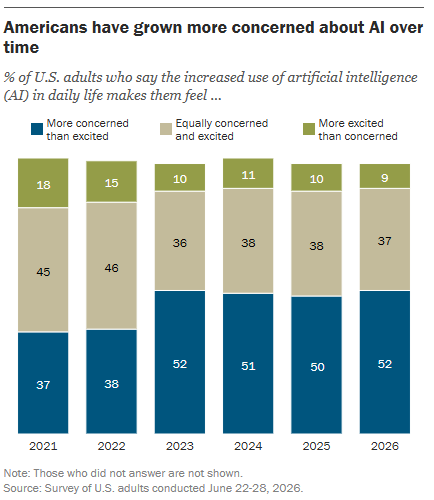
This anxiety has crept into higher education stakeholders. According to that American Association of University Professors survey report on AI that I previously referenced, “Eighty-seven percent of respondents maintained that it is important to improve job security and wages as AI is rolled out. Among part-time faculty members, there was near unanimity on this issue.”
University leaders understand AI’s potential, but they also understand what “productivity gains” can mean to the people who work for them. That, for some, is a euphemism for layoffs. Changing job descriptions, automating work, and reducing staffing requirements have historically generated strong opposition from employees across industries. Faculty and staff have legitimate questions about what these changes mean. To the extent that I’ve spoken with university leaders and faculty, they are all aware of the coming storm. Of expected technology-driven productivity increases in instruction. Of AI native online competitors with much lower cost structures that could intensify competition, reducing tuition and compressing margins.
Buying licenses to ChatGPT or Claude is easy. Redesigning instruction and administrative processes is much harder.
Clayton Christensen’s warning wasn’t that incumbents fail because they can’t see technological disruption coming. They often see it clearly. The problem is that responding requires them to disrupt the organizations that made them successful in the first place.
Higher education can see this one coming.
The question is whether universities will build the disruptor themselves.
Yes, yes and yes.