

Chipotle will release its 3Q26 financial results after market close on Wednesday. Yes, all sorts of companies report their results quarterly. Why focus on this one? As the youngest child at a seder might ask, why is this earnings season different from all other earnings seasons?
Because management might provide color on what may be happening with a September/October slowdown potentially affecting most restaurant companies.
You see, Chipotle stands at the epicenter of the broader economic changes occurring within the United States. How consumers are responding to K-shaped inflation. High-income households can continue to spend on fast casual dining. Meanwhile, price increases at Chipotle have priced out lower-income diners, who now have a greater incentive to pursue lower cost alternatives. In particular, young people with lower discretionary income are pulling back on spending at Chipotle.
This isn’t just about stocks or investing. We are about to get an insight that every working professional needs to know about regarding the US economy. No hyperbole in that statement.
Do we have a Chipotle problem, or do we have a macro problem?
Chipotle stock has fallen over the past forty days, while its peer group stocks have risen. Despite facing the same October headwinds.
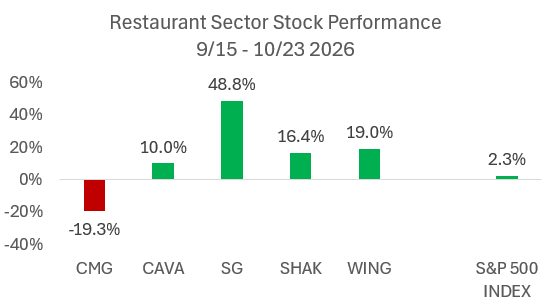
Yes, Chipotle saw a challenge this summer with the food safety issues you might have read about in the press. The multi-state salmonella outbreak linked to jalapenos sourced from Mejico.
But this is largely old news presumably priced into the stock months ago. So why the recent decline just for Chipotle?
Last week a TD Cowen analyst dramatically downgraded Chipotle from Buy to Hold ahead of earnings. I say dramatic because most sell-side analysts still have a buy rating on the stock. As a former sell-side analyst I can sympathize with the pressures related to stock coverage with anything other than a buy rating.
His stated concern was that October sales was seeing a slowdown more than he originally forecasted, citing alternative data. In an interview he cited Bloomberg Second Measure, which provides anonymized credit card transactions with a panel of over 20 million consumers.
In the past, only investment banks and hedge funds had access to this sort of credit card transaction data. But my data provider Carbon Arc has democratized consumer transaction data, making such data available to the masses.
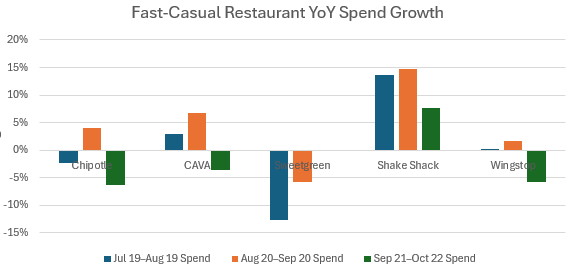
As you can see from my derivative work product from Carbon Arc (which complies with their terms and conditions as I understand it), the data for fast casual restaurants suggests weaker spending over the past thirty two day than the prior two periods (Sweetgreen serving as the exception, its stock almost doubling since August).
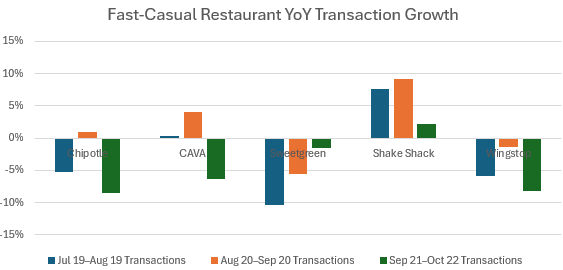
The same is true for overall transactions with the credit card panel.
But it’s not just fast casual. This pattern is true across most of the restaurant companies whose stocks I track.
Casual Dining companies like Texas Roadhouse. Cheesecake Factory. First Watch.
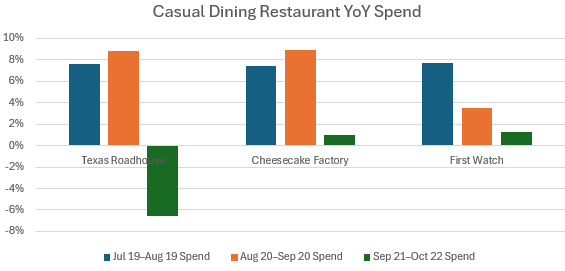
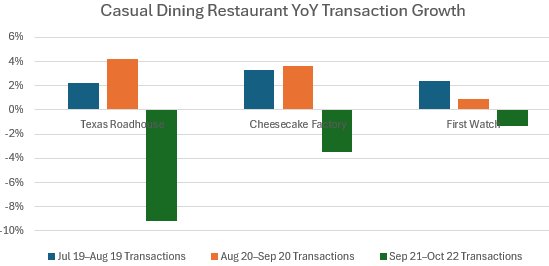
Other restaurants too. Quick service companies like McDonald’s and Taco Bell. Coffee chains like Starbucks and Dutch Bros.
I’m relying on credit card data from a consumer panel, and conceivably the data presented could represent a data issue rather than a reflection of reality. If that’s the case here, my apologies to anyone reading this. Historically though, at least for Chipotle, the panel data match directionally with Chipotle’s own reported same store sales growth/decline.
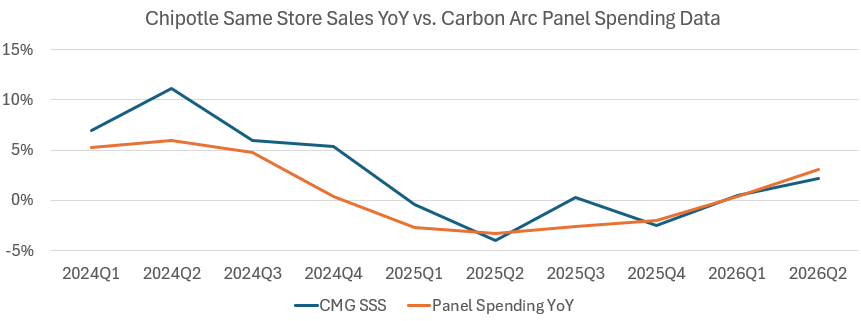
The obvious question — what’s driving this weakness?
My short answer: I have no idea.
I wish I could point to one thing. There are a lot of things that conceivably could explain the near-term weakness. Unfortunately, there’s a wealth of disappointing economic data as of late.
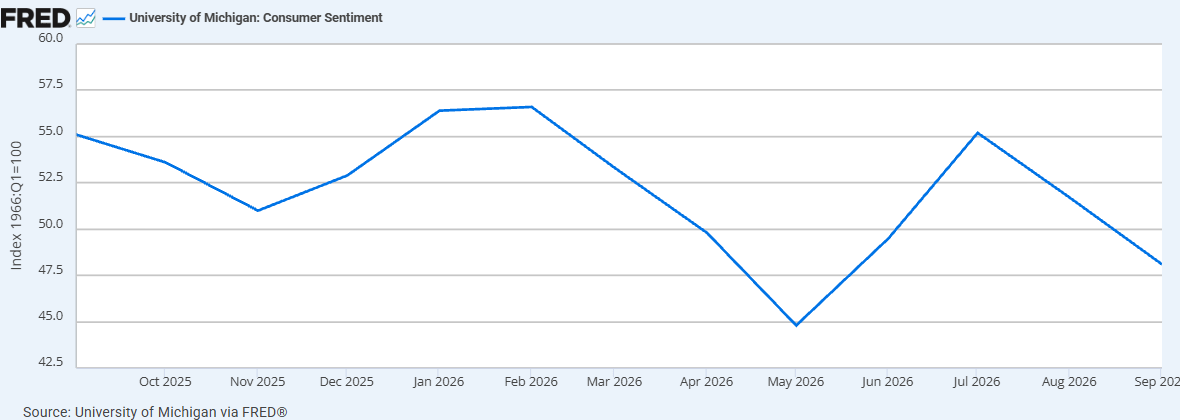
The University of Michigan’s Survey of Consumer Sentiment stands at 48. That’s near its historic low, which it reached last May following the outbreak of the war with Iran. Chipotle had a great Q2 result, with same store sales rising 2.2% YoY and traffic up 1% YoY.
It could be rising gas prices. But that was also an issue in May.
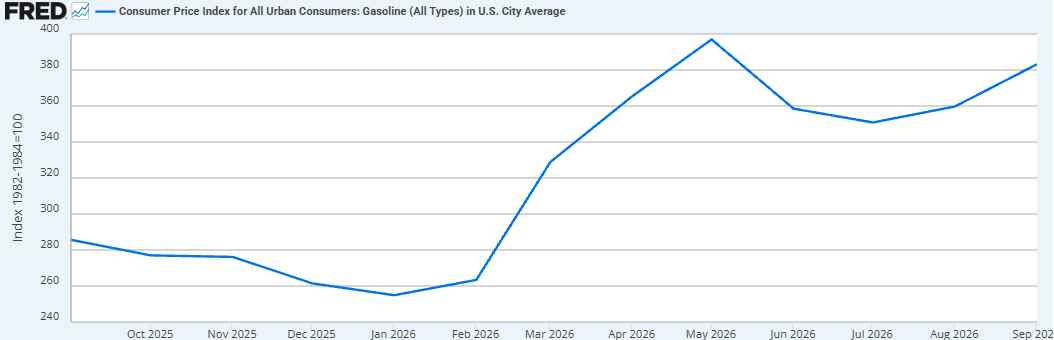
Has the cumulative cost of everything finally caught up with consumers? Possibly.
Has the political cycle with the upcoming election increased negativity causing families to save and/or divert their funds elsewhere? Who knows? The research on politics and consumer spending is mixed. Maybe this time it’s different.
Bigger picture, the breadth of the weakness across most of the restaurant group suggests to me that this isn’t just a Chipotle problem.
Which brings me back to Chipotle reporting results on Wednesday.
I don’t particularly care whether Chipotle beats Q3 earnings expectations. I’m more interested in what management says about its outlook on Q4 same-store sales growth. The Street might be looking for flat to slightly positive same store sales growth for Q3. My credit card panel data are directionally consistent with that, despite a deterioration at the end of September.
When valuing the restaurant peer group on a relative valuation basis I look at EV/Sales relative to Revenue growth. As you can see, both CAVA (CAVA) and Chipotle (CMG) trade at a premium multiple relative to their peers and stand above the regression line.
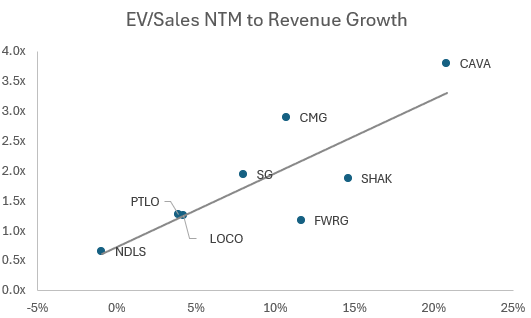
Only Chipotle’s stock has declined over the past month among this peer group. So the valuation gap between Chipotle and its peers already narrowed. Maybe we just saw a pair trade of sell Chipotle buy the group.
Here’s what we know — Chipotle’s CMG valuation multiple has compressed considerably over the past two years given its challenges. Primarily from weak same store sales growth. Investors clearly have concerns about the Chipotle value proposition. A veggie burrito/bowl, my preferred Chipotle menu item, cost $7.45 in 2019. In 2025, $10.80. Representing a 45% increase.
As you can see from the chart below, valuation on an EV/EBITDA basis peaked near 40x in May 2024. It’s near its recent low at 15x EBITDA.
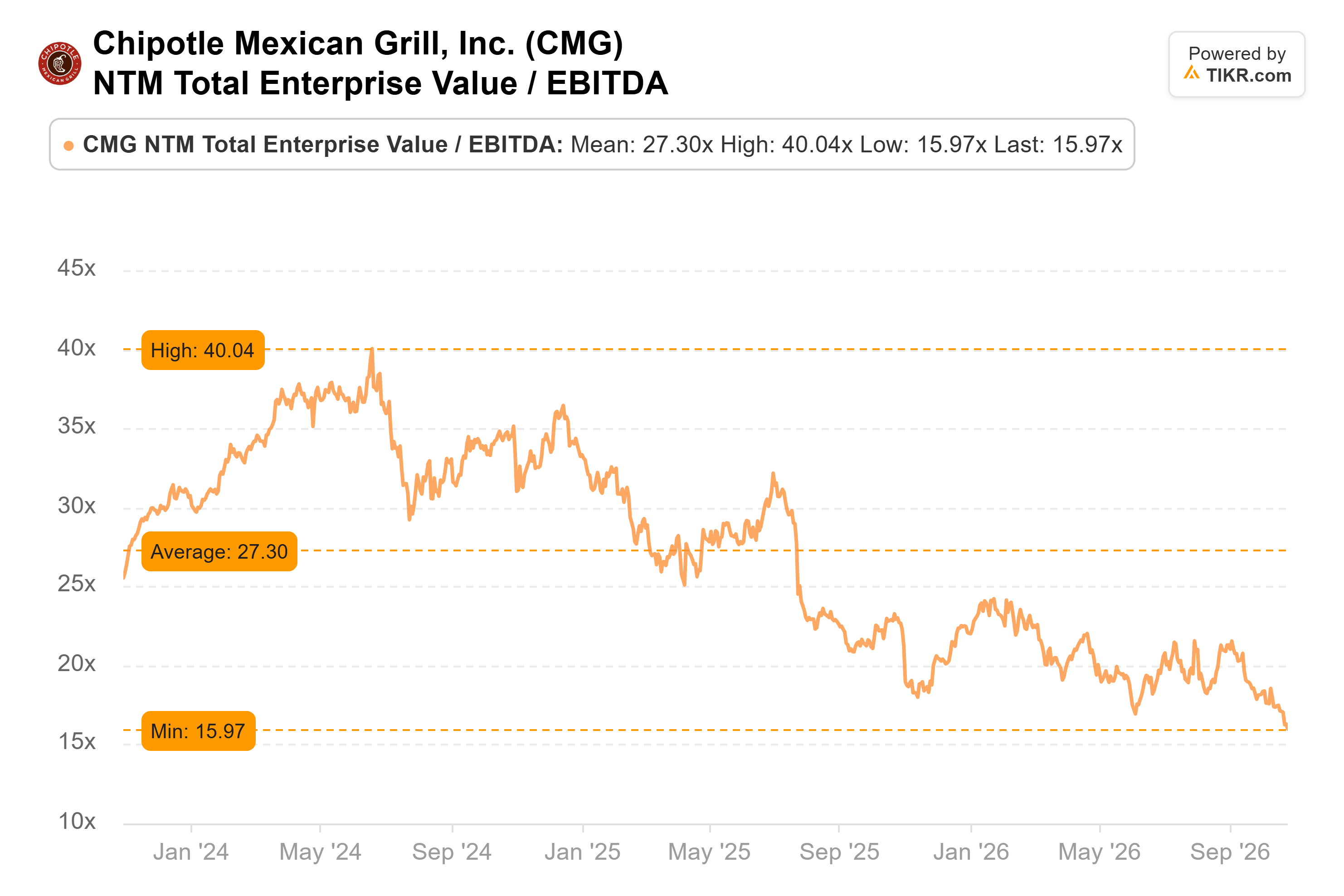
I like the company, I like the management team, and I like the product. I worry that price increases over the past six years have changed how consumers perceive the brand and the underlying value proposition. Despite that, I’m looking for an entry point to buy the stock, particularly with a much more reasonable valuation multiple these days.
I don’t like the circumstantial data supporting weakness. Like Google Trends data on users searching for “Chipotle Near Me”.
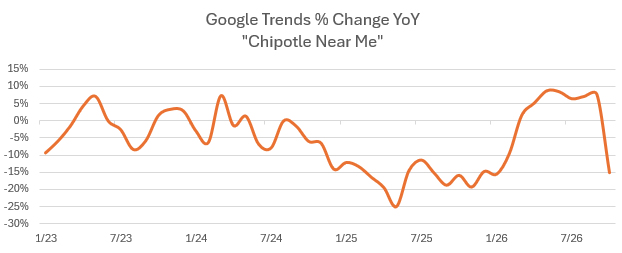
Meanwhile, other restaurant stocks are rising, despite the weaker September/October panel data. Something just doesn’t make sense.
I suppose on Wednesday we’ll find out if Chipotle is the exception to the group or an early warning.
If you made it to the end and like what you read, please subscribe. It’s free.
Subscriptions suggest that readers value the content.
Disclosure: I don’t own Chipotle or any other restaurant stocks. This article reflects an opinion and a perspective. It’s for informational purposes only. Don’t take this as investment advice. I’m not recommending that readers buy or sell stocks. This is for entertainment purposes only. Readers should conduct their own research and make investment decisions based on their own circumstances.