

Note: This piece serves as a window into the changes occurring across postsecondary education. I’m writing this to inform, not to recommend specific stocks.
TLDR
Postsecondary leadership teams have characterized the demand environment as healthy, particularly in healthcare and vocational programs. Google Trends data supports that view, showing strong growth in searches tied to nursing, trade schools, and adult education. Anxiety around AI and job security has likely contributed to that demand, as workers look for credentials that lead to occupations that appear harder to automate.
Surprisingly, postsecondary education stocks are underperforming the S&P 500. Even as meaningful regulatory risk has largely disappeared under the current administration. Q2 earnings results suggest that strong demand hasn’t translated cleanly into enrollment and revenue growth. Part of that has been due to fixable execution challenges (like not calling back leads). The more challenging issue broadly affecting the group: AI has changed the online student journey and the enrollment acquisition funnel. Prospective students are engaging with Google AI, ChatGPT, and other LLMs before they ever reach a school’s website. This has caused brand, pricing, and reputational baggage to surface in a way that institutions cannot yet control.
A small group of publicly traded companies that own or serve postsecondary institutions provide an extraordinary public service to higher education stakeholders.
The United States has close to 6,000 postsecondary institutions serving close to 20 million students. These institutions spend over $700B. Yet, for such a large part of the economy, we know surprisingly little about the real-time trends occurring within postsecondary education.
Take Western Governors University (WGU) as an example. With close to 190K enrollments and $1.7B of revenue, WGU ranks among the largest postsecondary institutions in the country. With at least half of that revenue coming from the federal government’s Title IV program, taxpayers surely should know a little bit about the operations of the institution. Their annual report provides great information about student outcomes. But nothing about efficiency of spend.
This contrasts with the forced transparency presented by publicly traded postsecondary companies. Given SEC reporting requirements, these companies offer detailed commentary on prospective student interest, application volumes, conversion rates, acquisition costs, the effectiveness of marketing channels, etc... All on a quarterly basis.
So what can we glean from Q2 earnings results?
Demand looks pretty good, particularly in healthcare and the skilled trades.
As Lincoln Education CEO Scott Shaw said in his Q2 conference call, a comment that perfectly captures the environment and trends,
Our focused programs are for trades expected to remain in high demand as the effects of artificial intelligence deployment impact white-collar and other jobs across the country.
But…
Enrollment and revenue haven’t grown commensurate with strong demand given execution challenges. LLMs (large language models) have altered how prospective students search for programs and institutions.
Postsecondary Stocks Declined in Q2
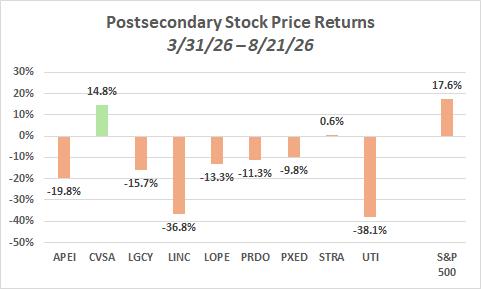
The publicly traded postsecondary group saw their stocks decline from the beginning of Q2 through the end of earnings season. Both in absolute terms and relative to the S&P 500.
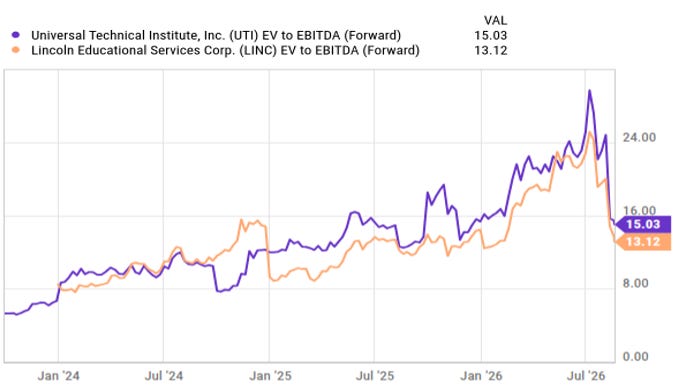
Vocational school providers Universal Technical Institute and Lincoln Education saw their stocks decline by over 30% post-earnings. The primary reason for such a stark movement? Those two stocks had the highest valuation multiples of the bunch. Traditionally, education stocks trade between 5-15x EV/EBITDA. That maxim has been true for at least twenty years and certainly true since I picked up the group while working on the sell-side. Those two companies recently traded in excess of 20x EBITDA. Their valuation didn’t leave room for any execution error.
You might say, so what? That’s just volatility. Stocks go up and down.
But the downward stock price movement this time around does matter; Q2 marks the first time since the beginning of the Trump Administration where the S&P 500 has outperformed a basket of the publicly traded postsecondary stocks.
The Trump Administration effectively removed the regulatory overhang that investors have worried about for years. So if regulation isn’t the problem and demand remains pretty good, the market is clearly telling us something about increased risk.
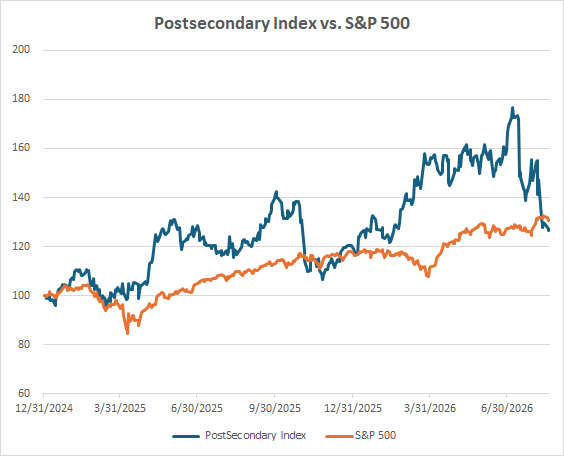
My interpretation: investors have lost confidence in how companies have translated demand into actual enrollments and revenue.
AI clearly changed the student journey within the digital marketing channel. Publicly traded companies are seeing weaker Internet-driven lead flow, lower conversion rates, and higher acquisition costs.
I only talk sparingly with investors these days, so I’m speculating here, but I imagine that generalist investors may have poured capital into education names to play a thematic trend regarding AI and labor market dislocations. Investors well acquainted with the group know all too well the painful truth:
Operating a postsecondary institution is hard. Really, really hard.
Institutions focusing on working adults have the wind in their sails given demand characteristics. But that isn’t enough when navigating the complexity of marketing the programs in a highly competitive landscape, managing an ever-changing search algorithm, and complying with the federal government’s complex Title IV rules, among other things.
Ultimately, the market has assigned lower valuation multiples based on increased risk and uncertainty.
Q2 Saw Reasonable Revenue Growth for Mature Companies
The chart below shows recent revenue growth across the postsecondary category.
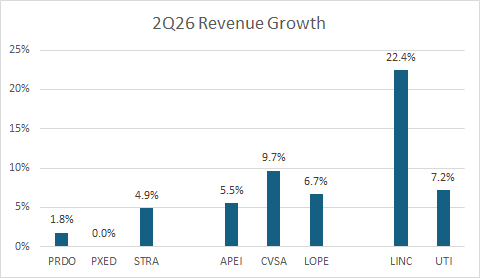
Most of the companies are seeing revenue growth at or above the rate of inflation. Except for Lincoln, none are growing double-digit. Lincoln stands out as an obvious outlier with 22% YoY revenue growth, but that number overstates the underlying trend because an academic-calendar change shifted a start class into Q2. The ending student population for Lincoln increased by 10.4% YoY.
I’m going to use some business school theory here, so please indulge me. It’s helpful to explain why some of these companies are growing their top line at higher rates than others.
NYU professor Aswath Damodaran describes mature companies in The Little Book of Valuation as those whose revenue growth converges toward the growth rate of the economy. Valuation depends on whether companies can preserve a sustainable competitive advantage.
Differentiation comes from the programs that institutions offer and the set of reinforcing activities that support competitive advantage.
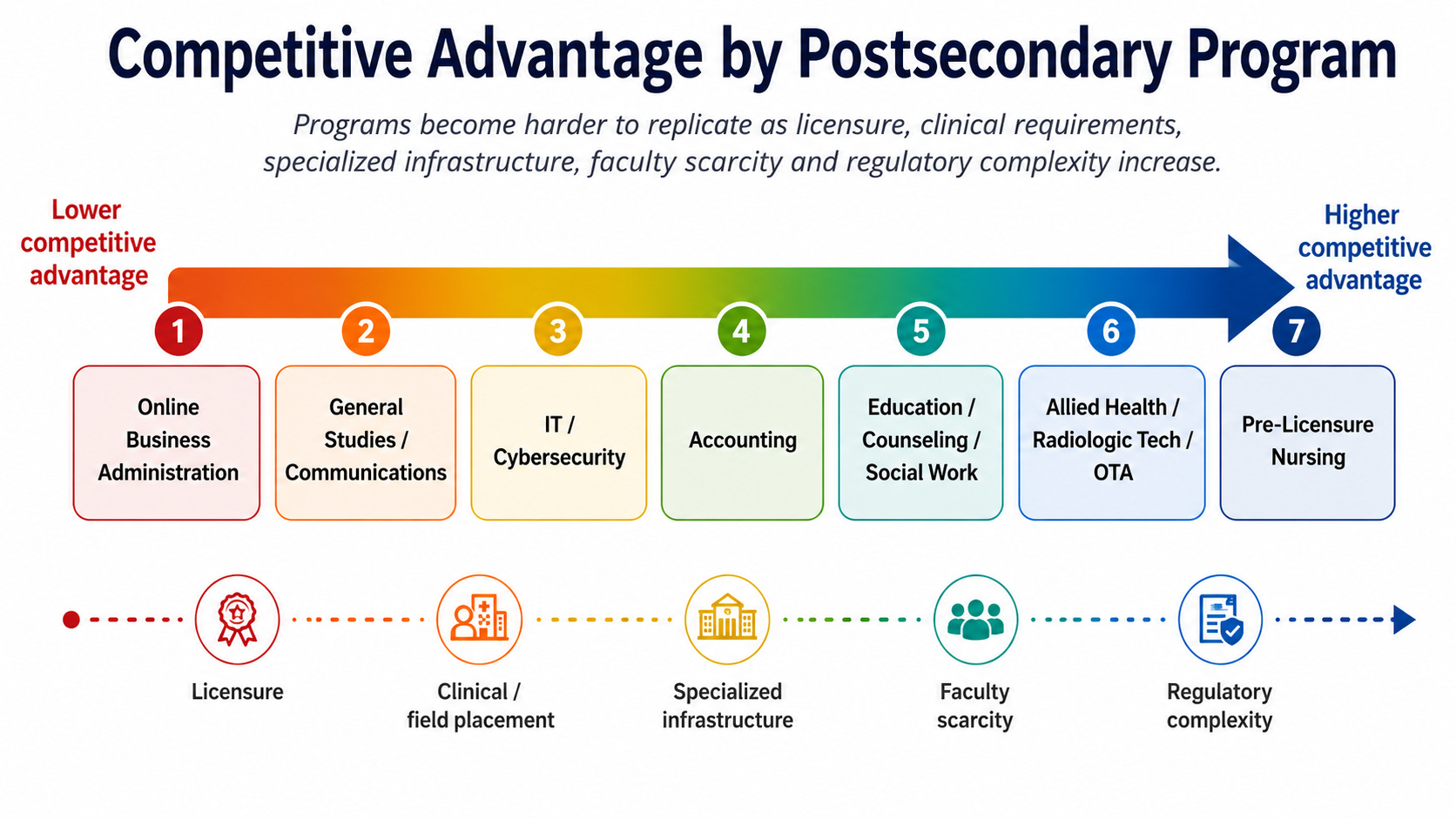
The graphic above is my attempt to show that continuum across program type. Programs on the left-hand side are commoditized. The programs farther to the right have moats. Driving competitive advantage includes licensure, regulatory complexity, and operational difficulty (like finding clinical placements for healthcare students).
Online business administration sits toward the left because almost anyone can offer it. Students also have a huge number of substitutes: another university, a community college, a state institution, or increasingly shorter credentials available through platforms like Coursera.
Pre-licensure nursing sits at the far other end. To operate a nursing program, an institution needs state approvals, accreditation, clinical placements, faculty (which is quite difficult to come by these days), simulation infrastructure, solid NCLEX outcomes, and success in complying with a significant amount of regulatory oversight.
I’ve seen firsthand through consulting engagements how difficult and expensive nursing programs can be to launch.
Grand Canyon Education CEO Brian Mueller made essentially the same point on his company’s Q2 call. He suggested that his institution had a competitive advantage because more than 70% of GCU’s online students pursue degrees that require licensure. Mueller explained the difficulty of providing these programs at a distance given teaching, observation hours, internships, clinicals, and other requirements.
Postsecondary institutions whose programs are exposed to business generally have the weakest growth. Nursing, healthcare, and skilled trades are growing faster.
Investors aren’t expecting companies to grow revenue at double-digits. High single-digit revenue growth represents a good outcome for mature institutions.
Mueller essentially provided long-term guidance for GCU when he said the online campus should continue growing roughly 6%–7%.
So Q2 revenue growth itself doesn’t concern me very much. It’s more about what comments and guidance suggest about Q3.
Sell-side consensus estimates suggest that almost every company in the group except PXED, owner of the University of Phoenix, will see revenue growth decelerate. UTI, for example, generated 7% YoY growth in Q2. Analysts currently expect roughly 6% in Q3.
Clearly a disconnect exists between language used by operators for demand (e.g., “strong,” “exceptionally healthy”) and future expected revenue growth.
AI Should Be Helping Education Demand
The conventional wisdom over the past several months has been that AI poses a threat to white-collar employment, particularly entry-level professional jobs.
Fortune Magazine in May captured this anxiety with the headline that “Microsoft AI chief gives it 18 months—for all white-collar work to be automated by AI”.
It makes for a great headline. It wasn’t quite what the Microsoft AI chief actually said.
In the underlying interview, posted on YouTube, he said
“I think that we’re going to have a human-level performance on most, if not all, professional tasks. So, white-collar work where you’re sitting down at a computer, either being, you know, a lawyer, an accountant, or a project manager, or a marketing person, most of those tasks will be fully automated by an AI within the next 12 to 18 months. And we can see this in software engineering… their role shifted now to this meta function of debugging, scrutinizing, of doing the strategic stuff like architecting, of, you know, etc.”
He’s describing how workers will move toward higher-level responsibilities, which will require higher-level strategic capabilities.
But why would the media try to accurately represent his comments? Surely it’s better to craft a narrative of fear and anxiety, one apparently disconnected with reality, to generate virality. The problem: folks are now questioning the value of continued adult education to help workers thrive in the new normal.
Gad Levanon, an economist at the Burning Glass Institute, put out an intriguing post on LinkedIn where he examined labor data and suggested that AI is hitting the most codifiable jobs first. As he wrote,
A job is vulnerable when its output can be specified, produced, and verified without preserving much human judgment, accountability, or relationship management. That is why translation, a skilled and nonroutine occupation by most traditional measures, still falls on the exposed side of the line: its output can increasingly be specified and evaluated without retaining the full human role.
His point: Jobs that depend on judgment, responsibility, persuasion, coordination, and accountability hold up.
That creates a pretty obvious incentive for adult workers to further their education journey. To retrain for something that looks harder to automate.
So it’s not surprising that management teams are characterizing demand as strong.
Google Trends Supports the Demand Story
In my March 2026 analysis AI Job Anxiety – The Next Catalyst for Edtech I used Google Trends data from 2021 through early 2026 to suggest that we would likely see the AI economy catalyze favorable enrollment trends. I created heatmaps based on YoY % changes of Google Trends output. Strong green on the heatmap = over 50% YoY growth. Strong red = a YoY decline greater than 20%.
I updated the data for this piece.
The trends still show and confirm that Google users continue to be uneasy about the rise of AI and are increasingly searching for higher education programs.
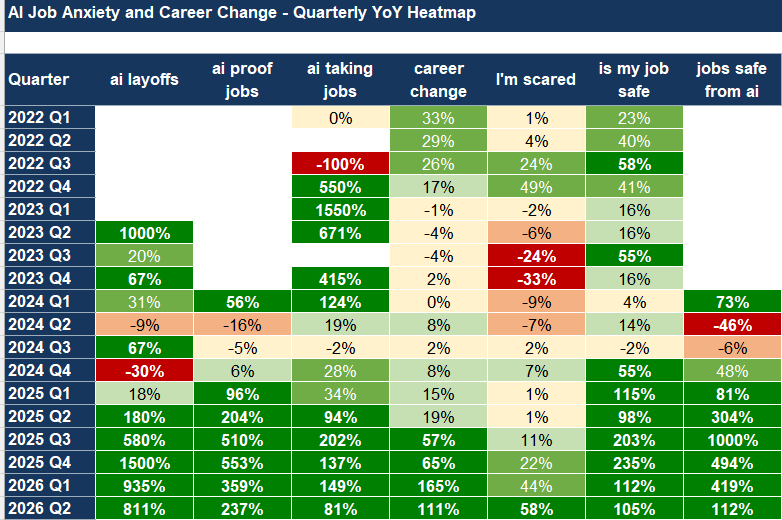
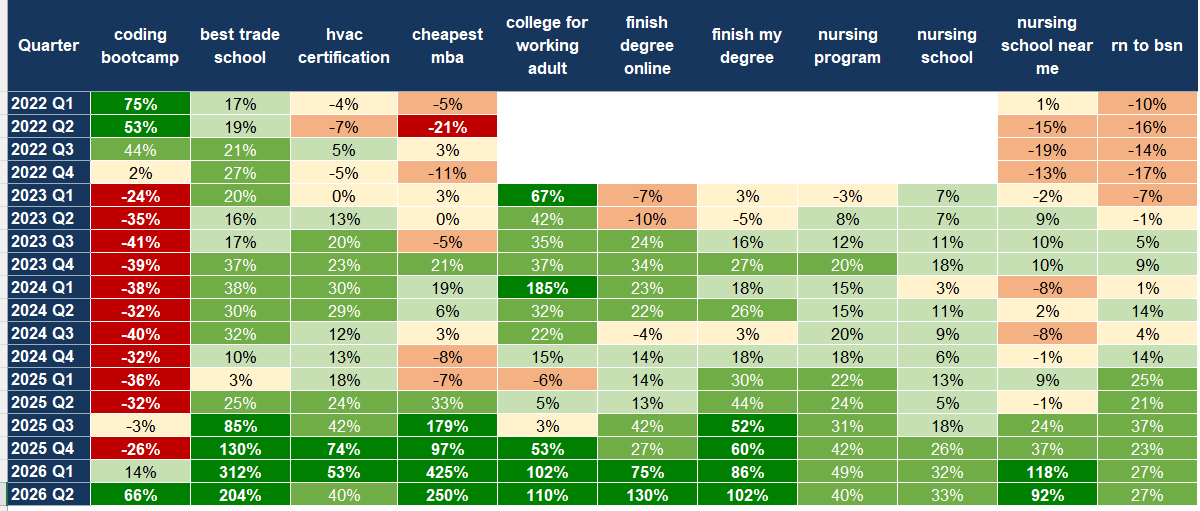
The Google Trends data shows that interest in education broadly and specific programs has not just grown but accelerated since 2025 Q2.
Some examples: “finish degree online” in Q2 increased more than 100% YoY. “College for working adult” also accelerated to over 100% YoY.
Searches for “best trade school” increased 312% YoY in Q1 2026 and 204% YoY in Q2. Searches for “nursing school near me” increased 118% YoY in Q1 and 92% YoY in Q2.
The Google Trends data provides some independent support for what management teams are seeing. Folks are searching for credentials that get them into a more durable occupation or improve their existing position.
Grouping the Publicly Traded Postsecondary Companies into Three Segments
One of the more frustrating challenges I had when I served as a sell-side analyst was explaining the nuances of the market to generalist investors.
The publicly traded companies aren’t a homogeneous group. Institutions provide distinct value propositions based on program type, degree level, and tuition. It’s inappropriate in many circumstances to offer blanket statements across the group. A welding program and an online MBA have almost nothing in common from a demand perspective.
I divide the nine public postsecondary companies into three admittedly imperfect groups. If you disagree with the grouping, complain in the comments.
Vocational and Technical Education:
Universal Technical Institute (UTI)
Lincoln Educational Services (LINC).
These companies provide skilled trades and career-focused technical programs. Their programs tend to have a direct connection between education and occupation. For example, automotive and diesel technology, HVAC, welding, etc…
These companies warrant the highest valuation multiples among the peer group. It didn’t use to be this way.
Investors used to look down on this group. That includes me. Largely due to historic concerns regarding weak student debt-to-earnings ratios. Unfortunately, I completely missed that the management teams of these companies over the past fifteen or so years went through the painful process of pruning programs and locations.
Ironically, the Obama Administration’s gainful employment regulations incentivized institutions to eliminate low ROI programs that didn’t comply with proposed thresholds. The government created a high bar for what debt a student should take relative to the income a student would generate.
The bad news? Close to 600 for-profit institutions closed from 2010 to the present day.
The good news? The surviving vocational institutions generally offer a much stronger student value proposition today. At UTI and LINC in particular, management’s efforts worked.
Since 2024, the valuation multiples of these vocational schools have more than doubled. A reflection of their revenue growth rate and perceived immunity from AI risk given the nature of their offerings.
Until recently they traded at more than 20x EBITDA. Then both ran into execution problems. Still, they trade at the high end of the historic valuation range.
Healthcare-Oriented and Campus-Based Education:
American Public Education (APEI)
Covista (CVSA)
Legacy Education (LGCY)
Grand Canyon Education (LOPE)
I’ll concede that definitionally this grouping is a bit stretched.
APEI owns Rasmussen University and Hondros College of Nursing, which represent slightly more than half of total revenue. The remaining half is American Public Education, an online institution with roots serving the military.
LOPE is technically an education services company, with its key university partner, Grand Canyon University (GCU), representing over 90% of revenue. Healthcare might represent a quarter of degrees awarded in 2025 (data available from the Department of Education). Most importantly, service partner GCU has a traditional ground campus with a differentiated Christian identity. Thus, the demand characteristics are a bit different from the other companies evaluated here.
CVSA provides primarily healthcare programs. They own Walden University, which primarily offers master’s degrees in nursing, social work, and education. They also own Chamberlain University, often considered the crown jewel of higher education by investors, as it’s the largest nursing school in the United States by enrollment.
LGCY is the newest kid on the block, having gone public in 2024. They primarily offer shorter-term allied healthcare programs.
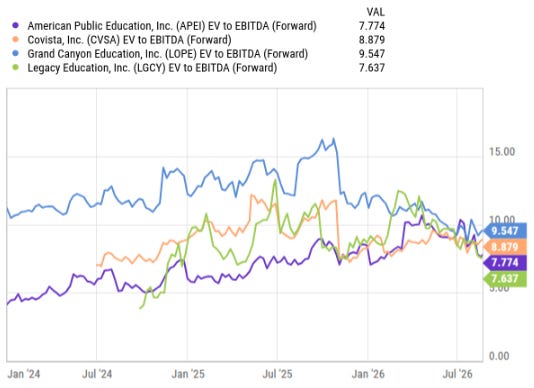
These four entities have seen their valuations converge to about 7-10x EV/EBITDA over the past half year.
Online Adult-Degree Education:
Perdoceo Education (PRDO)
Strategic Education (STRA)
University of Phoenix (PXED)
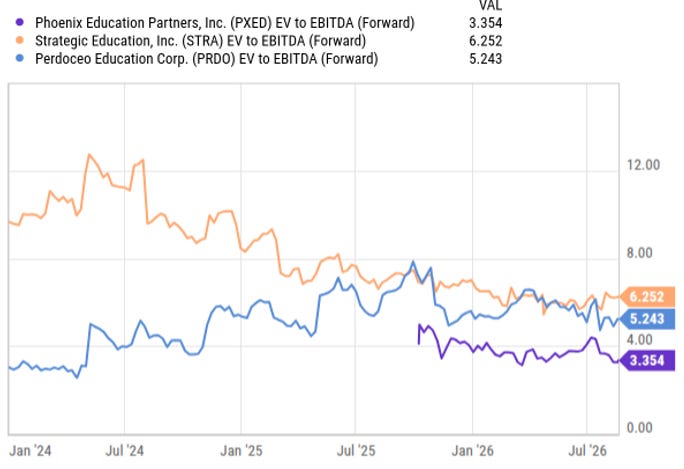
These businesses primarily serve working adults online. They also have substantial exposure to business programs.
Strategic Education also owns an Australian school and has meaningful healthcare exposure. So again, the categorization isn’t perfect.
Their concentration in business programs may help explain these companies’ low revenue and enrollment growth. Competition exists for business programs among well-branded state and nonprofit universities. Students can also stitch together relevant courses through platforms like Coursera. No licensure exists. It’s the easiest program to offer. That creates more substitution risk.
What Management Teams Are Seeing
My intent isn’t to summarize every company’s earnings report. Rather, I’m highlighting consistent themes across companies.
Technical and Vocational: Demand Exceeds Supply
Both UTI and LINC management described substantial interest in their vocational programs.
UTI’s management characterized the underlying demand environment as “exceptionally healthy.”
UTI operates as a parent company with two operational divisions. The UTI division trains students for automotive, diesel, and industrial trades. They saw inquiries increase by 18%. New student starts increased 23%. The Concorde Career Colleges focus on healthcare, nursing, and dental professions. They saw marketing leads increase by 22%.
CEO Jerome Grant made some pretty remarkable comments about the labor markets these schools serve:
The demand for skilled healthcare workers also remains quite strong, with providers continuing to face staffing shortages across many of the disciplines we serve. We’re seeing particularly strong momentum in our radiology technician programs where enrollment and demand have ramped rapidly. Now at the same time, employer demand for transportation technicians remains exceptionally robust. For example, there are more than twice as many open positions on our campus job boards than the number of automotive or diesel graduates we produce.
Management highlighted particularly strong interest in electrical, HVAC, welding, industrial maintenance, and other skilled-trades programs.
Lincoln CEO Scott Shaw provided similar comments on their trends.
as a recognized leader of education and training services for safe in-demand rewarding careers in the skilled trades, transportation and healthcare fields, we are benefiting from the continuously expanding interest across America as the demand for skilled workers exceeds supply.
These are strong statements by their respective CEOs. Let me reconcile the strong demand with the weakness they reported regarding enrollment and student start growth.
At Lincoln, student starts grew only 1% YoY in Q2, representing a deceleration from the 19.5% YoY growth rate in Q1. Apparently, they experienced two different issues. First, changes in advertiser platforms resulted in Lincoln receiving low-intent student leads. So the conversion rate proved terrible. Secondly, management said that some prospective students lost eligibility to receive Title IV aid that prevented them from starting at Lincoln.
UTI had a thoroughly different problem.
They had the students. They didn’t have enough admissions representatives in the field to get back to all of them. Of all the problems that an institution can have, this is a good one. It’s not great that it happened, but it’s a fixable situation.
Healthcare: Secular Demand
Healthcare programs have benefitted from labor shortages.
APEI reported a 7% YoY increase for pre-licensure nursing enrollments. On-ground healthcare enrollments grew by 9% YoY.
Covista benefited from the same healthcare tailwinds. Q4 (it reports on a non-calendar fiscal year) total enrollment increased 8.4%.
CEO Steve Beard suggested that:
From a macro perspective, behind our strategy and our guidance sits a demand backdrop that has not changed. The population is aging, care demand is rising, and the existing workforce is under real strain. This is a secular story, not a cyclical one.
That’s the entire postsecondary healthcare thesis.
Primarily Online Adult Degree: Anemic Overall Growth
These companies are generally showing flat to low-single-digit overall enrollment growth. Their heavy concentration in business programs may help explain that.
The Department of Education doesn’t report program mix based on enrollment, but it does report it on degrees awarded. That data gives a pretty good sense of where these institutions are concentrated. In 2025, business administration and management accounted for:
PXED/University of Phoenix, 43% degrees awarded
STRA/Strayer University, 48%
PRDO/American InterContinental University, 39%
PRDO/Colorado Technical University, 57%
Note that I’m using degrees awarded for comparability purposes. PRDO in its 10-K reports that business studies represented 66% of their 2025 student enrollment. To my knowledge, Phoenix and Strategic Education don’t provide a comparable enrollment-by-field breakdown.
The management teams of these companies in addressing the issue of commoditization pursued two actions. They diversified their program mix and attempted to create a moat within the business category.
For mature education companies, acquisitions provide a much faster way to change program mix than launching new programs organically.
STRA acquired Capella University (which offers mostly healthcare programs) in 2018. It then acquired Torrens University in Australia in 2020.
PRDO acquired the University of St. Augustine for Health Sciences in late 2024. The institution focuses on graduate-level healthcare degrees.
On establishing the moat within business programs, management teams over the past few years built deeper relationships with employers. Both in terms of sourcing students from enterprises and building customized programs.
That strategy has many benefits. These institutions rely less on the increasingly crowded market for Internet leads. It gives them access to working adults who already have jobs and thus may receive tuition assistance from their employers. Those students often have a clearer reason for earning the degree and may be more likely to persist and complete, which helps with the institution’s regulatory profile.
The University of Phoenix reported that 36% of enrollment now comes through employer-supported relationships, up from 33% a year ago. Strategic Education reported that 35% of its US Higher Education enrollment is employer-affiliated, up from 32% last year. At Perdoceo, 38% and 8% of enrollments at CTU and AIUS originated from employer-sponsored engagements.
The bright spots at these companies? Healthcare exposure.
At Strategic Education, enrollments in programs in its healthcare portfolio increased by 11% YoY.
At Perdoceo, total enrollment grew only 0.7% year over year in Q2. But… its University of St. Augustine school saw enrollment growth of 6%, driven in part by nursing, speech-language pathology, and other programs. Management said the fall enrollment pipeline at St. Augustine “looks strong.”
I wouldn’t be surprised if Phoenix eventually acquired a healthcare asset, as its two peers have done. The obvious challenge is the valuation disparity. Phoenix at 3x EBITDA would need to pay 7-12x for a healthcare asset.
So Why Isn’t Strong Demand Producing Faster Growth?
Unfortunately, institutions are having a hard time turning interest into leads and enrollments. I’m referring to traditional Internet lead generation.
For years, the postsecondary funnel consisted of the following: A prospective student searches for a program on Google. The user clicks on a link, one that the school has achieved a top ranking for either through search engine optimization or a sponsored link. The student reviews information on a school website and then fills out a form online. Voilà. They are then placed in the formal admissions process.
AI has changed that behavior.
Prospective students may still start their journey by searching on Google but now receive a response from Google AI Overviews, powered by Google Gemini. Students don’t just search for a term to get to a website. They have a conversation with the LLM. They might ask questions about the brand and about alternatives to the institution. Google might proactively tell the student to consider an alternative that has a cheaper price.
Most importantly, a student now evaluates the brand before they ever search for a specific program.
Historically, prospective students began with a specific program and then searched for institutions that offered the program. That sequence appears to have reversed. Marketing company EducationDynamics found that 58% of prospective students begin their search by considering schools first (and 60% of online learners).
This is where the historical baggage around “for-profit” institutions becomes relevant. When LLMs summarize these schools, they can surface decades of negative press and regulatory history. I think that creates a real risk of anti-for-profit bias in the resulting recommendation.
Esteemed BMO Capital Markets analyst Jeff Silber, who has covered the sector for close to thirty years, naturally asked Strategic Education management about this topic on their Q2 conference call. Pointing to how non-healthcare enrollments have been shrinking at their institution, he noted that “others in the industry that have talked about students searching using LLMs that may have some inherent bias against the for-profit sector.” I’m one of those others in the industry. Strategic Education CEO Karl McDonnell said, “That’s not something that we’ve identified as being an issue.”
I’m a bit puzzled by the response.
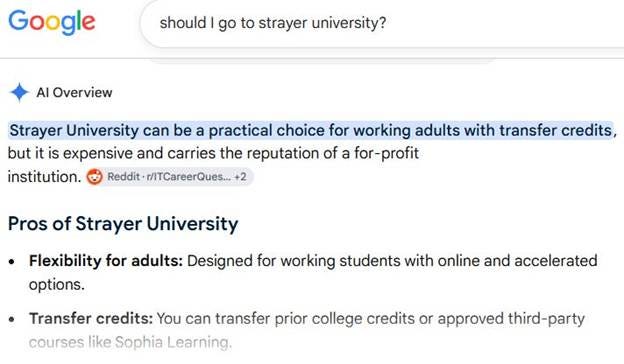
See the screenshot below. I queried Google and asked (in Incognito Mode on 8/24), “Should I go to Strayer University?” Google AI surfaces info that the school is expensive and carries the reputation of a for-profit. The conversation suggests that users on platforms like Reddit suggest that other options like WGU have a better value.
I find it difficult to believe this isn’t at least something worth monitoring by STRA management. Healthcare enrollment in their US Higher Education segment increased by 11% in Q2. My math suggests non-healthcare enrollment declined roughly 11%. How much of that reflects marketing allocation decisions, program mix, or changing AI-driven search? No idea.

Grand Canyon Education CEO Brian Mueller best expressed in my opinion how management teams should think through the new reality of LLMs, bias, and brand recognition. On LOPE’s Q2 earnings call he said:
AI is absolutely the future and positioning ourselves so that the best stories come out when people go to AI to check on Grand Canyon University is going to be the future of this whole -- of the whole market. And we are working very hard to position the best things about GCU, especially but other partners as well so that they’ll come up when people look for us. The Honors College. The opening of the law school, the tremendous contribution to what it has to be a rebuilding of the labor force in construction, industrial technologies, our relationship, our growing relationship with TSMC, which is the largest chip manufacturer in the world that sits 20 minutes from here.
Mueller gets it.
One way to establish credibility on LLMs is to demonstrate the value proposition of the institution. To partner with entities that validate the institution. To benefit from a halo effect.
If I ran a university, I’d want to know exactly what Google AI and ChatGPT say about the institution and then figure out how to make sure those answers reflect what the school actually does well.
What Management Teams Are Saying About AI Search
The management teams in the quarter provided useful commentary about the sources of inquiries and leads. But they don’t report consistent quarterly KPIs showing the mix of those lead sources. That leaves investors dealing with something of a black box when it comes to Internet student acquisition.
How many leads come from Google paid search? Organic search? Meta/Facebook? Lead aggregators? ChatGPT or other LLMs? It’s a mission-critical piece of information that stakeholders/investors don’t know.
Given how quickly student acquisition is changing, I think this lack of visibility on lead composition has become one of the biggest questions facing the group.
Grand Canyon Education
Grand Canyon CEO Brian Mueller’s comments on the Q2 call regarding Internet leads:
We’re impacted in the same way others are from the standpoint of web leads being down. But we’re not as impacted because we don’t have to get our growth from increased lead amounts like other people do.”
I found this a bit confusing. I get that web leads are down, but I thought that they would be more immune than their peers.
Grand Canyon University has nonprofit recognition from both the IRS and the Department of Education, as of December 2025. To the extent that anti-for-profit bias exists, GCU’s history as a former for-profit institution could still affect how it is characterized by LLMs. GCU pricing compares favorably with its nonprofit private university peers. I own LOPE partly because I assumed GCU would have more protection from changes in student acquisition than some other institutions for these reasons.
Mueller says it does. I’d like more details.
Management has said that more than 30% of starts come from relationships with outside organizations. Where do the other 70% come from?
Lincoln Education
Lincoln CEO Scott Shaw explained tactically how to address LLM synthesized comments:
We certainly saw some of our lead volume slow down a bit in the quarter. ... Sometimes the AI models are simplistic. And what they look at is cost, in which case they may highlight a community college over us. ... We’re trying to change what’s available on our website so that these large language models can give students a better insight into what a career or an opportunity is at Lincoln versus other things.
He’s effectively describing the process of answer engine optimization. That’s the process of creating content online such that LLMs provide a brand’s preferred narrative. Ultimately to cite and recommend a brand.
Covista
Covista CEO Steve Beard said AI hasn’t created a measurable headwind to its funnel yet.
… particularly the top of the funnel. That said, we believe the dynamic is real ... We actively track how our brands are represented across all the major AI platforms and answer engines, including tracking visibility, share of voice, competitive positioning.
Beard here describes another type of answer engine optimization called AI visibility tracking. Instead of targeting keyword rankings on Google, companies measure how often an LLM mentions their brands in a chat.
PRDO
CEO Todd Nelson said on his Q2 call that:
The shift from traditional Internet search engines to LLM-based AI-powered search is changing how prospective students research and evaluate their education options. However, our analysis indicates a majority of our prospective student inquiries come from channels that are not directly impacted by this trend. ... The overall impact on enrollment has been modest thus far.
Nelson like others acknowledges the change. I don’t understand his answer given the lack of data regarding the composition of student leads.
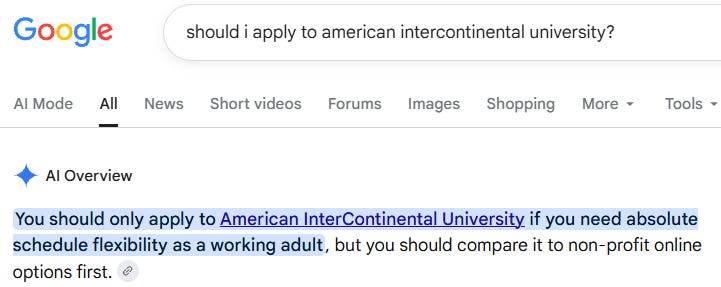
It’s a shame that more analysts don’t cover this company. I wish someone could have asked follow-up questions regarding channel mix. Google AI Overviews now appear on close to 50% of all Google search queries. I asked Google just now whether I should apply to American InterContinental University. Here’s the reply saying I should compare it to a nonprofit online option first. Its difficult to reconcile his comments with the screenshot below.
PXED
Phoenix management probably gave the clearest explanation of the underlying change occurring within the industry.
CEO Chris Lynne said:
We’re not seeing weaker demand for our programs. In fact, demand for the University of Phoenix’s brand remains strong. ... What we are seeing is a change in how prospective students evaluate their options. We’re seeing longer and more iterative evaluation processes as AI-powered search becomes more a part of the evaluation journey. And that’s really the driver of the near-term impact.
If AI extends the evaluation cycle and/or sends the student toward more alternatives, conversion takes longer and becomes less predictable. Arguably that’s the entire story of why the education stocks are underperforming.
To management’s credit, they were the first to actively discuss how changes in student acquisition negatively affected their business. Their comments on their earnings back on July 14th set the tone for the entire earnings season.
So What Does This All Mean?
Demand, student acquisition, and execution aren’t the same thing.
Demand remains healthy.
What changed in Q2? Confidence in the predictability of growth. If Internet search is changing, and the companies don’t disclose enough about lead sources or conversion by channel, investors have less confidence in their ability to forecast enrollments and revenue. That uncertainty presumably has lowered the group’s valuation multiple.
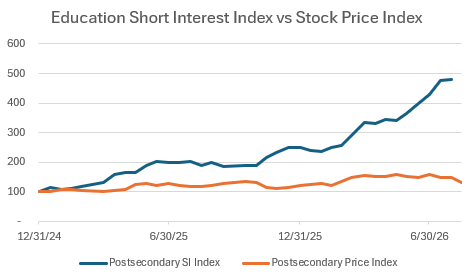
One other data point supporting the premise of increased investor skepticism of the group - short interest has risen dramatically for many of the names.
I indexed both the group’s short interest and stock prices to 100 as of December 31, 2024, using an equal-weighted basket of the publicly traded postsecondary companies. The short-interest index has increased to nearly 500 while the stock-price index sits near 130.
Investors betting against the group have increased their positions meaningfully greater than the stocks as a group have appreciated. That tells us that skepticism around the durability and predictability of these businesses has increased materially.
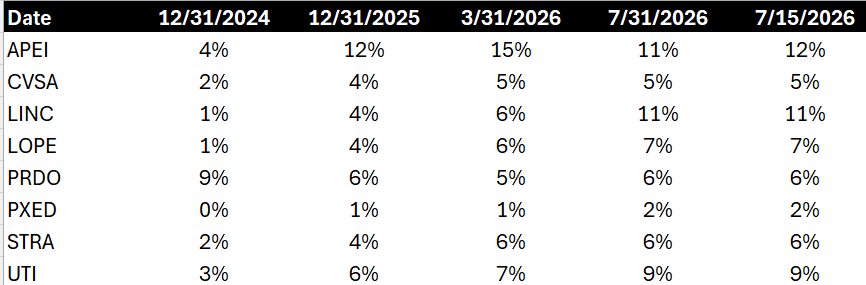
Here’s the same data presented a different way. The table below shows short interest as a percentage of float for each company over time. The increase is across the group, with PRDO the notable exception.
It’s important to note that when stocks have stretched valuations, it does attract short sellers. So the increases in short interest as a percentage of float at LINC and UTI aren’t necessarily reflective of deteriorating fundamentals. Their elevated valuations simply leave less room for error.It’s
Valuation
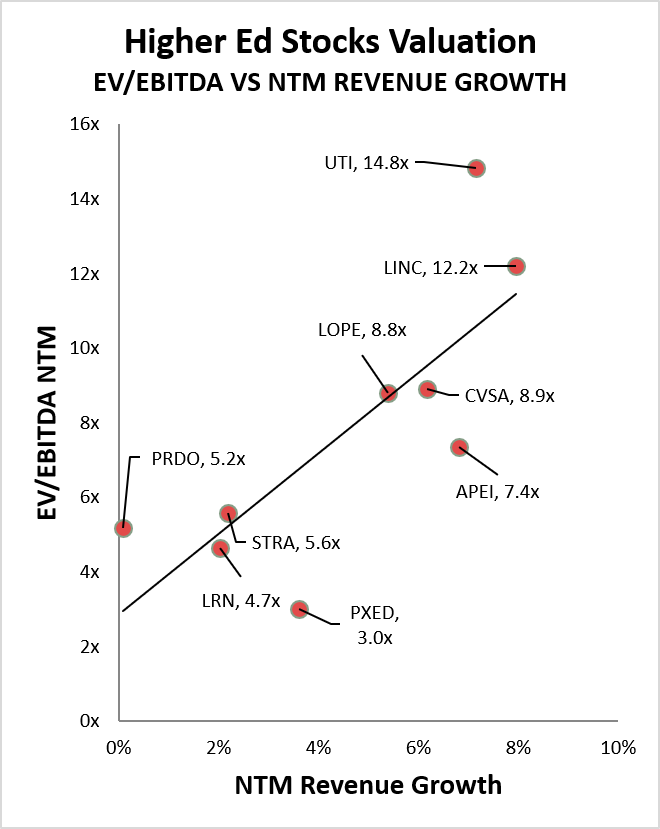
Despite the stock selloff, relative valuations across the group still look pretty similar to six months ago.
The postsecondary stocks have a clear relationship between NTM revenue growth and EV/NTM EBITDA. The correlation stands around 77%. The R² sits at roughly 0.60. For those who care about statistics, I can get a higher R² by adding EBITDA margins and EBITDA growth to the equation. But then I can’t make the nice two-dimensional chart. Visually, the chart tells the story, higher growth = a higher valuation multiple.
Vocational companies sit near the top of the chart, now around the mid-teens EV/EBITDA range. Healthcare and campus-oriented businesses generally trade around 7x–9x. Primarily online adult-degree operators sit toward the bottom at roughly 3x–6x.
So for all of my analysis regarding the durability of these businesses given AI, arguably the valuation story is simpler. Faster-growing companies generally trade at higher multiples.
Next Catalyst
One of the next meaningful catalysts for the group will be PXED’s financial results. Their quarter ends in August. Last year they reported results in November.
Management will provide an outlook for its upcoming fiscal year 2027. Analysts expect the company to see revenue increase by 3.2% YoY.
Given changes in student search and discovery, I have no idea if analyst estimates are conservative or aggressive. The company’s current year revenue growth rate faced difficult YoY comparisons given the recognition of “ghost student” revenue in the prior year. Spooky.
That being said, I would be remiss if I didn’t point out that based on current estimates, it appears that PXED remains the most undervalued stock on a relative basis.
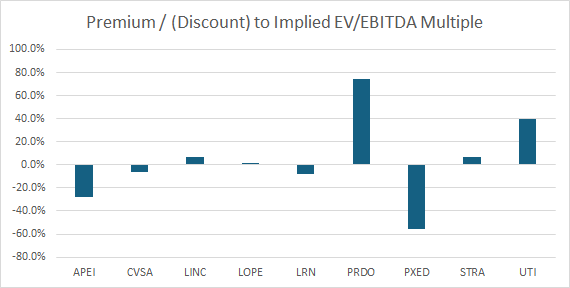
Assuming analysts are correct on their next twelve-month revenue estimates, the stock could respond favorably if management provides guidance in line with or above consensus.
Its existing valuation could provide some downside protection. Stocks trade at 3x EV/EBITDA when investors question the durability of the overall business. Maybe they are right to do so; I just don’t see it. Management has done a laudable job in altering many aspects of the institution: lowering pricing, increasing student outcomes, rebuilding the curriculum around workplace-relevant skills, and expanding partnerships to serve as a source of lead flow/students.
Despite my strong opinion of their management team and their actions to improve the institution, I don’t own the stock and am a bit reluctant to buy it (at least today).
Because… the company doesn’t disclose inquiries/leads by marketing channel.
Investors are challenged to quantify how much further disruption in search could affect enrollment or revenue.
Concluding Thoughts
Tying this back to where I started, I wish large nonprofit and public institutions provided something resembling quarterly earnings calls.
I’d love to hear Southern New Hampshire University, WGU, Arizona State University Online, University of Maryland Global Campus, Liberty University and others answer the same questions analysts are asking the public companies.
What are they seeing in demand?
How has search changed?
What are they doing differently?
How much of their pipeline still comes from Google?
What does ChatGPT say about them? Do they even think any of this matters?
For industry stakeholders, here are key takeaways / learnings from evaluating Q2 results:
Audit what LLMs say about the institution. ChatGPT, Google AI and other LLMs now sit between the prospective student and the school. Institutions need to understand what information surfaces, whether it’s accurate, and what alternative institutions are recommended to students.
Diversify student acquisition channels. Increase employer partnerships and other direct channels. They are now much more valuable. Reduce dependence on Google.
Reevaluate program mix in the context of AI demand. Nursing, healthcare, skilled trades and other programs tied directly to licensure or an occupation continue to show the strongest demand. They also tend to be the hardest programs for competitors to replicate.
Consolidate the market. The Trump Administration provides a unique regulatory window where institutions can transact. There are still high-quality healthcare companies that could serve as the basis for a beachhead from which to grow.
Disclosure
I own shares of Grand Canyon Education (LOPE).
During the past twelve months, I bought and sold shares of Phoenix Education Partners (PXED) and Strategic Education (STRA).
I am making no recommendation to buy or sell stocks.
This article reflects my analysis based on publicly available information.
No one has compensated me for writing and publishing this analysis. Don’t construe this as investment advice. It’s not. This is purely for informational purposes. Nothing in this article should be construed as investment advice or as a recommendation to buy or sell any security.
Estimates, forecasts, valuation assumptions, and opinions are subject to change without notice. I may buy or sell securities discussed in this article without updating any readers.