

TL DR
Google AI Overviews are breaking the link between search queries and website traffic. Visibility now depends on whether content exists inside the sources LLMs cite.
Despite deteriorating economics driven by Google AI Overviews, companies have been able to adjust their business models and tactics to survive and thrive in a challenged environment. In the piece we review the examples of three companies who have adapted successfully.
Case 1: Higher Ed. University of Phoenix fixed lack of visibility in AI Overviews by moving outcomes content to YouTube.
Case 2: Publishers. People Inc has replaced lost traffic with licensing, platform distribution, and commerce.
Case 3: Lead gen companies. NerdWallet has shifted its model toward paid acquisition and owned ecosystems.
Entities need to adjust their marketing, the destination is no longer the website. Leaders now need to managing their total digital footprint.
In the 1980s, Ralph Macchio played a young man on a journey. He sought out a seasoned mentor, learned a difficult craft, faced a seemingly superior opponent in a high-stakes climax, and, against all odds won.
I’m not talking about The Karate Kid.
Two years after Daniel LaRusso did the crane kick, Macchio starred in a much less well-known film called Crossroads. In it, he plays a Juilliard student trying to master the blues. The movie follows the exact same narrative beats as The Karate Kid, but it ends with a supernatural guitar duel against a demonic opponent played by rock legend Steve Vai.
Same actor. Similar setup. Completely different story.
There is a parallel here to how organizations develop their brand in the AI era. We are using the same actors (C-Suite / marketing teams) and the same setup (search engines), but we are in a completely different story.
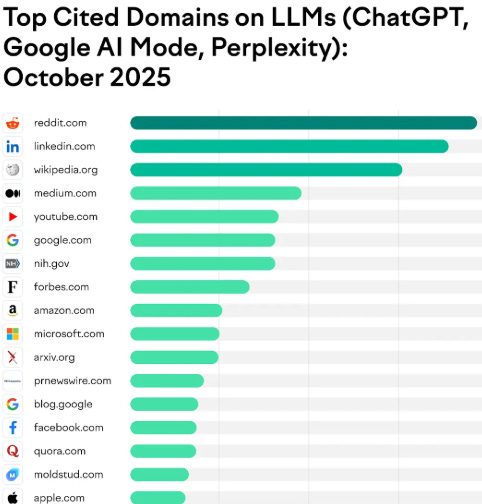
The New Normal is that Discovery has moved outside of an institution’s control. Large Language Models (LLMs) are affecting user discovery not by sending users to a destination website but by answering questions directly by pulling information from “trusted” authority sites like Reddit, LinkedIn, Wikipedia, and YouTube.
The Thesis: Marketing as Portfolio Management
This New Normal requires more than just fixing a website. It potentially requires rethinking an institution’s business model and the profession of marketing.
My thesis: Marketers are Portfolio Managers of External Content. The profession isn’t just about driving traffic to a website.
This was validated this past week when Phoenix Education Partners, owner of the University of Phoenix, announced their most recent financial results. Management suggested that a change in the Google AI Overview algorithm had directly affected their enrollment pipeline.
As anyone doing a basic web search knows, Google now provides a synthesized answer instead of a list of links. The problem Phoenix saw was that because they lacked content on YouTube, they were invisible in those synthesized answers. Or perhaps differently, AI was filling the void with messages that didn't align with their brand.
Their solution? They created content on YouTube. According to their conference call, that pivot solved the problem.
Other companies have complained about the deleterious effects of Google AI, but this is the first circumstance that I’m aware of where a management team addressed the specific type of content being harvested.
Right now, leadership of companies or institutions of higher education need to obsess over visibility inside the answer layer of AI. A successful marketing function in 2026 will figure out:
How to show up in the AI Overview answer
How to ensure that the LLM cites its data as the “truth”
This article is intended for stakeholders of laggard institutions. Institutions that aren’t making meaningful changes to their business model or how they market. Readers need to understand the severity of the problems that Google AI Overviews has caused.
Some companies (e.g., Chegg) are on the road to extinction.
Others though are evolving and growing with a model shift.
There are real answers to the existential problem that Google AI Overviews creates.
I have identified three distinct types of failures that I’ve seen from Google AI Overviews, but also three publicly traded companies that have made adjustments to their business model and tactics employed.
The Publisher Failure: Content is Used, But Traffic is Lost
In 2022 media entities announced a new Karate Kid movie would be developed.
If a user wanted to learn more about the movie they would have typed in a web search most likely on Google. Links to various websites related to the movie would have emerged. Perhaps the first link would have been to Wikipedia, the second might have been to Reddit, and the third might have been to People.com.
People.com relied on users landing on the website page and monetizing users via ads or subscriptions.
The rise of Google AI Overview broke this model.
If you want to read about the next Karate Kid movie, Google AI Overview will provide you all the info you’d ever want.
This hasn’t been a good development for publishers. For example, IAC’s People Inc saw a 50% drop in Google Search referrals over the past two years. By 2025, Google search accounted for less than a third of the company's traffic, down from 60% in 2021.
The Wall Street Journal reported on this dynamic this back in June 2025. This publisher issue is far from new. In 2026, Define Media Group suggested that organic searches for publishers had declined by 42%.
People management didn’t try to fix their search engine optimization. Instead, they built a business model that assumes Google traffic isn't coming back.
AI licensing. They signed deals with OpenAI, Microsoft, and Meta to get paid for the content the AI uses, creating a revenue stream that does not depend on website visits.
Non-Google distribution. They moved where other users are—TikTok, Apple News, and YouTube—nearly doubling off-platform views in two years.
Commerce. They pivoted toward monetization through purchases, reducing their reliance on raw traffic volume.
By the end of 2025, digital revenue rose 14% despite the traffic collapse. They stopped being a destination and became a licensed content supplier.
The Lead Generation Failure: No Click = No Funnel
Publishers want users to land on their pages and consume content.
Lead generation companies, like NerdWallet or Bankrate or Quinstreet, create content as a catalyst for transactions. They create high quality guides to inform consumers about product offering and then connect the user to that service. Think of a website where you learn about an offering and then hit “apply now”.
In the old search model, a user typed "best travel credit cards," clicked NerdWallet, and was guided to a bank's offer. Today, Google AI Overview has become the advice layer itself. If the AI tells the user which cards are best, the user may go directly to the bank, bypassing the intermediary.
This obviously has negatively affected the lead gen companies.
Publicly traded NerdWallet (NRDS) saw meaningful business challenges in their most recent Q4 results. Credit card revenue declined YoY by 24%. SMB products revenue declined by 12%.
But they adapted. They re-engineered their business model. NerdWallet revenue for 2025 overall increased by 22%. They did it through:
Vertical Integration: They moved away from being just an intermediary. By acquiring the mortgage brokerage Next Door Lending, they became a broker, capturing a higher profit margin which provided them a cushion to pay for more expensive traffic.
Performance Marketing: They increased their spend on sponsored links by 40%. They stopped paying for broad brand awareness, like Super Bowl ads, and started buying the top spots on Google to guarantee a click.
Direct Relationships: They use paid traffic to drive users into their own app. Once a user links a bank account, NerdWallet can reach them via notifications, bypassing Google entirely.
NerdWallet is no longer just a lead generator; they are building a private ecosystem to protect themselves from the decay of organic search.
The Institution Failure: Omission from the Synthesis
In the first two cases, companies had to make structural changes to their business models. People Inc. moved toward licensing and platform-native distribution to survive the loss of site traffic. NerdWallet pivoted to high-margin verticals and direct app engagement to protect their revenue from the loss of the organic search click.
The case of the University of Phoenix represents a different type of disruption. A visibility failure. Granted, the financial impact from Google AI Overviews was modest compared to the other cases. Nonetheless, it revealed the new mechanics of discovery.
During their Q2 2026 earnings call, management noted that an “algorithm shift in AI search on Google” changed how prospective students navigated their search. Google’s AI was prioritizing YouTube as a primary source of information.
Phoenix has always possessed outcomes-based content proving that their programs lead to career advancement, but that data didn’t reside on YouTube. Google AI didn't pull this data into the synthesized AI answer. Phoenix’s value proposition was omitted.
Their solution included migrating outcomes-based data onto YouTube.
While Phoenix’s immediate problem has been resolved, it demonstrates the threat of AI affecting their enrollment funnel in the future. Content on third parties clearly will play a meaningful role in their financial results on a go forward basis. Historically Phoenix has had one of the best marketing capabilities around. So they likely will figure it out on a go forward basis. The same cannot be said of its higher ed peers.
The End of the Destination Website and the Rise of Managing the Digital Footprint
While Google still has 90% market share of search, its expected that this will whittle down in size with other LLMs gaining share over the coming years. As specialized LLMs gain traction, we will enter a fragmented era where discovery happens across multiple proprietary search mechanisms. Each with their own idiosyncratic methods and sources.
Like with publishers and lead generators, academic institutions may see an existential crisis.
The traditional model of buying keywords to drive traffic to a homepage where a student can apply is done.
This new reality doesn’t have to end poorly though for institutions with forward thinking leaders. Institutions have options. As the cases of People, NerdWallet, and the University of Phoenix show, there are ways to adjust.
One place for leaders to start is rethinking the marketing function. Marketing is now about managing a Portfolio of External Content.
To maintain visibility, institutions will need to have consistent messaging across YouTube, Reddit, Wikipedia, LinkedIn, and other authority sources.
Higher ed institutions must now manage the data supply that feeds these models. The organizations that survive this shift will be those that realize their reputation isn’t what they’ve written in their marketing collateral. It’s the aggregate/synthesis of what the most trusted sources on the web say about them.
Historically higher ed has not adjusted with speed to market conditions. That explains the success of the for-profits. Business owners adjusted quickly to market conditions. Nonprofits responded over the course of years. The for-profits embraced digital delivery for working adults. The nonprofits eventually realized the financial opportunities to service this same student population.
Given the speed of AI though, slow adaptation may mean closure.
There is a final chapter to the Ralph Macchio analogy that I provided in the beginning of this article.
For decades, Macchio was a nostalgia act. He wasn’t part of the current cultural conversation.
Then came Cobra Kai.
Macchio’s career resurgence happened because he embraced a new platform (YouTube). He took advantage of the modern fragmented streaming era. He stopped waiting for Hollywood to find him and instead went where the new audience was already living.
For laggard institutions, the lesson is the same. They cannot wait to be found on Google anymore.
In the age of the AI synthesis, doing nothing is a death sentence.