

TL;DR
The Washington Post’s investigation into Sophia Learning this past summer introduced a meaningful risk for the company. If universities lost confidence in the academic integrity of Sophia’s courses, the business could have been seriously damaged. Judging by social media accounts, management acted swiftly to strengthen its academic integrity protections. Crisis seemingly averted.
I dug further into the situation though, and discovered how deeply Sophia is embedded into the operating model of online universities. Much more than I previously understood.
Alternative credit providers like Sophia may help solve one of online higher education’s biggest problems: low completion rates driven by student time poverty. Students with jobs, families and other responsibilities struggle to fit a traditional 120-credit degree into their lives.
That creates a strange economic incentive for online universities: they may be better off encouraging students to buy fewer courses from them. Particularly lower-level general education courses that may be better suited to a self-paced subscription model. That could ultimately result in universities ceding a meaningful portion of general education instruction to providers like Sophia, Study.com and StraighterLine.
What I Missed About Sophia Learning
In July I published an article on Seeking Alpha arguing that a series of Washington Post articles had created a new risk for Strategic Education (STRA), the parent company of Sophia Learning.
The Post called into question the academic integrity of Sophia's courses. Sophia is STRA's fastest-growing business. Over the past several years, revenue has increased 25% to 30% annually, compared with management's notional model of 4% to 6% annual revenue growth for the overall company. Sophia sits within a segment whose operating margin exceeds 40%, compared with roughly 15% for STRA overall.
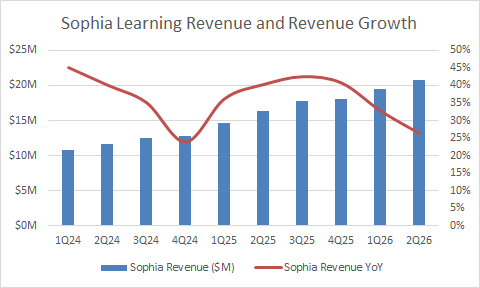
I wasn’t necessarily wrong in what I wrote about Sophia. Increased risk does exist for the parent company’s stock. We’ll find out soon enough when the company reports its financial results if that risk materializes. I thought that students might opt not to take their courses following the implementation of quality enhancing initiatives. It didn’t dawn on me until after I hit the submit button to publish that lengthening the time it takes to complete Sophia courses could increase subscription retention rates. For all I know quality enhancing initiatives could accelerate revenue growth.
Look, I have no idea what’s going to happen over the next several quarters. That’s not the point of this piece.
After spending more time learning about Sophia, its competitors, and the underlying market dynamics, I now realize that a much more fascinating story exists regarding the future of higher education.
Sophia Learning, Study.com and StraighterLine fit into the broader category of alternative credit providers. These companies offer inexpensive, self-paced college courses that students can transfer into degree-granting institutions.
Their offering represents, in my opinion, one of the most important developments in online higher education over the past ten years.
Online universities will become finishing schools.
They will cede a meaningful portion of the first year or two of bachelor's-level instruction to alternative credit providers.
Even more surprisingly, online universities will encourage their own cannibalization.
That may sound economically irrational. Why on earth would a university voluntarily tell students to purchase fewer courses from it?
Because the existing system doesn’t work. At least not particularly well for working adults trying to finish a bachelor’s degree.
There simply aren’t enough hours in the day. Working adults have jobs, children, spouses and other responsibilities competing for their time. Asking them to fit a traditional 120-credit bachelor’s degree around the rest of their lives has produced predictably poor results.
More than twenty-five years after online education emerged as a way for working adults to complete their degrees, the sector still struggles with persistently low completion rates and the stigma that comes with them. Critics point to those outcomes as evidence that online education doesn’t work. That the degrees by these institutions are worthless. Online universities respond, correctly, that they serve a fundamentally different student population. That inputs equal outcomes, and that the inputs aren’t great.
Here’s the real problem: asking working adults to squeeze a traditional 120-credit four year bachelor’s degree, designed for a very different kind of student, into a workable schedule.
The perpetual argument only resolves when universities try doing something different.
When they partner with Sophia and other alternative credit providers, universities are implicitly acknowledging this. It’s time to try something else. Institutions don’t need to deliver all 120 credits themselves. Universities have always accepted transfer credits, that’s true. What’s new is actively telling students that it’s in their best interest to take lower-level courses elsewhere. That doing so is faster and cheaper.
The online university starts to look less like a traditional four-year institution and more like a finishing school. By reducing the time to graduate, institutions should increase their graduation rates.
If what I’m saying is true, and I’m sure that many will disagree with my framing, then Sophia may be worth considerably more than STRA’s overall valuation implies.
Why Would A School Agree to Sell Less?
Online universities have a graduation and completion problem.
Completion rates serve as the ultimate proxy for an institution’s quality and return on investment. On this measure, online institutions typically perform worse than traditional institutions.
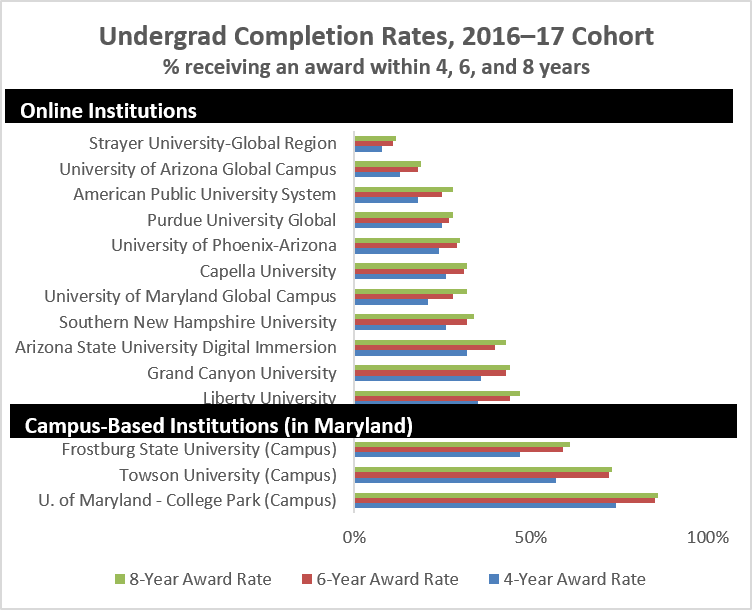
In the table below, I compare the completion rates of the largest online institutions with three campus-based public universities in Maryland, my home state. Importantly, these are completion rates that include transfer students, not the traditional graduation rate for first-time, full-time students that is sometimes cited when discussing the efficacy of online.
The data tracks students who matriculated in the 2016–17 academic year and the percentage who earned an undergraduate award from the institution within four, six and eight years.
None of the largest online schools had an eight-year completion rate above 50%. Liberty and Grand Canyon did best among the group, at 47% and 44%. Most students at online institutions never earn a credential from the school that enrolled them over eight years.
Maryland public universities performed considerably better. Frostburg State and Towson exceeded 60% and 70% completion rates, respectively, while the University of Maryland, College Park approached 90%.
Because of these low completion rates relative to traditional institutions, online universities continue to have a societal stigma, including among employers.
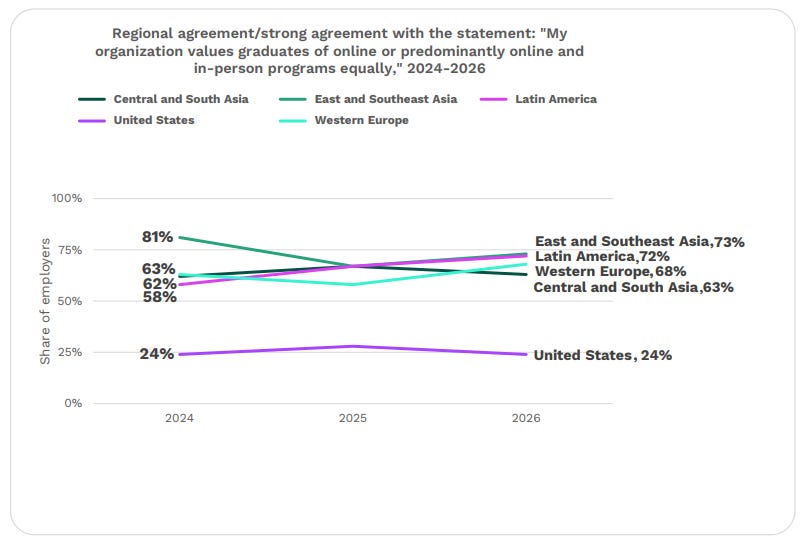
In GMAC’s 2026 Corporate Recruiters Survey, only 24% of US employers said their organization values graduates of online programs equally to graduates of in-person programs. In the other international regions shown in the image below, that figure ranged from 63% to 73%. Why the variance? No idea.
The reasons why online schools have lower completion rates are heatedly debated. Critics point to weak academic rigor. Defenders of the institutions point to the characteristics of the working adult demographic that these institutions serve.
The debate misses the point.
‘Working adults’ is a demographic description. It doesn’t explain the underlying problem.
Time Poverty. That’s the problem.
I came across this concept in a Forbes article, which describes time poverty as “experiencing a lack of sufficient time to fulfill responsibilities, pursue interests or engage in activities that contribute to one’s well-being due to various demands on their time.”
Adults have jobs. Spouses. Children. Household responsibilities. Many online students previously attended college and didn’t finish.
If we reframe the conversation around time poverty, every hour of free time counts. A commute of even thirty to sixty minutes to a campus creates a threshold many working adults won’t cross. For many of these students, there simply isn’t enough time to complete a traditional bachelor’s degree.
In 2025 Inside Higher Ed ran an article titled Online Degrees Out of Reach, which raised (once again) the issue of low graduation rates at online higher ed institutions.
The article cited a University of Florida study titled The Role and Influence of Exclusively Online Degree Programs in Higher Education. The authors wrote:
enrolling in an exclusively online degree program had a negative influence on students’ likelihood of completing their bachelor’s degree or any degree when compared to their otherwise-similar peers who enrolled in at least some face-to-face courses.
The phrase “otherwise-similar peers” is an interesting point. The study captures observable demographic data. But it doesn’t capture time poverty. Two students can both be employed with a spouse and children, but the demographic data doesn’t capture the volatility of their lives. One might work longer hours. One might be more stressed than the other even with similar demographic characteristics. But what about the psychographic characteristics? Data like that isn’t collected by a survey. The survey doesn’t capture how much the learner values their free time. Ultimately, the value of an hour of free time can be very different for each learner. I would wager thousands of dollars if I could that the psychographic attributes of online learners are not “otherwise-similar”.
I’m not exactly saying anything that the authors would disagree with either. They themselves acknowledge this limitation on page 25 of their study.
A disproportionate share of exclusively online students face time- or location-based constraints that can make them less likely to graduate from college—regardless of medium of instruction. This suggests that readers should exercise caution when interpreting our results, as some of the observed effects outlined in the present study may be due to selection.
Researchers can control for variables like age, income, employment and marital status. But the data captured by the Department of Education doesn’t include the demands competing for an individual’s time. Why one student might need to log into a course from home or work while another can drive to a campus several times a week.
The debate about completion rates reminds me of the movie Moneyball where Billy Beane, the GM of the Oakland A’s, asks his staff, “What’s the problem?” The problem wasn’t that they lost great players from their team. Rather, they were a small market team competing with teams that had greater financial resources. The solution? Try something differently. Moneyball. Buy players on the basis of on-base percentage.
Similarly, higher ed stakeholders historically have focused on the wrong problem.
Online institutions don’t have a completion problem. Low completion is the symptom.
Students attending online institutions have a time-poverty problem.
So how to solve the problem?
One approach is to continue to attack online institutions, their leadership, their brand, and their credibility. Deride these institutions in articles. Say nasty comments on Reddit. Now, this doesn’t solve the problem per se. But it’s definitely one approach. One that critics continue to use every now and then.
Another way to solve the problem is to embrace competency based education. Students advance by demonstrating mastery of specific skills and knowledge rather than spending a set amount of time in a classroom. This is the Western Governors University model, which has worked to great success from a student acquisition perspective. WGU is the largest online university in the US.
We are seeing the emergence of a third approach, a hybrid approach, which incorporates Sophia Learning and its peers.
Rather than redesign the entire degree, online institutions are allowing students to complete a portion of their general education requirements through self-paced, mastery-based courses offered by alternative credit providers and then transfer those credits to a university. The university cedes the lower-division general education to providers designed around self-paced learning. Meanwhile the university retains the upper-division coursework, faculty interaction and granting of the degree.
Would it be better to just get rid of general education courses entirely and have a new type of degree for working adults with fewer credit requirements? Maybe. But that’s probably a heavier societal lift than to have providers like Sophia own the first two years of instruction within the existing higher ed industry structure.
Ultimately, that’s why a university might willingly agree to sell fewer courses. For a student whose scarcest resource is time, every general education credit completed elsewhere is one fewer credit standing between that student and graduation.
I’d be remiss if I didn’t also mention that if students who transfer alternative credits are more likely to persist, universities may make some lost revenue back as students progress further into their degrees.
What Sophia Sells, and Why Students Buy It
Sophia Learning and its peers Study.com and StraighterLine sell self-paced, asynchronous online general education courses, first and second year material, on a subscription for about $100 a month. Students complete the courses and transfer the credit into an online university.
The cost savings to a student are rather extraordinary. For example:
University of Maryland Global Campus (UMGC), one of the largest online schools in the country, requires 120 credits to graduate with a bachelor’s degree. UMGC charges about $500/credit hour for an out of state student. Assuming the student doesn’t transfer any credits to UMGC, that comes out to $60K.
If a student takes ten Sophia courses, that comes out to 30 credit hours. That saves the student $15K in tuition. If a student knocks out ten courses over the span of six months, the student would only pay $600 with their Sophia subscription.
An economically rational learner, not taking into account the benefit of instruction from a professor and classmates, presumably would rather pay $600 to Sophia Learning than $15K to UMGC.
Sophia and its peers aren’t accredited universities. But accredited institutions accept completed courses. The American Council on Education (ACE) recommends that universities provide credit for learners who take these courses. The accreditor Higher Learning Commission (HLC) endorsed Sophia Learning back in March 2026, saying that it met the “high-quality standards in offering short-term credentials of value”.
So this is a financial win for students. Accreditors are endorsing this. And schools are accepting these courses as credit.
Sophia lists 115 partner schools on its website that provide transfer credit. The list includes the largest online institutions. Like Southern New Hampshire University, Western Governors University, Liberty University, and others.
In its marketing collateral, Sophia has suggested that “transcripts have been sent to more than 2,900 institutions for review”. But clearly it’s the online partners that see the greatest benefit to the product judging from the partnerships signed.
The First Credits Matter Disproportionately in Online Instruction
Critiques on online university completion rates aren’t helpful, because aggregate data hide where students are lost. For nontraditional students, the retention risk appears concentrated in the first few courses they take.
A Columbia University research brief reported that 48% of Tennessee community college students who completed English Composition I and II and college math in their first year earned a credential within six years. Among those who didn’t complete those three courses that year, the figure was 18%.
The researchers describe measures like these as “early momentum metrics.” Students who accumulate meaningful college credits early in their academic careers are much more likely to eventually earn a credential.
So Sophia and peers don’t just reduce the number of credits a student has left to complete. They can help students build academic momentum before the university has delivered the courses itself.
A student who successfully completes credits through Sophia has demonstrated that they can make time for school, complete college-level work and accumulate credits toward a degree. Most importantly, the student is now that much closer to the finish line.
Sophia’s own data are consistent with that thesis.
In its partnership material for University of Maryland Global Campus (UMGC), Sophia reports that students who successfully completed Sophia courses continued to their fourth term at an 86% higher rate than the comparison population. At Purdue Global, Sophia reports a 55% higher fourth-term continuation rate.
Excelsior University students who complete Sophia courses graduate at a 23% higher rate. Excelsior University students who successfully complete Sophia courses pass their fourth term at a 13% higher rate.
I’m obviously relying on data provided by a vendor in its marketing collateral. I’d be remiss if I didn’t point out self-selection bias. Students who are motivated to complete cheap courses may also be motivated to finish their postsecondary career.
Sophia Is Part of the Enrollment Workflow
Sophia has something more valuable than a traditional consumer subscription business: an institutional distribution channel embedded within the advising and enrollment processes of partner universities. UMGC provides a good case study.
UMGC’s website says it accepts credits from Sophia, Study.com and StraighterLine and tells interested students to “speak with a transfer advisor to see how these credits fit into your program plan.” Based on learners posting on Reddit threads, it appears that UMGC enrollment advisors are actively encouraging students to take courses through Sophia.
But it’s not just posting on a website. This is integrated into the overall academic experience.
In an interview with CAEL (Council for Adult and Experiential Learning), Christopher Davis, UMGC’s Vice President for Academic Quality, described how Sophia is built into the first course every student takes:
We built it into the first course students take. When we teach a unit on degree planning, students learn about all of the alternative credit pathways that they can use at UMGC. While we provide the information on our websites that a student can access at any time, we really want to give visibility to our learners that Sophia courses, or a test, might be an alternative to shorten their pathway to a degree. The students that have been successful at Sophia are successful students. They have the skills to thrive in an online environment and they are among the most likely to succeed at UMGC.
Student reports on Reddit confirm this approach. In a 2023 UMGC Reddit thread, a student reported that a UMGC academic advisor identified four specific courses the student could take through Sophia. In a 2024 discussion, one student said UMGC staff told them they could continue taking Sophia courses while already enrolled and “seem to even encourage it.”
Admittedly, these are anecdotes. Not formal policy discoverable on the Internet. But it lines up with what the UMGC executive said on record.
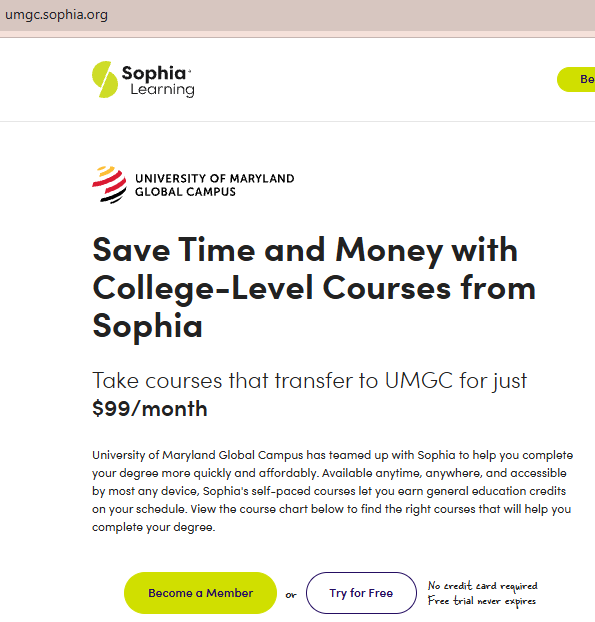
The process looks even more formalized at University of Phoenix.
Students are told to consult their academic counselor before enrolling in Sophia, and completed Sophia transcripts are sent automatically back to Phoenix. A student profile on University of Phoenix’s website highlights one student working with an academic counselor to speed up her degree and cut its cost. The counselor worked with her on which courses to take and the deadlines for transferring them back.
University of Phoenix in its 2025 Academic Annual Report actively spotlights the usage of alternative credit providers. The report says that “we help students reduce their costs by accepting lower-cost, self-paced, online general education and elective courses through approved learning partners StraighterLine, Sophia Learning and Study.com”.
The report notes that 6,567 students used alternative credentials in fiscal 2025, earning 92,939 total credits and saving students $37M in tuition. Phoenix had 88K students at the time. Assuming that the data are comparable, this suggests that 7% of its student population used alternative credentials. That works out to about 14 credits per user, or close to five courses each.
What’s most interesting is that over the past five years, the ratio of credits taken to the number of students using credits has risen at the University of Phoenix.
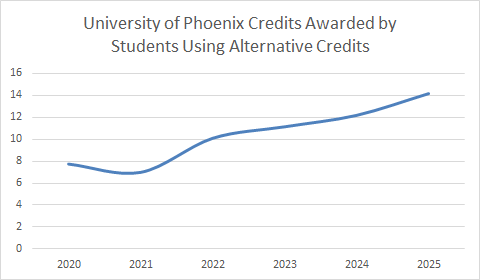
The data above doesn’t exactly support my thesis regarding the unbundling of online higher education. 14 out of 120 credits from an institution that actively uses Sophia in its workflow doesn’t exactly prove my point.
Let’s see what happens in ten years though. Sophia and its peers benefit from network effects. A positive feedback loop exists of more students taking the courses, more institutions accepting those credits, social media chatter on the benefit of taking courses, and so on.
This is what the unbundling of higher education looks like in practice. Institutions aren’t fighting for every credit hour. They are trying to get more students to the finish line, because a student who graduates is worth more than the tuition on a few general education courses.
I need to acknowledge that unfortunately, many of the largest online universities don’t provide the level of transparency that University of Phoenix does regarding its enrollment base. Why? No idea. This is an aside, but it’s very disappointing. So thus far we only have one data series at one specific institution. We have to do with what we have.
The Academic Integrity Controversy and Sophia’s Response
This all sounds great. Right up until one intrepid Washington Post reporter examined how quickly students could complete Sophia’s self paced courses and to what degree AI and other tools could game the system.
Improved completion rates mean nothing when institutions and the industry question the academic integrity of courses.
In one afternoon the Washington Post reporter completed two courses. He noted that Sophia was unproctored and open book, and a student could keep two browsers open and use CTRL-F to find assessment answers. Students interviewed by the Post described using Google or AI, and the Post found services that will complete coursework for a fee.
Sophia Learning didn’t counter the Post’s claims. Rather, management took action.
They removed the option to download PDFs of the course materials. They took away the CTRL-F function to search text.
Sophia already had academic integrity controls before the Post’s reporting. But based on social media postings, it looks like management has become pretty aggressive in enforcing its policies and procedures this past summer. You can see Sophia’s 2024 course rigor FAQ here. It describes IP monitoring, keystroke biometrics through TypingDNA, Jumio identity verification, plagiarism detection and testing designed to identify AI-generated work.
Since the Post’s publication, it seems like much of the discussion on social media relates to Sophia’s detection systems and what can trigger a suspension.
A TikTok creator/influencer with close to 24K followers and 487K likes posted a video on avoiding suspension back in August. His advice, don’t: use a VPN; have someone else do your assignments; switch tabs constantly; and move through milestones and quizzes at an unnaturally fast pace.
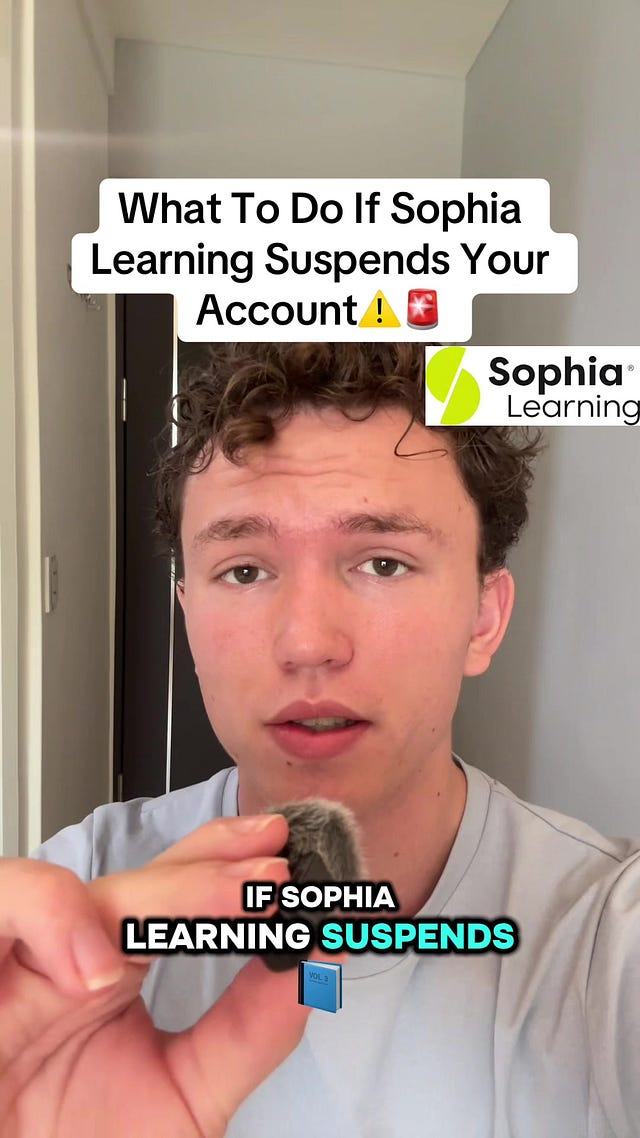
 Tiktok failed to load.
Enable 3rd party cookies or use another browser
Speed-related suspensions seem to be a real thing now. Over the past two months, two students have filed Better Business Bureau complaints about suspensions.
Users are scared. Here’s a post from a user concerned about getting flagged.
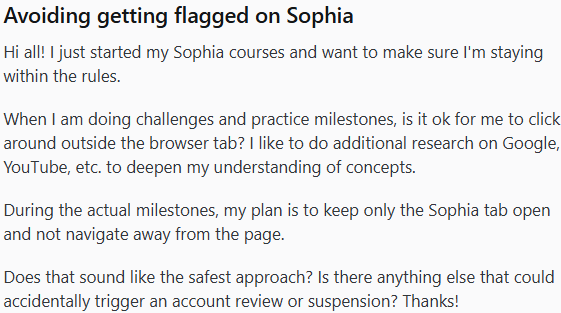
TikTok is littered with users complaining of suspensions. For example, below I pasted one comment from a student complaining about completing a course in one day.

One Reddit user posted that after completing two courses in a day, they received an email saying that they were sanctioned and their account was suspended.
Judging from Reddit posts, there’s at least a perception among some students that management may have overcorrected.
Since the Post’s reporting, institutions haven’t appeared to distance themselves from Sophia Learning. At least not publicly. No Redditor suggested that their institution encouraged them to take a competitor’s course rather than Sophia’s.
ACE hasn’t distanced itself from Sophia Learning.
Even with the press scrutiny, Sophia continues to attract institutional partners. In August, Berklee Online announced a partnership and signed a deal with Sophia.
Perhaps because Sophia is integrated into the advising process at its partners, it’s hard to displace it. Just because of one bad news cycle.
I’m sure that the days these Post articles came out weren’t the best for Sophia’s leadership, employees, and partners. But overall the reporter did a mitzvah.
A reckoning over academic integrity was inevitable. Students were bragging on social media about how fast they could complete courses. One Reddit user wrote three years ago that they had completed an anatomy and physiology I course in a day. On TikTok this past week a commenter wrote that “I finished 20 classes in 23 days. Thank God I wasn’t flagged.”
Students completing courses at such a fast pace and bragging about it on social media simply wasn’t sustainable. Media criticism was inevitable.
The reporting does change one element of Sophia’s value proposition: speed. If tighter controls mean that students need more time to complete courses, they’ll remain subscribed for more months. That could actually increase Sophia’s revenue per subscriber.
But the price advantage is large enough to absorb substantially longer completion times. A student who takes twelve months rather than six months to complete ten Sophia courses would spend roughly $1,200 instead of $600, still a fraction of the roughly $15,000 those 30 credits would cost at UMGC.
Based on what I’ve seen on social media, the leadership of Sophia and Strategic Education have handled this crisis well. They acknowledged the issue and took corrective action. The clear evidence of complaints on Reddit suggests management has implemented appropriate measures to ensure academic integrity.
It’s these tighter controls that may strengthen institutional confidence in the Sophia offering.
What All of This Means
In 2026, Brown University economics professor Roberto Serrano suspected that dozens of students had used AI to cheat on a take-home midterm. The class averaged 96%, compared with a historical range of 65% to 80%. Serrano held the final exam in a classroom setting. Eighteen students subsequently dropped the course, nine didn’t take the final, and the average among those who did fell to 48.6%.
Big picture: things happen. Academic integrity issues are everywhere, including Ivy League universities. It didn’t make for a great headline. But life moved on.
If universities are going to award credit for Sophia courses, they need confidence that the student has learned the material and that the courses are rigorous enough to warrant academic credit.
Academic integrity isn’t a problem unique to Sophia, alternative credit providers or even online education. It’s an industry-wide problem. Generative AI has made academic integrity much more difficult to police.
I started researching this piece expecting to find evidence that the Washington Post controversy had materially weakened Sophia. That students had unsubscribed. I didn’t find it.
That doesn’t mean my original concern was wrong. Sophia’s growth could still slow as a result of the changes it has made.
From my research though, I now realize that, for years, I’ve underestimated the long-term strategic value of the business.
I’m still not buying STRA stock. I sold the stock because of my concerns about the rest of the company, on university student acquisition challenged by changes in search and discovery by prospective students. Those concerns haven’t disappeared. But on a sum-of-the-parts basis, I now believe Sophia is worth far more than I thought it was when I wrote about the company in July.
Sophia generated $20.7M of revenue in the most recent quarter. Annualizing that yields $83M of run-rate revenue. Put a 5x revenue multiple on Sophia and the business would be worth $414M. That equals about 24% of Strategic Education’s $1.7B enterprise value. That’s for an asset still growing revenue north of 25%. If Sophia continues to grow at its current revenue clip, it could be worth over $650M in two years, equal to 40% of the company’s current enterprise value. You might be reading this and asking, why 5x revenue? That’s a software multiple. You can easily say an assumed 50% margin equals close to $40M. At a fifteen EBITDA multiple that’s a valuation of $600M today. The point is that you have this great growth asset embedded in a low-growth company.
Study.com and StraighterLine are privately held companies. I’m now thinking that they represent incredibly interesting acquisition targets for strategic and/or private equity investors. As an investor, I’d want to own the platforms capturing an increasing share of the credit hours that universities historically delivered themselves.
The key question now is, how far can Sophia and its peers take the unbundling of higher education?
Do me a favor. If you’ve made it to the end of the article, please provide a comment if I’m on the right track. I have to imagine that academics and university leadership have an opposing perspective. Please let me know where I’m wrong.
Also, please share this with as many people as possible.
Lastly, if you find this sort of writing interesting, please consider subscribing. The purposes of these pieces is to establish thought leadership.
Disclosure: I do not own shares of Strategic Education (STRA) or Phoenix Education Partners (PXED), but I previously bought and sold those stocks. This article is for informational purposes and is not investment advice. Do your own research.
Ariel - my doctoral dissertation was about how to measure retention at an online university and I’ve published several articles as well. The most successful students matriculating at an online university are those that transfer credit. Years ago, APUS and UMGC contributed to a study of successful students for the Department of Defense’s DANTES organization. I believe the conclusion was that because of the number of students able to “test drive” online programs, retention should be measured after a student completed 15 credit hours at an institution. Many of those early dropouts were “swirling” students. Getting them to complete a full semester (15 credit hours) even when they were part-time was an indicator of their seriousness. Both UMGC and APUS used to publish their completion rates using those parameters. Naturally, they are much higher when you eliminate the “one and done’s, the swirlers, etc.” At the same time, it’s a way for institutions interested in improving persistence and completion to track the progress as well as intervene when appropriate to improve outcomes for students.
You’ve likely seen this, but an interesting attempt at an internal alternative to Sophia that’s actually a better financial option even if you transfer them to a different institution:
https://www.wgu.edu/single-courses.html