

Just when I thought I was out, they pull me back in.
Yes, once again I’m writing about education stocks, but only because the sector became considerably more interesting this past week.
While I was at the beach last week, University of Phoenix parent Phoenix Education Partners (PXED) reported its fiscal third-quarter results and lowered its full-year revenue guidance. Publicly traded postsecondary education stocks subsequently declined by an average of roughly 14%.
Management attributed its weaker revenue outlook primarily to changes in search and discovery.
CEO Chris Lynne explained:
“What we are seeing is a change in how prospective students evaluate their options. We’re seeing longer, more iterative evaluation processes as AI-powered search becomes more a part of the evaluation journey.”
Management’s explanation is that underlying demand for University of Phoenix remains strong, but prospective students are taking longer to make decisions as they incorporate AI tools into the evaluation process.
That is a plausible explanation.
Investors punished the other publicly traded higher education names, including Grand Canyon Education, which I own. As perhaps they should. If search and discovery is extending the enrollment cycle for everyone, then forward estimates are at risk of going down. If.
In this piece, I suggest that Phoenix management may have identified a symptom rather than the underlying problem. If I’m right, the market’s read-through to the rest of the sector may be too broad, and some high-quality companies may be considerably less exposed than Phoenix. In turn this may create an attractive entry point for some great higher ed names.
LLMs Clearly Posed a Risk to Enrollments at For-Profit Higher Ed Institutions Before Last Week
Back in March, I published two related pieces about how AI-powered discovery could affect higher education institutions:
AI Discovery Is Rewriting University Marketing—and Incremental Change Isn’t Enough
LLM Bias Against For-Profit Universities Could Reshape the Industry
My thesis was that LLMs would not merely change the interface students use to find schools. They would change which institutions students consider and, potentially, which institutions they ultimately choose.
The crux of my argument: LLMs provide explanations, comparisons and recommendations, an upgrade from traditional search engines which just provided a ranked list of links.
That is a fundamental change in the enrollment funnel.
Under the old model, a prospective student might search for an online degree, click on a paid advertisement, land on an institution’s website and submit an inquiry. The institution could then control much of the information presented during the enrollment process.
Today, a prospective student can ask an LLM whether a particular institution is a good choice. The model can discuss reputation, tuition, employer perception, outcomes and historical controversies.
That would introduce meaningful risk to for-profits given years of sector critiques and attacks by regulators, politicians, and advocacy groups.
LLMs can also introduce alternatives the student had not previously considered.
LLMs are not just sources of information. Increasingly, people treat them as trusted advisers.
For example:
AI isn’t an input in an evaluation process. For some, it’s the arbiter of what the consumer ultimately chooses to do.
So presumably it’s a pretty big deal if an LLM advises a user to consider nonprofit alternatives to for-profit institutions.
Are Prospective Students Taking Longer - or Making a Different Decision?
If the enrollment process is simply taking longer, then the disruption may largely be a timing and marketing-efficiency issue.
Prospective students remain interested and eventually enroll, but require more time, additional website visits and potentially more marketing touches before starting.
Financially, this means the delay of revenue recognition and incremental student-acquisition spending.
That would hurt for a few quarters, but it wouldn’t necessarily represent a fundamental deterioration in the business model.
In the case of Phoenix, management didn’t provide enough information for investors to determine whether that’s actually what is happening.
Management on the call didn’t disclose:
New-student start growth
Changes in lead-to-enrollment conversion
The age or size of the enrollment pipeline
The eventual outcome of students taking longer to decide
Conversion rates for AI-influenced prospects compared with traditional search leads
So there’s quite a bit that investors don’t know.
The absence of data likely contributed to the market reaction we saw last week. Investors had little choice but to apply Phoenix’s experience broadly across the sector.
To be clear, I’m not disputing Phoenix management’s assertion. Yes, they are likely seeing a lengthening of the decision process.
The question is why. Why now? What has changed? The internet already contained a wealth of information, so what is altering prospective-student behavior?
My alternative explanation is that prospective students may be taking more time because LLMs surface negative information and encourage users to evaluate additional institutions.
That introduces more competition into the process and could ultimately reduce conversion rates for institutions the models present less favorably.
The longer decision cycle may be the symptom.
The expanded consideration set of institutions may be the underlying cause.
Other Operators Are Seeing the Same Shift
Grand Canyon Education CEO Brian Mueller made a similar observation on the company’s first-quarter 2026 earnings call:
“The lead generation environment is definitely being impacted by the increasing numbers of people using artificial intelligence rather than an organization’s website to gather information that they will use to make important purchases and life decisions.”
That means that by the time the student enters the enrollment funnel, an LLM may already have framed the institution, raised concerns and introduced competing schools.
Test the Bias Against Undifferentiated Online Schools Yourself
Here’s an exercise you can run - open an incognito browser window to reduce the effects of AI personalization and enter the following searches into Google:
“I am considering applying to University of Phoenix. Should I?”
“I am considering applying to Grand Canyon University. Should I?”
“I am considering applying to Western Governors University. Should I?”
The Google AI Overviews responses are notably different.
In repeated searches involving University of Phoenix, Google frequently provided a dedicated section presenting “alternatives to consider.”
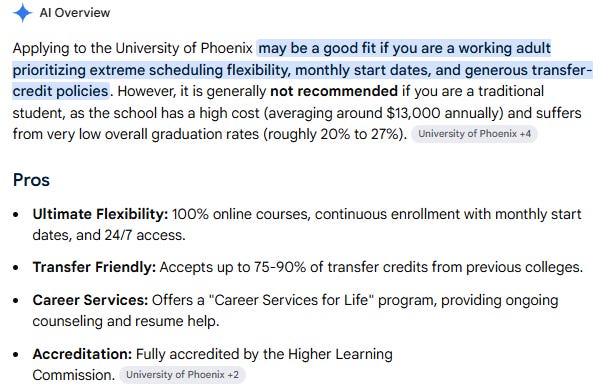
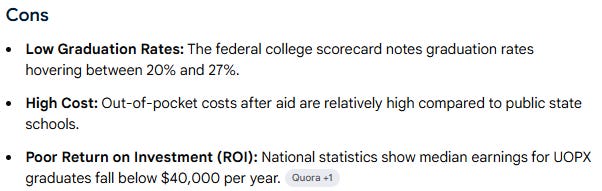
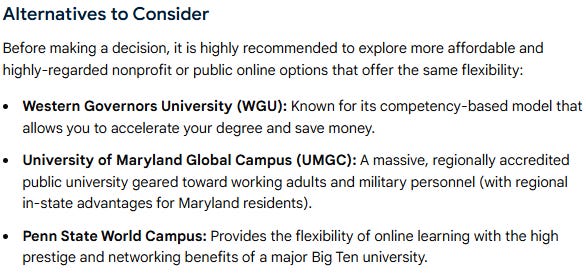
The prospective student did not necessarily ask for alternatives. Yet Google’s AI system introduced additional institutions into the decision process.
Assume that a group of a thousand people enter this query to Google. What percentage do you think would follow Google’s advice to explore alternatives? One? Two? Ten? One hundred? More?
Google isn’t just providing alternatives though. It’s providing “Cons” on why not to go to the school. Which is fine in the scheme of things, particularly if they are offering “Cons” to nonprofits (from what I’ve seen they tend not to). The Cons surfaced by Google appear to rely on factually outdated and incomplete information. It seems like clear intentional misrepresentations.
Google AI references “low graduation rates” as a “Con”. It doesn’t mention that the graduation rate (21-28%) is for first-time full-time undergraduate students who complete their degree within six years. These students represent a small fraction of their total student population, who tend to be working adults. Critics attacking Phoenix and other for-profit institutions have historically relied on an analytically weak framework that did not capture the reality of their student populations.
Is Google’s “Con” regarding graduation rates fair? I don’t think it’s fair or appropriate, but that’s just me. Don’t trust me. Trust Google. I asked Google if it was appropriate to use this data. Here is the AI output:
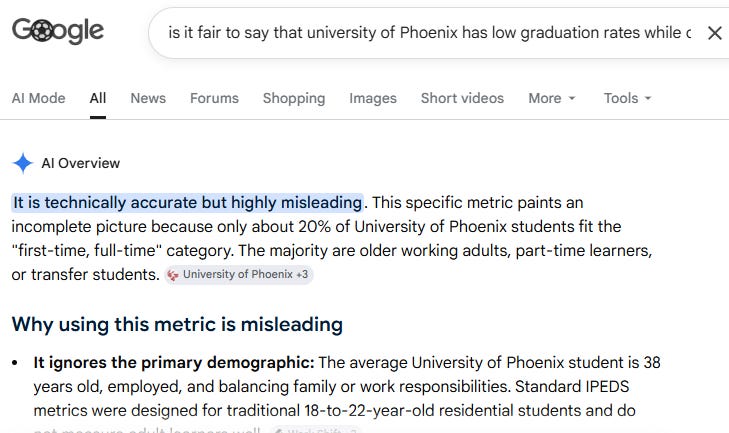
Ah, so Google says it’s technically accurate but highly misleading. And yet, Google AI provides this info to prospective users.
University of Phoenix tuition interestingly is pretty competitive to state institutions these days. That wasn’t always the case. The institution over the past decade as part of its quality enhancing initiatives lowered its tuition. But not according to the Google AI Overviews information, per the screenshot I posted to this article.
This is what I mean when I say that there are decades of legacy baggage stored across the web that are damaging to the reputation of for-profit institutions and potentially affecting enrollment growth.
What makes this especially striking is that University of Phoenix is allegedly one of the top 100 ad spenders on Google. Phoenix pays Google significant amounts to reach prospective students. Yet, Google’s AI product actively undermines its own premium advertiser. In what world does it make strategic sense for a platform to divert traffic away from the client keeping its lights on?
Does Google engage in this same sort of behavior for nonprofit schools? Not that I’ve seen.
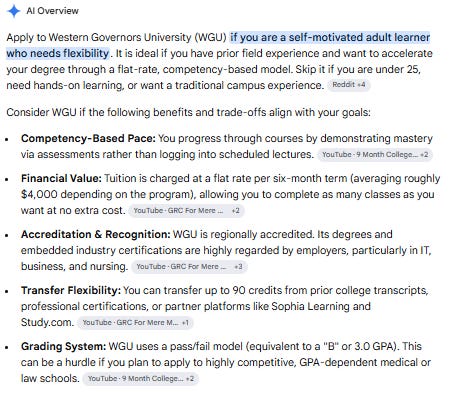
Western Governors University generally received a much cleaner assessment, without the same emphasis on alternatives.
Grand Canyon University produced a more complicated result.
The institution was converted to a for-profit close to twenty years ago, and then split into a nonprofit university and a for-profit service provider. Only recently has the US Department of Education recognized the university as a nonprofit.
Google AI Overviews still calls the institution a “for-profit Christian university”. That’s false information.
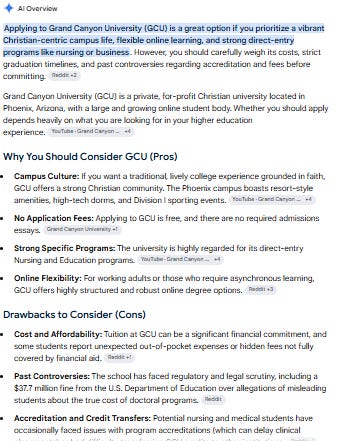
That illustrates the problem with AI-generated discovery: models can perpetuate outdated classifications or historical narratives even after the underlying facts have changed.
In the case of Grand Canyon, this is a discoverability issue that their management teams should address by ensuring that accurate authoritative explanations of the university’s nonprofit status are consistently available across the sources AI systems rely upon.
Ultimately, the issue here is whether AI LLMs are influencing which institutions enter the student’s consideration set before the institution ever receives an inquiry. In a world where users rely on LLMs for recipes, financial advice and medical guidance, it seems reasonable to assume that these tools are materially influencing where people apply to school.
Sector Participants Will Not Be Affected Equally
All sector participants saw their stocks fall, potentially creating an opportunity because the exposure I’ve described likely varies, perhaps significantly, by business model.
A prospective student considering an online business, technology or general education degree may have dozens of nonprofit alternatives. An LLM can easily compare institutions based on price, reputation, flexibility and perceived employer acceptance.
This makes University of Phoenix, Perdoceo Education’s online institutions like American InterContinental University and Strategic Education’s Strayer University particularly relevant to the discussion.
Running my own non-scientific experiments, LLMs provide critiques and alternatives to these online institutions that have clear substitutions.
Campus-based career education might be better protected.
Students pursuing automotive, welding, skilled-trades or hands-on healthcare programs generally need access to physical facilities, laboratories, instructors, clinical placements and local employer relationships.
An LLM can recommend another institution, but the practical alternatives are constrained by geography, program availability and required in-person instruction.
That should provide some insulation to operators such as Universal Technical Institute and Lincoln Educational Services, as well as companies operating differentiated campus-based healthcare programs like APEI’s Rasmussen University.
This may create an investment opportunity if the market continues to treat every publicly traded education company as though it has the same exposure.
Conclusion: Transitional Delay or Redirection to Competition?
Phoenix management may ultimately be proven correct.
The current disruption they are experiencing may be transitional. Students may simply require more time to evaluate their choices before enrolling, while conversion rates and long-term demand remain intact.
But management has not yet provided enough evidence to establish that conclusion.
My alternative thesis does not contradict management’s observation that the enrollment journey is lengthening.
I am suggesting that in addition to this, LLMs are changing the student’s consideration set, influencing how institutions are perceived and directing some prospective students toward alternatives.
No, I don’t have data proving that this is happening.
But readers can directly observe meaningful differences in the responses generated by AI LLMs. We know that consumers are increasingly relying on those tools when making consequential decisions.
So what should investors do?
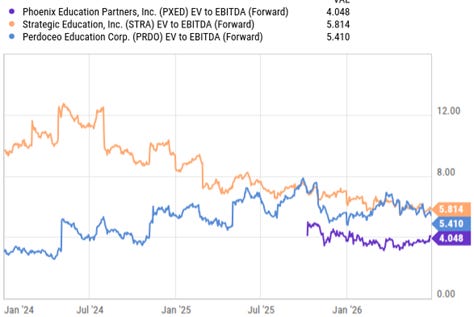
For the time being, I am avoiding owning stocks of companies that operate primarily online institutions. Yes, they trade at relatively inexpensive valuations below 5x EV/EBITDA. But I believe they may be the most exposed to LLM-driven competition and bias.
Note that I wrote for the time being. I actually like how these companies are positioning themselves for the future.
These companies are undergoing a meaningful business-model shift by sourcing more students through employers. That shift should improve student outcomes, strengthen their regulatory standing and reduce their dependence on consumer Internet searches. Personally, I think these companies become considerably more attractive once employer-affiliated students represent more than 60% of enrollment. That is my own threshold. Given their strategic focus on employer channels, and potentially M&A to accelerate this transition, I believe some of these companies could approach that level within the next few years.
You can see from the chart below that these stocks are converging to EV/EBITDA multiples of around 5x.
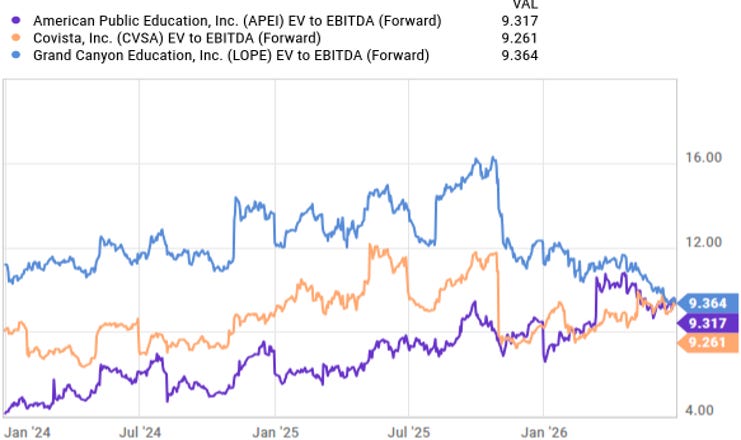
I own Grand Canyon Education, which provides services to Grand Canyon University, because the underlying university it serves is a nonprofit. I think that it’s less exposed to the bias of LLMs than its peers. Not immune, just less exposed.
I’m also looking for a better entry point into Covista, owner of Chamberlain University, arguably the best asset in all of higher education because of demographic tailwinds benefitting nursing education. It’s the largest nursing school in the country.
American Public Education also looks interesting given its ownership of Rasmussen University. APEI’s primarily online model for its American Public University asset means the AI-discovery risk should not be dismissed.
I think that these companies may trade between 7-15x EV/EBITDA. I think that these companies have the best risk/reward characteristics of the postsecondary stocks.
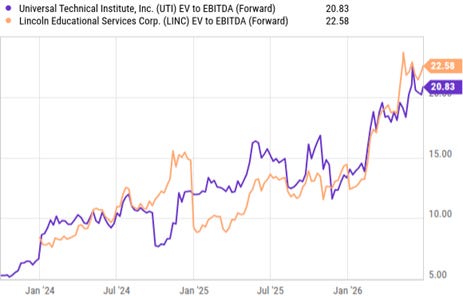
The best growth stories of the sector are the vocational-school providers, like Lincoln Educational Services and Universal Technical Institute. They train folks for jobs less susceptible to the ravages of AI. The key problem with these stocks is that they now trade at premium valuations. Which means it wouldn’t take much to see their multiples compress if bad news for the companies materializes. I would become more interested in these stocks if an earnings disappointment caused their valuations to compress.
10-15x EV/EBITDA may make a great entry point for these stocks.
Big picture, I think that AI creates an incredible opportunity for postsecondary providers to thrive as working adults seek credentials in a world of AI job displacement. Given the favorable administration from a policy/regulatory perspective the stocks could potentially do quite well.
But industry participants and investors need to acknowledge the anti-for-profit bias of LLM providers and the potential harm they are doing from a student acquisition perspective.
*************************************************************************************************************
Update 7/20
The Google AI Overview responses for Grand Canyon University no longer suggests that its a for-profit. I created multiple posts on Reddit correcting other posters by saying that it’s a nonprofit. I also created a post on Reddit explaining quite clearly that its a nonprofit.
The fact that I, but one humble industry analyst, could shape how Google AI Overviews characterizes an institution because of Reddit posts should be a somber moment for anyone who cares about how folks can be potentially manipulated by bad actors. I acted as a good actor in this case, but imagine companies badmouthing each other on Reddit. Or political parties fighting it out on Reddit. Scary.
*************************************************************************************************************
Disclosure: I own shares of Grand Canyon Education (LOPE). I do not own shares of any of the other companies mentioned in this article.
Disclaimer: This article is provided for entertainment purposes only and should not be considered investment advice or a recommendation to buy, sell or hold any security. Any discussion of potential investment actions reflects only what I may consider doing based on my own circumstances, risk tolerance and analysis. It is not intended to suggest what any reader should do. Readers should conduct their own research and consult an appropriate financial adviser before making investment decisions.
Ultimately I suspect the HE sector is becoming democratic. Choices will be made based on quality and performance. As well as career success. The days of hard sell marketing are probably over and HEIs will likely need to charge for outcomes more and more. Their quality vs cost will be far more emphasized. This is all good for students. Not so good for rolling in numbers, collecting fees and then paying little attention to student support and real quality teaching and learning. Will also be the same for schooling over time.