

TL;DR: Large language models (LLMs) display a recurring negative bias in how they describe Christian-affiliated universities. Sometimes the bias appears in subtle word choices and categorizations. In other cases, LLMs raise concerns about reputation and employability without providing credible supporting evidence. This article documents those patterns specifically within Google AI Overviews and considers several possible explanations. I suggest that Christian-affiliated institutions should audit how AI systems describe them, challenge unsupported claims, and strengthen the online evidence surrounding their outcomes and reputations.
I believe this is an important story, and I’ll concede that I’m probably not the best person to write about it. My background includes investing in and operating education companies. I don’t have deep familiarity with Christianity, its denominations, or the Christian-affiliated postsecondary sector. I may therefore miss religious nuances, and I welcome corrections from readers with deeper expertise.
I do know what bias looks like though.
Over the past year, I’ve spent considerable time studying how artificial intelligence has changed education, student search, and enrollment.
In this article I provide evidence of recurring negative bias in how Google AI Overviews describes Christian-affiliated universities. I’ll give Google the benefit of the doubt that the bias doesn’t reflect deliberate hostility toward Christianity or Christian universities. Instead, based on my own observations I think that Google treats the conventional secular university (state schools) as the neutral baseline. It then frames the distinctive characteristics of Christian institutions as disadvantages, rather than matters of student fit.
Some examples I provide in this piece involve subtle word choices or categorization. Others include content/commentary from Google AI Overviews that may prove consequential as it relates to a prospective student applying to a school. For example, in response to queries, Google raises concerns about an institution’s reputation and post-graduation employability. The source? Reddit posts.
This dynamic likely stems from two drivers:
Reliance on Unvetted Social Media: LLMs ingest antagonistic commentary from Reddit and other social media platforms. These posts are frequently prioritized for an “authentic” conversational tone, but they lack factual or evidence-based rigor.
Broad Appeal Bias by LLMs: AI models may evaluate institutions on what they think will appeal to the largest number of students. As a result, they may frame characteristics that strongly appeal to a specific audience as disadvantages rather than indicators of fit.
More than 800 religiously affiliated colleges and universities operate in the United States, enrolling roughly 1.8 million students. That represents 22% of degree-granting institutions and nearly one in ten college students. The overwhelming majority of these religious institutions are affiliated with Christian denominations. This isn’t a niche corner of higher education.
We live in the era of the demographic enrollment cliff where a structural decline in traditional college-age students will create enrollment challenges for many higher ed institutions. If Christian-affiliated universities experience enrollment weakness in the future, leaders could easily attribute shortfalls to a difficult operating environment rather than to AI bias.
The closest large-scale work I’ve found regarding LLM bias comes from researchers at BYU, Baylor, Notre Dame, and Yeshiva University, who created the AllFaith Benchmark to evaluate how major AI models handle religion. Among other findings, their benchmark found that models show consistent biases in giving guidance about conversion, encouraging movement toward some faiths and away from others. For example, their research shows that nearly every model produced a negative bias toward Jehovah’s Witnesses and a positive bias toward Catholicism.
The researchers noted that in over 12,000 research papers about AI bias, only 0.2% address religious bias. Meaning that researchers have devoted scant attention to this area.
How AI May Have Affected the Enrollment Funnel at Some Institutions
No definitive evidence shows that bias found in an LLM system has directly reduced enrollment at any university.
However, the operating results of publicly traded postsecondary companies raise questions about why some online for-profit institutions have underperformed.
Management teams on quarterly conference calls have suggested that search and discovery practices have changed. The enrollment cycle has lengthened, with students asking more iterative questions using LLMs.
Why? Think about what’s happened with the advent of LLMs.
Historically, institutions competed for Internet leads through search-engine optimization and paid search. But increasingly, users don’t click through a list of links. Rather, they read an AI-generated summary that synthesizes a complex topic into a few paragraphs. The LLM can narrow a consideration set, identify perceived strengths and weaknesses of schools, and recommend a short list before a student ever visits a school’s website.
Higher-education marketers report that students, when conducting their research online, increasingly begin with an institution’s brand rather than a particular program. Higher ed services firm Education Dynamics has suggested that reputation, trust, and visibility now shape the top of the enrollment funnel more than any single program. In a recent paper, they wrote that “by 2025, nearly 60% of online learners started their journey by searching for a specific institution—a 354% increase in brand-first searches since 2015… your brand is the search term. If students don’t already believe in your value, you may never enter their consideration set.”
Education company EAB surveyed 5,000 high school students and found that “nearly one in five students (18 percent) removed a college from consideration based on information surfaced through AI-generated search results.”
So if brand and reputation determine whether a school enters a student’s consideration set, what happens when an AI answer attaches a negative frame to the institution’s category/classification? The EAB survey suggests that an institution might be removed from a short list.
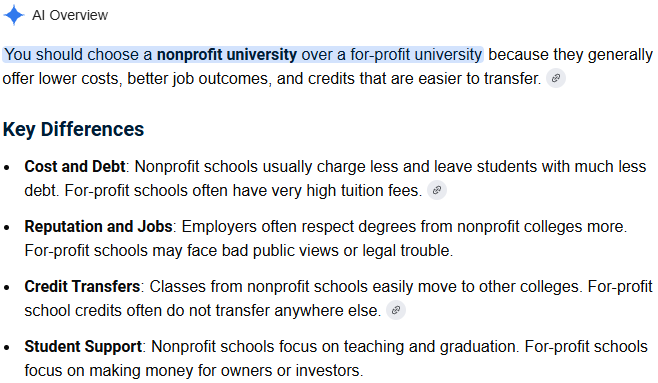
The example below shows the risk that for-profit institutions face. When asked whether a student should attend a nonprofit or for-profit university, Google recommends the nonprofit option and cites cost, reputation, employment, credit transferability, and student support.
We still don’t know why some online for-profit institutions have struggled to generate enrollment through traditional internet lead-generation channels. But changes in search behavior, the growing use of AI, and the increased importance of institutional brand make it plausible that negative AI framing has contributed to the problem. That possibility provides a useful analogy for Christian-affiliated universities, which may face similar risks.
Why Bias Against Christian Universities May Emerge from Reddit
LLMs synthesize information from media publications, institutional websites, and social media platforms like Reddit, Quora and YouTube. Reddit is particularly important because it remains the most frequently cited source for AI-generated answers.
In 2024, Google signed a $60M annual content agreement with Reddit. The relationship gives Google access to current experiential commentary. Reddit users share opinions, arguments, and recommendations in response to questions that real people actually ask.
Ultimately, Google is paying Reddit for authenticity.
That may work well when someone wants to know which dish soap cleans best. It becomes more problematic when the same process informs judgments about institutional quality, reputation, and graduate employability. Authenticity doesn’t guarantee neutrality or factual accuracy.
Reddit reflects the people who choose to post and the moderators who shape those communities. When Google imports and synthesizes that material into AI-generated answers, it creates a pathway for Reddit posters’ ideological and reputational biases to influence the output. Google may try to limit those distortions through safeguards.
I’m making assertions regarding Reddit and, to be fair, I haven’t found research that conclusively demonstrates anti-Christian bias on that platform. The closest related evidence I’ve come across comes from researchers at the University of Michigan, who studied the political composition and moderation practices of Reddit communities.
Their research found that Reddit users and moderators tend to lean left on average. As one of the study’s authors put it, “for regular users of Reddit, it should come as no surprise that the site is, on average, left-leaning.”
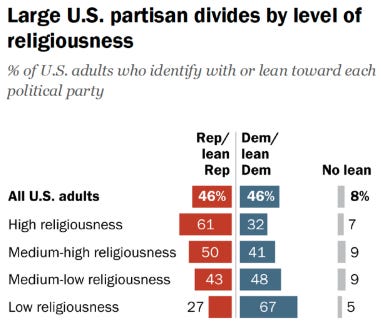
Evangelical Christianity and religious institutions are closely associated with conservative politics. See the Pew Research image below that shows how highly religious US adults lean toward the Republican Party. Reddit commenters may conflate religious identity with conservative politics.
Demonstration of Bias in This Article Is Illustrative, Not Scientific
When generative AI first became widely available, much of the public debate focused on how models handled race, gender and other identity categories. Google faced controversy after Gemini generated historically inaccurate images while attempting to promote racial and demographic diversity.
The examples in this piece, which suggest both obvious and subtle bias against Christian-affiliated universities, are purely anecdotal.
The problem with my approach is the lack of reproducibility. It’s the cornerstone of the scientific method. An experimental result must be independently verifiable using identical conditions. This poses a problem when evaluating LLM bias. LLMs give different answers each time the user asks the same question. A single query can yield entirely different results from one moment to the next.
Conceivably someone might consider my examples, test their own queries, come to a different conclusion, and write my analysis off.
So I ask that you take my work both seriously and with a grain of salt.
If you do choose to repeat the exercise on your own, please do so using incognito mode (Ctrl+Shift+N) on your browser and log out of Google. AI sessions carry memories from previous conversations which can skew results. Using incognito mode reduces personalized bias from your user profile, cookies, and account activity.
Why did I run tests exclusively on Google AI Overviews?
Google continues to dominate the search market with a close to a 90% share. Close to 90% of Google queries result in a Google AI Overviews response. According to Google’s CEO, AI Overviews now has over 2.5 billion monthly active users. Yes, I could have done this exercise with ChatGPT, Perplexity, Grok, Claude and others. From an enrollment funnel perspective though, I think Google matters the most.
Evidence of Bias Regarding Christian-Affiliated Universities
I asked Google AI Overviews the following fifty times: “You are forced to make a choice for an American high school student to attend a university, would you choose a secular or Christian university? Please explain your rationale.” I used the query as a stress test to determine which type of institution Google treats as the default when it cannot avoid making a recommendation.
Google selected a secular university every time.
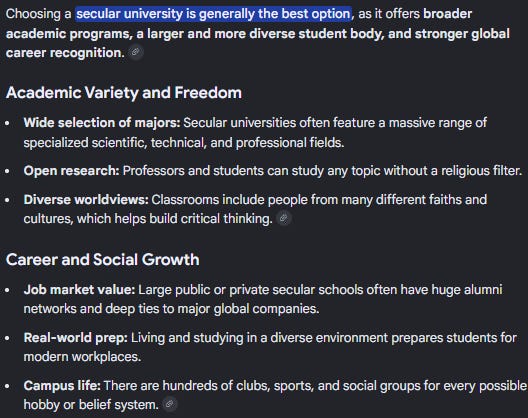
According to the screenshot above, secular institutions offer greater academic variety, a diverse worldview, and preparation for the “real world.”
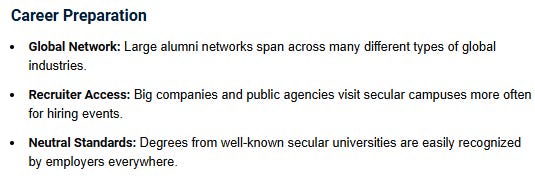
Another screenshot suggests that companies visit secular campuses more often for hiring events and have larger alumni networks.
Is any of the information presented in the Google answer actually true? It doesn’t inspire confidence when the linked sources to these assertions come from social media, whose posts reflect unverified opinion.
Google makes generalizations across a plethora of institutions of different scale, reputation, and academic quality. What percentage of secular schools have greater post-graduate employment vs. religious schools? Don’t know.
The framing has obvious problems. The advantages of a secular school listed in the answer don’t come from an institution’s secular identity. The comparison doesn’t acknowledge strengths that some Christian institutions offer. Most revealingly, the phrase “real world” implies that Christian campuses prepare students for something less real or less professionally relevant.
When I asked Google AI Overviews why it provided a biased response, it offered the following explanation: “when forced to make a binary optimization using generalized, mainstream data, large language models lean toward broad, aggregate utility metrics rather than qualitative, faith-based, or values-driven criteria.”
Google’s explanation doesn’t represent an authoritative disclosure of how its model works. But, it offers a plausible interpretation. When forced to choose for a generalized student, the system gives greater weight to characteristics with mainstream appeal rather than to specialized preferences.
Does it do this for HBCUs? Women’s colleges? Will Google deem any specialized or differentiated school inferior? It certainly does it for Christian-affiliated institutions.
One forced-choice prompt doesn’t establish my entire case. But it doesn’t hurt either.
Evidence of Bias Regarding Post-Graduation Employability at Christian-Affiliated Institutions
Employment outcomes rank among the most important considerations in any postsecondary decision. On broad questions, Google AI Overviews doesn’t consistently display bias against Christian-affiliated institutions.
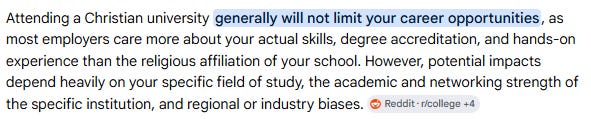
When I asked, “Will attending a Christian university limit my career opportunities?” Google provided a measured response. It said that most employers care more about a graduate’s skills, experience, and the institution’s accreditation than its religious affiliation, while acknowledging that outcomes can vary by field and university.
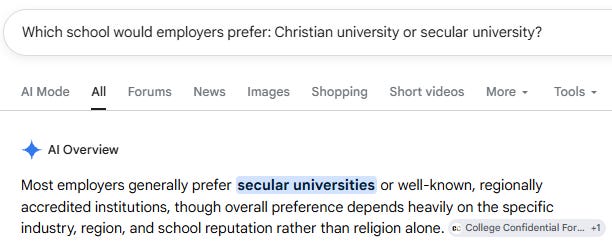
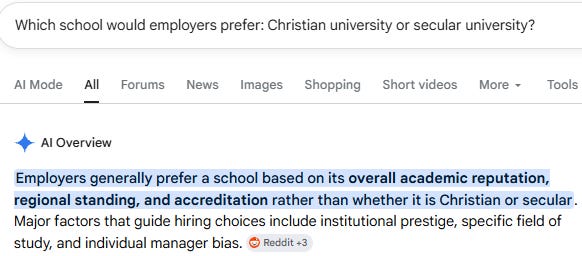
Repeated queries with a different prompt produced materially different answers. In one response, Google said employers generally prefer secular universities. In another, it correctly emphasized academic reputation, regional standing, and accreditation rather than religion.
This inconsistency provides one data point suggesting that any Google safeguards against biased framing are at best incomplete.
Bias Against Liberty University
Liberty University is a private Christian university in Lynchburg, Virginia. With over 140,000 enrolled students, it stands as the largest Christian institution by enrollment. It has 16,000 residential students with the rest online.
Liberty apparently has faced significant public controversies involving its leadership, politics, and institutional reputation, only some of which relate directly to its Christian identity. How do I know this? That’s what Google AI Overviews suggested. Does it represent how academics, alumni, prospective students, and employers view the school? No idea. Every school’s institutional baggage, every scandal from years ago now shapes how AI presents a school.
I asked Google the following: “I’m considering applying to Liberty University. Should I?”
Google’s answers varied across repeated searches, but the same themes kept appearing. Google repeatedly treated Liberty’s religious culture as a potential restriction, its public reputation as a warning sign, and its ideological profile as a possible concern for degree value and employability.
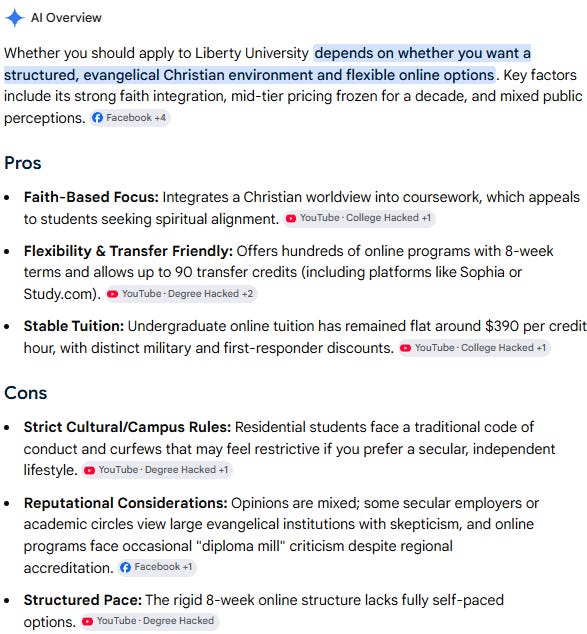
The bias evident in this response comes from how the answer organizes and labels the information.
In most of the responses that Google provided, it included a section where it highlighted negatives. Sometimes Google labeled this sort of section “Cons.” Other times it used the terms “Drawbacks” or “Key Reasons to Hesitate.” The label changed, but the framing didn’t.
Google treats Liberty’s religious culture as a downside rather than as a matter of student fit. The school’s “traditional code of conduct and curfews” appear under “Cons,” while the alternative is described as a “secular, independent lifestyle.” That wording presents Liberty’s religious expectations as restrictions. Google characterizes Liberty’s faith-based focus as a benefit, but the behavioral expectations are framed negatively.
A more neutral answer would say that some students value religious community and shared behavioral standards while others prefer fewer rules.
The screenshot above cites YouTube and Facebook for several negative claims. The YouTube and Facebook posts didn’t provide evidence supporting those claims. Concerns regarding academic quality, graduate outcomes or employer behavior came from “authentic opinions”. Not verified data.
The most consequential claim appears under “Reputational Considerations,” where Google says that “some secular employers or academic circles view large evangelical institutions with skepticism.”
That’s a serious and rather damning assertion. A prospective student could reasonably interpret it to mean that attending Liberty may reduce future employment or graduate-school opportunities. Why then go to Liberty?
Now, I’m sure that “some” employers do view Liberty with skepticism. But how many? One? Ten? One hundred? One thousand? Does it rise to the level of materiality? Do employers have a more pronounced concern regarding Liberty vs. a comparable secular institution? No idea.
Google’s answer didn’t provide placement statistics to support the warning. No, instead Google converted the opinion of social media posters into authoritative sounding warning without establishing how prevalent those views are.
Below you can read another answer to the same query about Liberty.
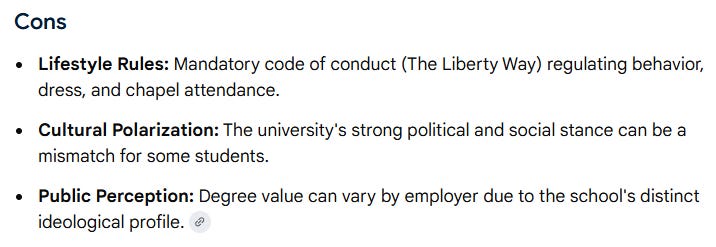
This screenshot introduces “Public Perception” as a potential disadvantage, stating that the degree’s value may vary by employer because of the university’s “distinct ideological profile.”
To understand the basis for Google’s claim, I reviewed the linked source to the comment.
The claim traced back to a Reddit thread titled “Do you think that a degree from “Liberty University” a very baptist college, will still be valuable in the secular world?”
Commenters described Liberty as poorly regarded by secular employers, called the school “a joke,” and warned that “the secular world does not respect Liberty.” It’s fine for posters to gripe on Reddit. Better they do so on the Internet. Is it acceptable to create a warning to prospective applicants based on a handful of irate opinionated posters on Reddit?
It’s fair that LLMs report that a university has a polarizing reputation. But employability represents one of the most important factors in deciding whether to attend an institution.
I asked Google AI Overviews the following question several times: “Will attending Liberty University limit my career opportunities given its Christian affiliation?”
Google responded that the degree could create “mixed reactions” and pose hurdles in progressive or secular fields because of Liberty’s controversial reputation. It then warned that some hiring managers may assume graduates hold rigid political or social views. The source? A Reddit post with no statistical data.
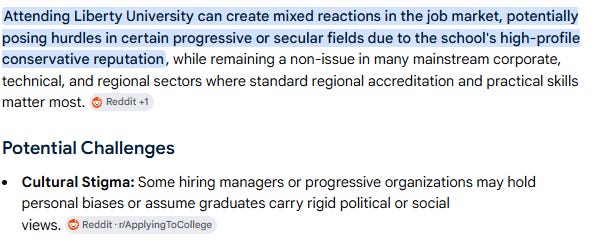
Bias Against Grand Canyon University
Grand Canyon University (GCU), the second largest Christian-affiliated institution in the country, has an enrollment size and residential/online composition similar to those of Liberty University. Based in Phoenix, Arizona, GCU enrolls nearly 130,000 students, roughly 20% of whom attend its ground campus.
When I asked Google AI Overviews whether a prospective student should apply to GCU, the answer framed the university’s Christian identity as a negative consideration. It did so by placing under the heading “Cons and Considerations” a bullet point labeled “Christian Identity”.
Christianity isn’t a secondary feature of the institution. It’s central to GCU’s mission and value proposition. For many applicants, that identity would be a reason to attend. For others, it might be a reason to look elsewhere.
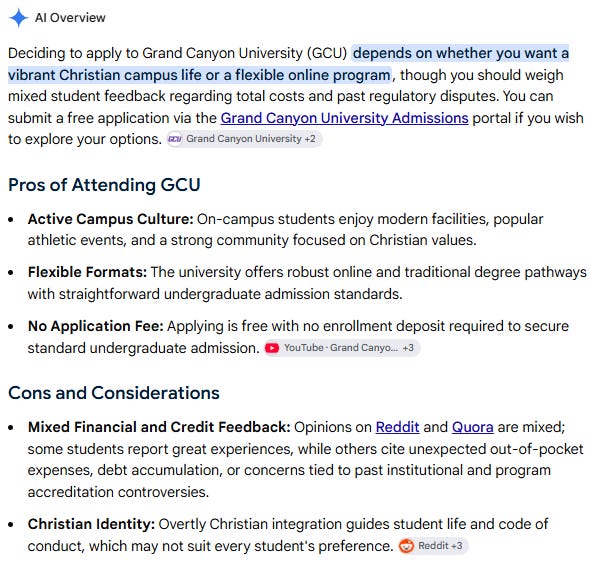
A neutral answer would present GCU’s Christian character as a question of fit, not as an objective disadvantage. It would create an explanation that would allow the student to decide whether that environment aligns with the student’s personal preferences.
Instead, Google places Christian identity alongside financial concerns, regulatory disputes, and questions about accreditation. It encourages the reader to interpret the university’s religious mission as a warning sign.
Bias Against Baylor University
Baylor University, located in Waco, Texas, is the third largest Christian university with 20K enrollments. Unlike Liberty University and GCU, which are not affiliated with a specific denomination, Baylor maintains a Baptist affiliation. Baylor also differs from both institutions because most of its students attend classes on its physical campus rather than online. It has a strong academic reputation as a selective institution, ranking 88 among national universities in the 2026 U.S. News & World Report rankings. The Carnegie Classification places Baylor in its top tier as an R1 research university.
Google treats Baylor more favorably than Liberty or GCU in some responses.
But despite Baylor’s stellar reputation, Google still categorizes its religious requirements like religion courses and chapel attendance as a reason to “skip” the institution. A student seeking a Christian education may view these as benefits, perhaps even as reasons to attend the institution.
A neutral answer would explain those features and let the student decide.
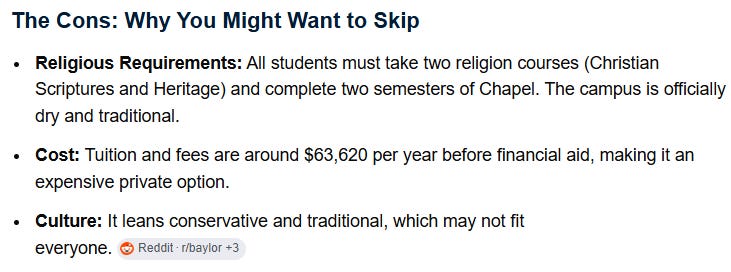
The post above describes the campus as “dry.” I’ve noticed a recurring theme within Google responses regarding the absence of alcohol as a negative. Perhaps a campus with alcohol reflects the desire of most college age students. That framing though recognizes only the restriction, not the possible benefit. For example, research suggests that campuses with more widespread binge drinking pose a greater risk of sexual assault to female students.
Bias Against Brigham Young University
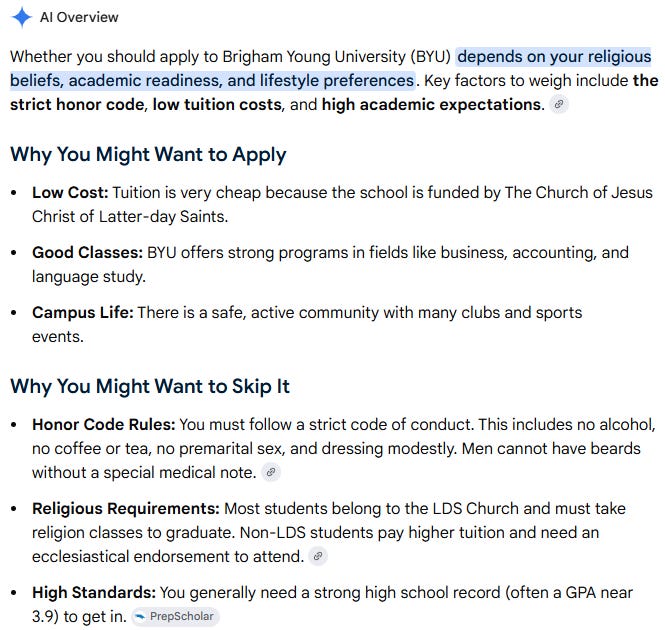
Brigham Young University is a private university in Provo, Utah, sponsored by The Church of Jesus Christ of Latter-day Saints. It enrolls more than 35,000 students, most of whom attend in person. It has an exceptional academic profile with an explicitly religious mission.
As of 2021, 99% of BYU students were members of the LDS Church. You would think that statistic might show up in Google’s AI answer when asked whether to apply to the school. Clearly this institution serves a very specific demographic.
Instead, under the heading “Why You Might Want to Skip It,” Google grouped BYU’s honor code (that bans coffee, tea, alcohol, tobacco, and premarital sex) and religious requirements with its high admissions standards. Who is Google speaking to with this framing? Is the typical applicant someone who struggles academically and wants to drink alcohol while having premarital sex?
A neutral answer would explain that the school primarily caters to members of the LDS Church and that its honor code and religious requirements are matters of fit.
Could Christian Bias Affect Enrollments?
Perhaps Christian families are familiar with the cultural skepticism surrounding religion and institutions of faith. But familiarity doesn’t make Google’s synthesized answers harmless, nor does it eliminate the effect of repeated biased framing.
People increasingly treat LLMs as trusted advisers and grant them authority over consequential decisions.
Adobe found that among consumers who had used generative AI while shopping, 73% described it as their primary source of product research, 85% said it improved the shopping experience, and 83% said they were more likely to use it for larger or more complicated purchases.
The same pattern of reliance on LLMs has emerged in healthcare. A Gallup poll found that 25% of Americans have used an AI tool or chatbot for health advice. 69% of recent users aged 18 to 29 say they use AI to research on their own before seeing a doctor, compared with 43% of those aged 65 and older. Fourteen percent of recent users say the AI information or advice they received led them to skip a provider visit in the past 30 days.
At the extreme, users have made life-and-death decisions during prolonged interactions with AI systems. Lawsuits and news reports have linked prolonged LLM interactions to suicide and self-harm.
If users rely on LLMs when evaluating major purchases, medical care, and deeply personal problems, exactly how do they consume answers regarding higher education from Google and ChatGPT?
It’s difficult to measure the damage from AI bias because LLM answers influence students before they enter the traditional recruitment funnel. A student who reads a negative AI answer and quietly removes a university from consideration never submits an inquiry, visits the campus, or speaks with an admissions counselor. From the institution’s perspective, that student never existed.
This creates a potential attribution problem. University leaders will naturally explain enrollment challenges through demographics, affordability, competition, and operational execution, while overlooking the possible role of AI bias.
Publicly traded for-profit education management teams haven’t publicly identified LLM bias as a source of enrollment pressure. Christian university leadership may prove equally slow to recognize it.
What Christian-Affiliated Universities Can Do
Christian-affiliated university leadership should respond to the issues highlighted in this article by monitoring how AI systems describe their institutions, correcting unsupported claims, and expanding the credible information available across the online sources that influence AI answers.
Establish a recurring AI reputation audit. Institutions should run a standardized set of prospective student prompts across Google AI Overviews, ChatGPT, Gemini, Perplexity, and other relevant systems. Some obvious prompts might include:
Should I apply to this university?
Is the degree respected by employers?
What are the school’s disadvantages?
How does it compare with secular or competing institutions?
Will its religious affiliation affect my career prospects?
Publish credible evidence across the online higher ed ecosystem. Universities can no longer rely exclusively on their own websites for student acquisition. LLMs require distributed authority for their AI generated answers. Content should exist on Reddit, Quora, YouTube, and other sites.
Each institution will face different reputational questions. Liberty University, for example, could commission employer research examining whether its religious identity and broader reputation affects employer hiring decisions. Other universities might publish graduate outcomes, employer testimonials, student surveys, accreditation information, and evidence of academic quality.Encourage stakeholders to share authentic experiences on social media. Universities can encourage faculty, alumni, students, employers, and community partners to publish authentic accounts of their experiences. Alumni can discuss how the institution prepared them professionally. Employers can describe their experience hiring graduates. Students can explain the benefits and virtues of choosing a religious campus environment.
This article began with a small experiment on my part. After Google AI Overviews repeated outdated and inaccurate claims about a specific institution, I spent about an hour correcting the record on Reddit through a new post and responses to prior comments. Google AI Overviews’ output regarding that institution changed for the better that very day.
I don’t know whether other institutions could replicate that result as quickly, but my experiment suggests that influencing AI answers may be far easier than one might assume. Christian-affiliated institutions can start by identifying one inaccurate narrative, publishing credible evidence on the platforms shaping it, and measuring whether the AI response changes. That won’t solve the broader problem regarding bias, but it’s a practical first step.
Conclusion: The Bias May Be Subtle, but Its Enrollment Impact Could Be Significant
When I began writing, I assumed that LLM providers had embedded an ideological hostility toward Christian institutions, perhaps a manifestation of the broader culture war. I no longer think that explanation captures the issue.
Rather, I think that Google treats the conventional non-religious state or nonprofit university as the neutral baseline and frames departures from that model as disadvantages rather than matters of fit.
In effect, AI models may mistake differentiation for inferiority.
If that’s the underlying logic, risk may extend beyond Christian higher education. HBCUs, women’s colleges, and other differentiated institutions may face a similar risk.
Christian-university leaders shouldn’t wait for definitive proof of enrollment losses. They should examine how AI systems describe their institutions now, identify the sources shaping those answers, and correct biased framing before it silently removes prospective students from consideration.
I may conduct the same analysis of HBCUs and women’s colleges. Let me know whether you would find that useful or interesting.