

TL;DR
LLMs and AI search are changing how colleges are perceived by surfacing indications of financial difficulty, including solvency concerns.
Institutional financial challenges, which were once opaque, is now immediately visible at the start of the enrollment process. Parents can now see this financial risk before ever visiting a website or engaging with admissions.
For financially weak colleges, even small declines in enrollment can trigger operating deleverage that quickly triggers a financial crisis. This creates a feedback loop: financial concerns → fewer students → worsening finances → greater concern.
Hampshire College illustrates the risk — its financial challenges and going concern warnings are now surfaced directly in AI-generated answers. Will already challenged enrollments deteriorate with increased transparency?
Institutions need to act now: understand how they appear in AI-driven search, strengthen their digital footprint and third-party validation, and develop a clear plan to address both perception and underlying financial risk in a fully transparent environment.
Higher education leaders are underestimating how quickly AI will reshape institutional durability—and in some cases, accelerate institutional failure.
Consider Hampshire College.
Hampshire College is a small liberal arts college with a distinctive, non-traditional academic model. Founded in 1970, the institution emphasizes self-directed learning, individualized concentrations, and uses narrative evaluations in place of traditional grades.
When I was at Amherst College, part of the Five College Consortium, Hampshire students clearly stood out. They were unconventional, willing to take a different path in life. The school lacked the more structured “corporate” feel of traditional elite liberal arts colleges. That was part of its appeal.
It has also faced persistent financial challenges.
In 2019, Hampshire’s auditors issued a going concern opinion, indicating significant doubt about the institution’s ability to continue operating within a one-year period. Leadership announced that the college might not admit a full incoming class and began exploring strategic alternatives, including a potential merger.
The situation escalated quickly. Students protested, occupied administrative offices, and drew national attention to the school’s future. Students occupied the president’s office for 75 days. The school drew national attention regarding the institution’s future. Filmmakers made a movie about it.
Hampshire ultimately avoided closure. It downsized operations, restructured, and raised funds to stabilize itself, ultimately surviving the pandemic as a smaller institution.
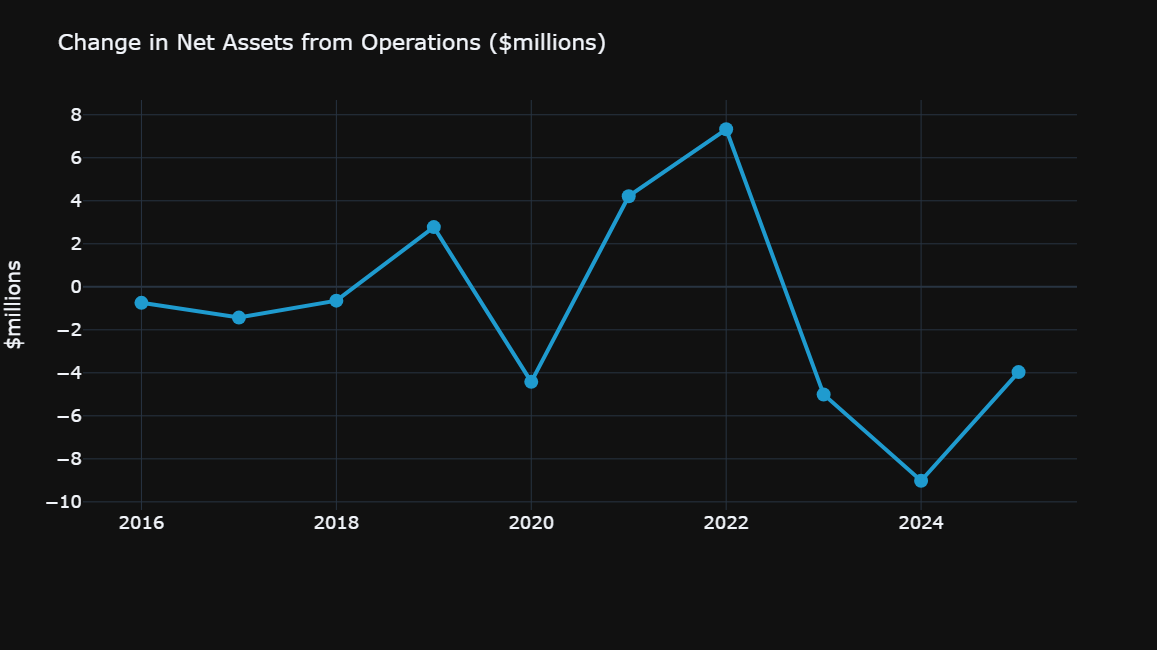
In 2026, its auditors once again issued a going concern opinion. Its accreditation is now at risk. The institution appears to be operating at a loss.
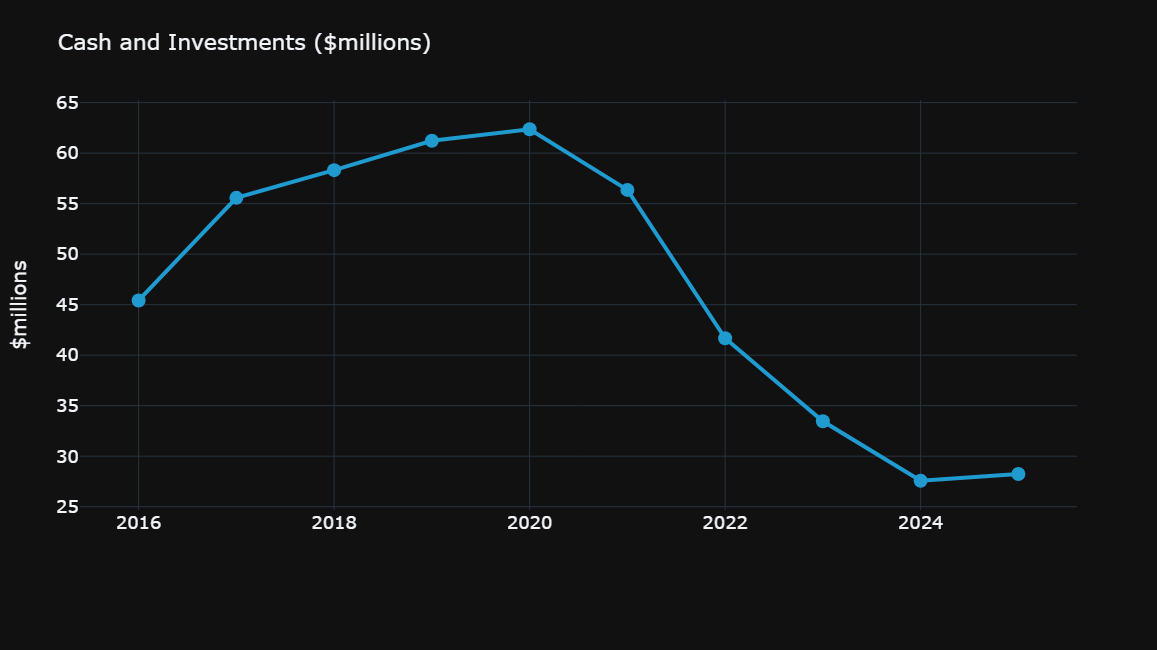
As you can see from the chart below, Hampshire’s cash and investments have continued to decline since 2020. It has a lower cash balance than it did during its 2019 crisis.
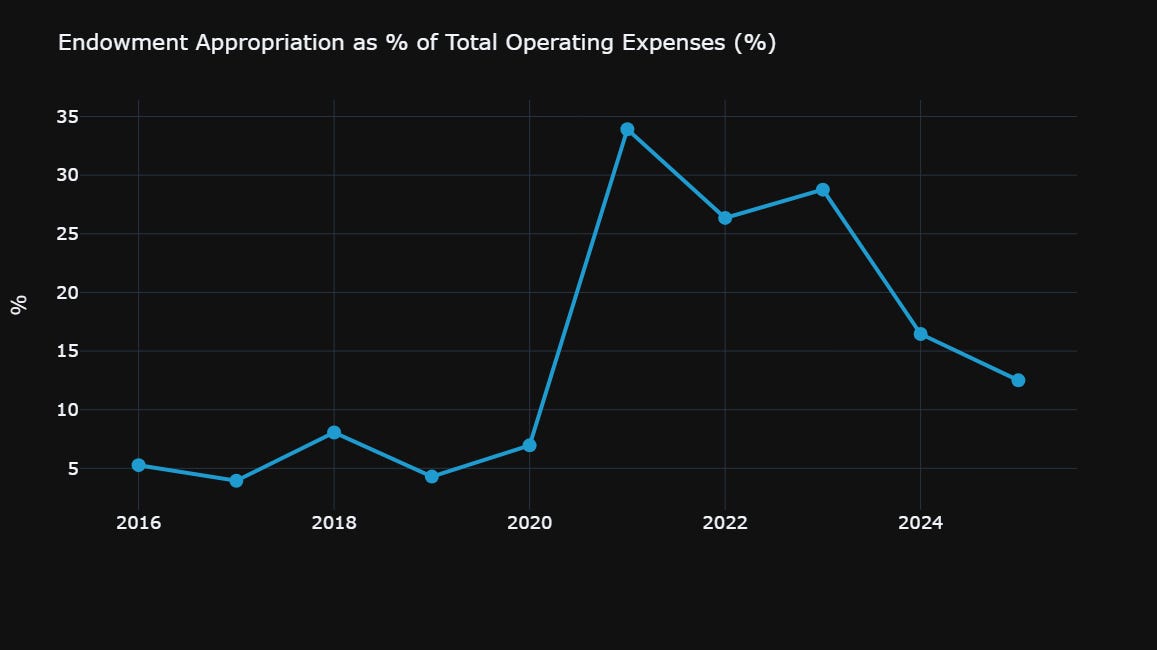
Note that its endowment draw as a percentage of operating expenses exceeded the typical industry norm of ~5%. This was not a sustainable path for them over the long-haul.
Now introduce AI into the equation.
I asked ChatGPT a simple question.
My daughter may apply to Hampshire College, what are your thoughts?
The response did not just describe the academic model or student experience. It surfaced concerns about financial instability.
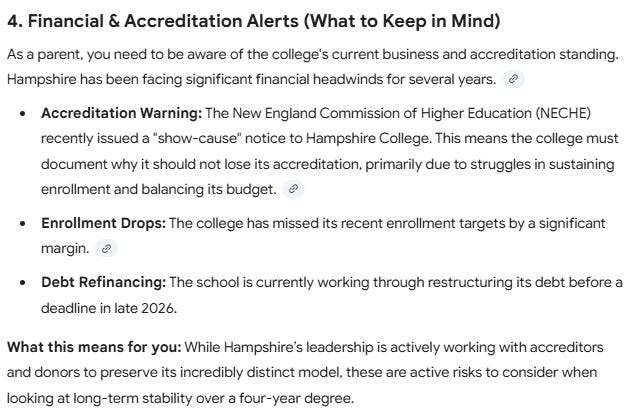
When I asked the same question to Google, AI Overviews produced a more balanced response—acknowledging risk, but also emphasizing the institution’s unique model.

ChatGPT suggested that there were risks, whereas Google AI Overviews suggested that the institution’s unique model was worth those risks. The issue is not which system is right. The issue is that this information is now surfaced, and surfaced immediately.
This is a remarkable shift in public transparency about an institution’s financials.
Historically, while this type of information existed it wasn’t front and center. A parent might encounter it later in a process, perhaps after visiting campus or speaking with an advisor. Or maybe not at all.
Now, it appears at the very beginning of the enrollment process.
The narrative of an institution is no longer controlled by the school. It is synthesized from across the Internet from the institution’s digital footprint.
AI Will Compress the Enrollment Funnel
My thesis, the point of this piece: AI will accelerate the decline of financially challenged schools by compressing the top of the enrollment funnel.
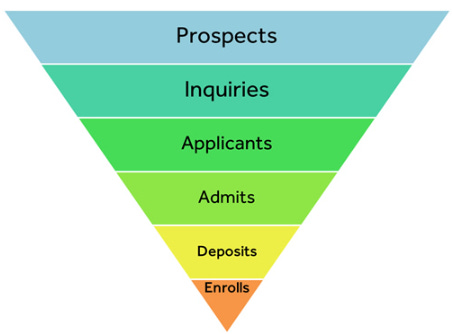
Industry practitioners typically think about the enrollment cycle as a funnel.
Prospects → Inquiries → Applicants → Admits → Deposits → Enrollments
Everything starts at the top. The funnel narrows with each step of the process. Perhaps 50K prospects become 1K enrollments.
In the past, a student or parent would begin with a Google search, click through multiple websites, and gradually form a view. If a school could get a click, it could tell its story.
AI has broken this model.
Instead of browsing on the web, a user asks a question and receives a synthesized answer. A small number of institutions are recommended. Others are not mentioned at all.
For those that are mentioned, framing matters. A school may appear alongside commentary about outcomes, reputation, or financial instability.
In effect, LLMs are becoming de facto college counselors.
This has a direct effect on the funnel.
If fewer institutions are surfaced, fewer enter the consideration set. If an institution is excluded or included with negative framing, the number of prospects entering the funnel declines.
Fewer prospects → fewer inquiries → fewer applications → fewer enrollments
Discovery Problems Compound Financial Difficulties
For institutions that are already fragile, even small declines at the top of the funnel can have outsized consequences.
Higher education has a high fixed-cost structure. Faculty, facilities, and administration do not scale down easily with enrollment. When revenue declines, costs remain largely intact.
This is operating deleverage. The loss of even a small number of students can materially increase financial risk.
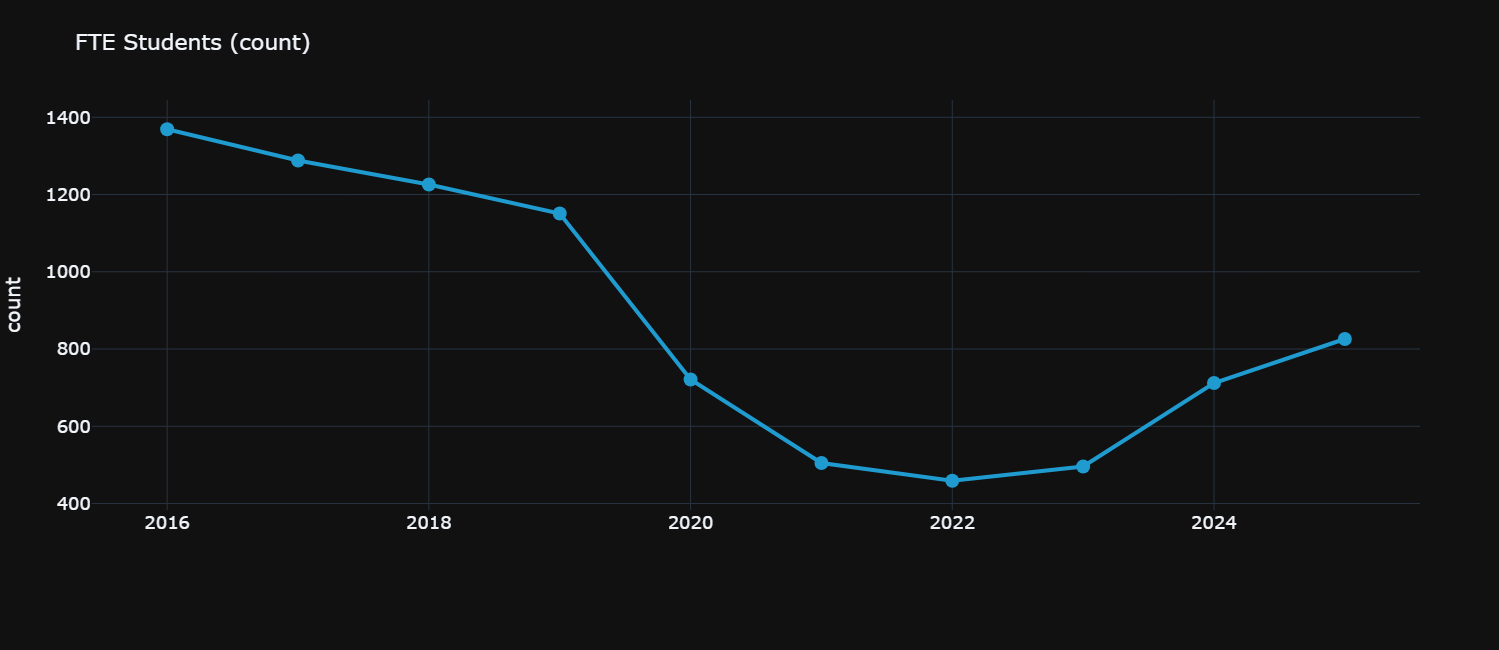
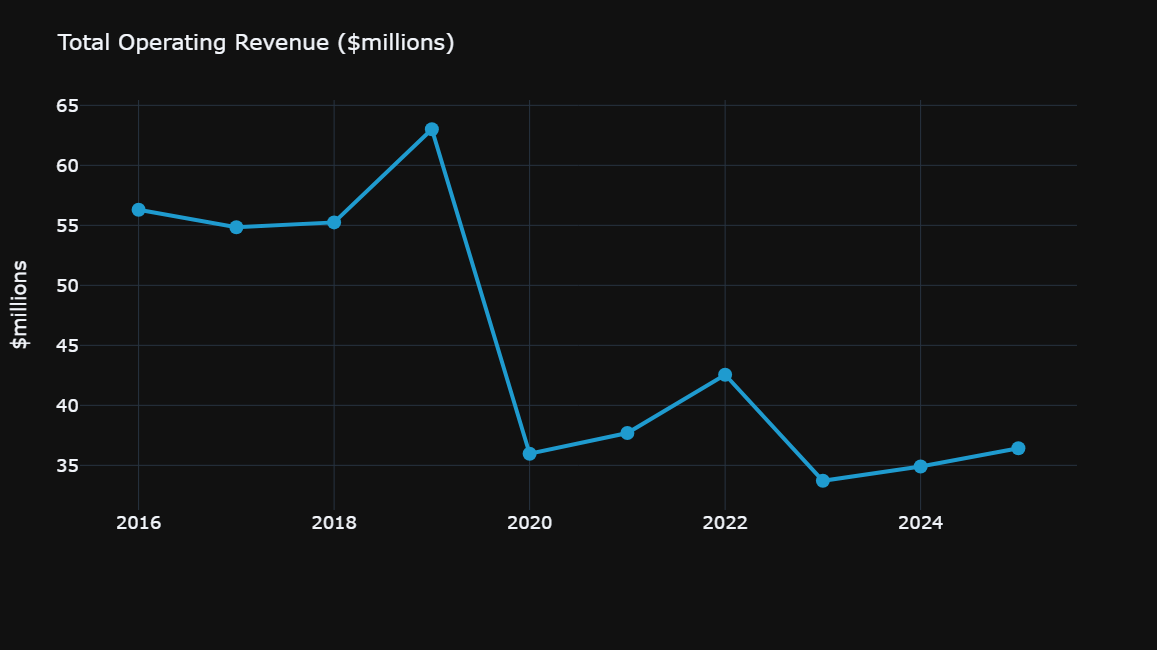
In the case of Hampshire College, you can see that revenue declined from roughly $60M earlier in the decade to roughly $30-35M.
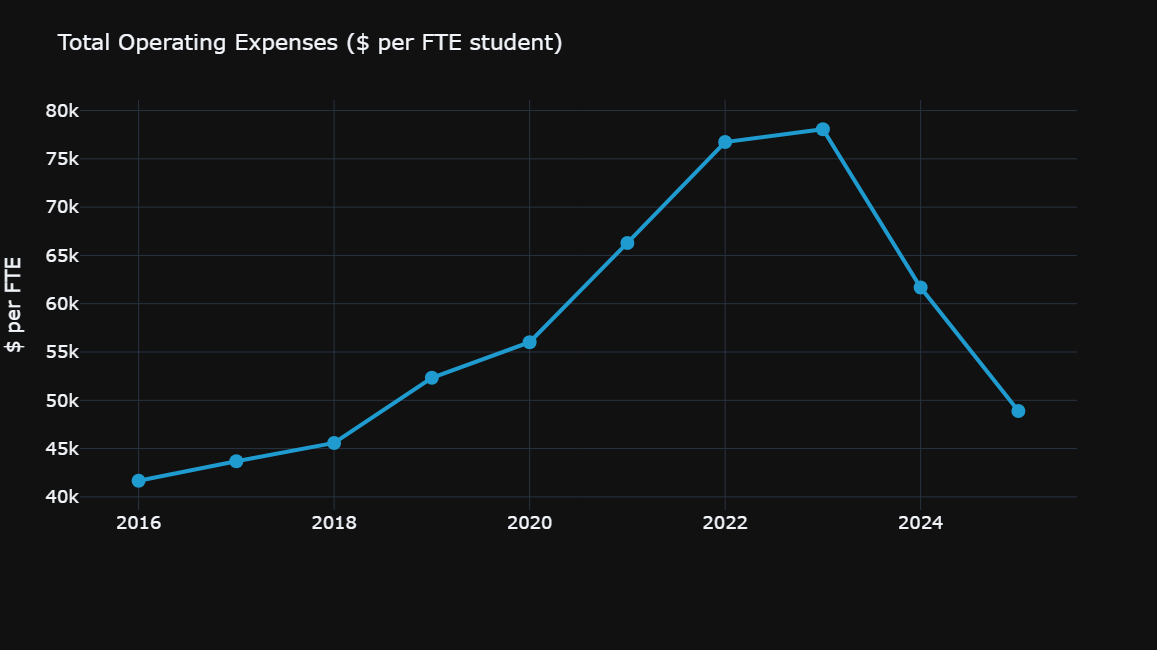
Leadership I’m sure did its best to cut costs, but with enrollment declines and the inability to cut fixed costs the cost per enrollment increased.
AI/LLM Risk Different Than Other Past “Existential Risks”
Yes, colleges have always had varying levels of financial strength.
Yes, institutions have survived significant challenges in the past. Like the recent pandemic.
What is new is that this sort of information is showing up front and center during the top of the funnel.
The income statement and balance sheets of financially distressed institutions have always been opaque to prospective students. Families are not in the habit of reviewing financial statements, reading accreditation reports, or trade journals that describe the issue.
AI changes that.
It surfaces institutional reputation, outcomes, and financial signals at the very start of a process. Before a school has an opportunity to engage the family.
This creates a reinforcing dynamic.
If concerns about financial stability are introduced at the prospect stage, some families may never move forward. They may not inquire, apply, or visit campus.
The funnel narrows before the institution can tell its story.
And because fewer students enter the funnel, enrollment declines.
For a financially fragile institution, that decline can worsen the underlying financial position—further reinforcing the original concern.
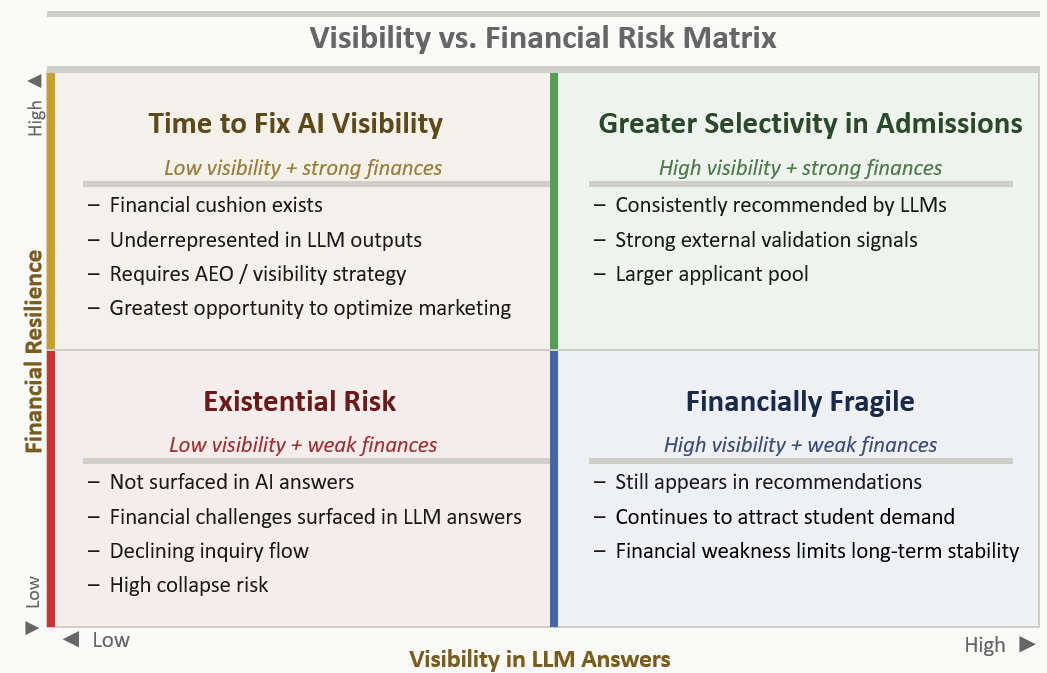
How to Think About Institutional Risk in an AI-Driven Market
AI now introduces a new variable into what already has been a financially challenged sector.
Two factors now interact:
How financially resilient the institution is
How visible and how it is described in AI-driven discovery
A school that is financially strong but not visible has a marketing problem. That can be fixed through a focused marketing effort.
A school that is visible but financially weak has a structural problem. The school has time to consider merger options, launch new revenue generating initiatives, or cut expenses.
A school that is both weak and not surfaced has an existential crisis. Not a lot of time to make changes.
What Institutions Need To Do
I hope that Hampshire College successfully navigates this period. They can fundraise their way out of this. They can seek a merger. But they need to do something immediately.
Institutions that are several years away from this sort situation have the flexibility to start acting now in a structured and thoughtful way.
They need to:
Diagnose how they appear in AI-driven queries
Strengthen external validation across third-party sources (outcomes, employer relationships, alumni narratives, media coverage)
Clarify positioning so the institution is differentiated in AI outputs
Communicate financial strategy clearly and credibly to stakeholders
LLMs will not determine which colleges succeed.
But they will make it painfully obvious which institutions were already at risk.
And in doing so, they may accelerate outcomes that would have otherwise taken years to unfold.
Don’t Discount How Bad of a Situation This Could Be
AI is arriving at a time when the sector is already under pressure.
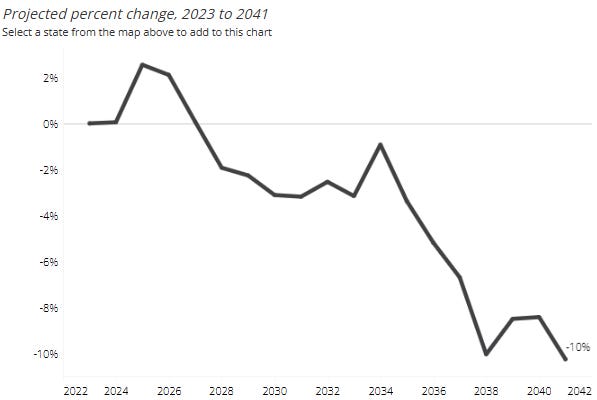
The enrollment demographic cliff—a projected decline in high school graduates beginning around 2025–2026—will intensify competition for students.
The Western Interstate Commission for Higher Education projects a ~10% decline in high school graduates by 2042 relative to 2022 levels.
Unfortunately, the next decade or so will see many schools close due to financial challenges. The Federal Reserve of Philadelphia estimated that, in a worst-case scenario, up to 80 institutions could close per year.
This dynamic in itself intensifies competition for students.
Fewer prospective students means fewer enrollments. For tuition-dependent institutions, that translates into lower revenue.
Hopefully those reading this are aware as to how quickly AI can disrupt demand-driven businesses.
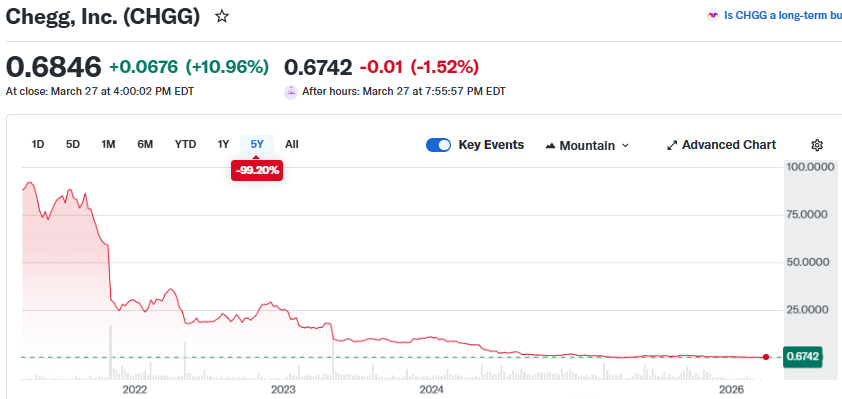
Consider Chegg, a publicly traded provider of “homework help”. As LLM-based tools began to replicate its core offering, the company experienced a rapid deterioration in its subscriber base. Billions of dollars in market value were erased over two years. The company’s long-term viability is in doubt.
When AI changes how users access information, demand can shift quickly. And abruptly.
Conclusion
LLMs will make it immediately visible which institutions are at risk.
And by surfacing that risk at the very start of the enrollment process, they may accelerate outcomes that would have otherwise taken years to unfold.
Institutions with weak financial profiles cannot wait.
They need to understand how they are perceived, how they are surfaced, and how much time they have to respond.
Because once these dynamics become visible at scale, recovery becomes significantly more difficult.
Disclosure: This piece reflects my analysis; AI tools were used for editing support and visual generation.