

TL;DR
In March, I argued that AI-related job insecurity could potentially trigger a new enrollment supercycle. Particularly in healthcare, skilled trades, and career-oriented degrees / programs. I based this on Google Trends data, which reflects a sample of search requests made across Google properties. AI job anxiety keyword searches saw a massive YoY growth spike in Q1 and Q2 of 2026. As did terms related to education degrees, programs, and credentials.
Seven months later, the picture has changed a bit.
The same search terms have seen a significant YoY deceleration of growth or an outright decline.
The reversal occurred during the period of rapid AI adoption. 61% of Americans reported using generative AI in Q3 2026. Workers have adopted AI faster than personal computers and the Internet at comparable lifecycle stages.
Education entities have reported strong enrollment growth in health care and vocational programs through Q2 2026. Will prospective learner interest abate? Will we see enrollment challenges over the next several quarters given less anxiety and difficult YoY comparisons? We’ll find out soon. More publicly traded postsecondary companies will report their Q3 results this month.
Revisiting My March Thesis, That AI Anxiety Could Drive Enrollment Growth
Back in March, I published the article AI Job Anxiety: The Next Catalyst for Edtech. It’s always good to revisit a thesis when the most recent data tells a different story than the one that I pitched. We’re seeing a YoY decline in various search terms as reflected in Google Trends data. So I thought that now is the time to provide the updated data to my loyal readers. Particularly ahead of publicly traded postsecondary companies reporting their Q3 financial results.
The context of the original piece - the “SaaSpocalypse” began on January 30, 2026, when Anthropic announced plugins for its Claude Cowork agent. The release demonstrated that autonomous AI agents could handle complex workflows across organizational functions, raising fears regarding the obsolescence of software.
The fear among working professionals was palpable. Within days $300B of market capitalization from publicly traded software companies disappeared. It turned out to be more than $1T within weeks.
Chapman University puts out an annual survey of American fears. In 2026, they published their 12th Annual Survey. The survey was conducted in April, still in the midst of the SaaSpocalypse.
Chapman found that 49.7% of Americans feared AI’s potential impact on the economy, making it the seventh-ranked fear. 51.9% expressed concern about AI harming the political process, placing it third.
Interestingly, AI replacing people in the workforce only showed up as the twenty-third ranked fear. That was above AI harming personal relationships. The twenty-fifth and sixth fears were nuclear meltdowns and terrorism, respectively.
Big picture, the situation was a bit more complicated. Reflecting back, it was reductive on my part to assume anxiety largely focused on job and career.
Back in March, I wrote that workers likely would respond to anxiety by pursuing educational degrees and certifications. Workers would seek credentials to gain an edge in a more competitive labor market.
During my years as a sell-side analyst at several investment banks, I saw professionals flock to online postsecondary institutions during the Great Recession. I assumed that we could see something similar with AI.
I was right. And wrong.
Obviously the vast majority of postsecondary institutions don’t report quarterly enrollment growth. Assessing trends within higher education comes largely down to evaluating publicly traded companies that own postsecondary universities.
Management teams reported in Q1 and Q2 2026 enrollment strength in health care and vocational programs. You can read more about this in my Q2 postsecondary review found here.
Demand didn’t exactly manifest into a seismic change in enrollment growth. Changes in how prospective learners conducted online search and discovery for postsecondary institutions negatively affected the top of the enrollment funnel. The usage of LLMs like ChatGPT and Google Gemini changed how users learned about programs and how long they took to apply to an institution. As well, the publicly traded proprietary institutions saw struggles with legacy negative headlines affecting student perspectives of their institution. LLMs recommended that learners actively compare for-profit institutions to state and nonprofit institutions. Which makes looking at the publicly traded companies perhaps not the best sample for evaluating demand for all of higher education.
That also complicates the Google Trends analysis. Some prospective students may be moving their research to AI tools rather than losing interest in education.
Here we are, seven months later. We have seven months’ worth of Google Trends data. Two additional quarters plus October data.
The data looks great. Or bad. Depending on your point of view.
The good news: the search data suggests people may be less freaked out about AI.
It’s unclear what drove this. I couldn’t find any research suggesting why the American people have chilled out. I didn’t see any data points about an increase in prescriptions for benzodiazepines like Xanax or Valium.
The potential bad news for higher education: if anxiety helped motivate professionals to explore further education, less anxiety could mean less urgency to enroll. Given where work might be heading, that could prove shortsighted.
What Changed in the Google Trends Data
I created heatmaps showing YoY changes in Google search, segmented by quarter.
Below I provide a heatmap showing search interest across AI-related job concerns.
Search interest decelerated across nearly every category. October suggests continued weakness.

Google searches for “AI layoffs” increased ~850% YoY in Q2 2026. Growth decelerated to 56% in Q3. In October the term saw a 70% YoY decline.
Search growth for “AI-proof jobs” decelerated from ~225% YoY in Q2 to no growth in Q3. “AI taking jobs” decelerated from 82% YoY growth in Q2 to 8% in Q3.
Adapting to the New Normal
The SaaSpocalypse seems like ages ago. But we’re talking about only 10 months. Roughly 300 days.
To paraphrase Bill Pullman’s President in Independence Day -- Humanity didn’t go quietly into the night. We didn’t vanish without a fight. We lived on. We survived.
My thesis - I suspect part of the calm regarding AI reflects its adoption within the workplace. This isn’t a misunderstood threat anymore. The adoption rate has increased rather remarkably. Faster than earlier technological innovations like the computer and Internet.

We know what AI can do very well. Like replace tier one call center employees. We also know more about the durability of certain jobs.
Perhaps AI has become familiar enough that workers have adjusted to the new reality.
Technical Education: Recent Google Trends Reversal

The Google Trends heatmap above shows an outright reversal in October for the six technical education terms in our analysis. “Coding Bootcamp”. “Computer Information Systems”. “Computer Science Degree”. “Cybersecurity Certificate”. “Cybersecurity Degree”. “Google IT Certificate”.
Searches for “cybersecurity certificate” increased 96% YoY in Q2. They declined by 26% YoY in Q3.
It’s difficult to draw conclusions from this data.
One obvious question I have — does AI raise questions about the durability of demand for short courses?
We did see revenue weakness with short course provider Coursera when they announced their Q3 earnings. But that’s not a great data point, as the company is in transition following their merger with edtech provider Udemy.
Skilled Trades: Even AI-Resistant Careers Saw a Decline in Search YoY

In March, I suggested that workers concerned about AI displacement might pursue occupations less vulnerable to automation, including HVAC, electrical work, and other skilled trades.
The latest search trends have weakened since then.
“Trade school” searches decelerated from 50% YoY growth in Q2 to 1% in Q3. They declined by 20% YoY in October.
Searches for “HVAC certification” decelerated from 39% YoY growth in Q2 to a 5% YoY decline in Q3 and a 35% YoY decline in October.
All seven vocational and skilled-trade search terms in our analysis declined YoY in October.
Employers still continue facing shortages of qualified workers. Regardless of how frequently prospective students search for training programs.
So it will be interesting to see how Universal Technical Institute and Lincoln perform in Q3, and to what extent they speak to potential weaknesses regarding demand. Both of these companies saw temporary execution challenges in Q2 that may have persisted into Q3, so again we won’t really know to what extent a new demand environment has impacted their operations.
Healthcare Education: Slower Growth; More Resilient

Healthcare education search term growth also decelerated. But the category performed better than the others presented in this article.
Searches for “nursing school near me” increased 92% YoY in Q2 but just 5% YoY in Q3. They declined 28% YoY in October.
Healthcare occupations continue to benefit from broader demographic trends.
Note that postsecondary education company Covista, the owner of the largest nursing school in America the Chamberlain School of Nursing, reported its Q1 fiscal 2027 results on October 29th. They reported better results than expectations and raised their full year guidance. CEO Stephen Beard commented that “We see no reduction in demand for health care workers, from employers or from the talent who wants to choose these purposeful careers.”
So we may not have seen this Google data reflected yet in the enrollment funnel. Or perhaps we are seeing it at the top of the funnel, and won’t see an impact until a quarter or two later. Or perhaps student acquisition costs are rising or will rise over the coming quarters. Obviously, a lot of ifs and speculation on what this means.
Degree Completion: An Exception to Weaker Trends
For the most part intent to complete degrees has surprisingly held up rather well, at least relative to the other groupings of search terms we reviewed.

For example, searches for “finish my degree” increased 104% YoY in Q3 and grew by 75% YoY in October.
Why no meaningful decline in search with this group? No idea.
The other groupings consisted of career changers. Prospective learners using degree-completion search terms might consist of motivated professionals who want to further their progression within their career.
The Recent Data Probably Not a Reflection of Difficult YoY Comparisons
The astute readership of this newsletter no doubt at this point in the article will raise the question — isn’t this just difficult YoY comparisons? Deceleration doesn’t necessarily mean that search interest has declined.
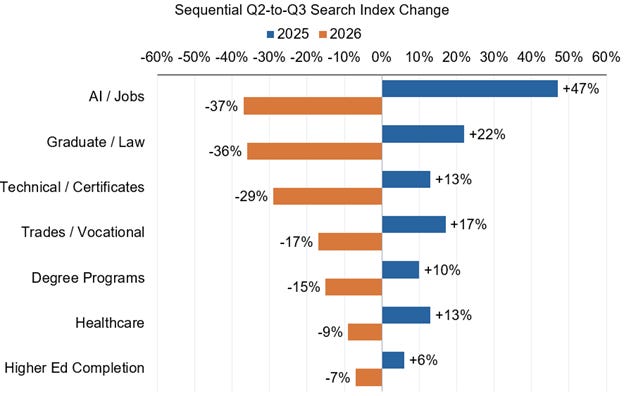
When dealing with spikes in growth, it’s always helpful to look at sequential change. Meaning looking at quarter over quarter change rather than year over year change.
I compared the sequential change between Q2 and Q3 in 2026 with 2025.
The sequential change in 2026 reflects a genuine decline in search. In 2025, search interest increased between the second and third quarters. In 2026, every category showed a negative sequential change.
We Survived the SaaSpocalypse. But What About the Next Five Years?
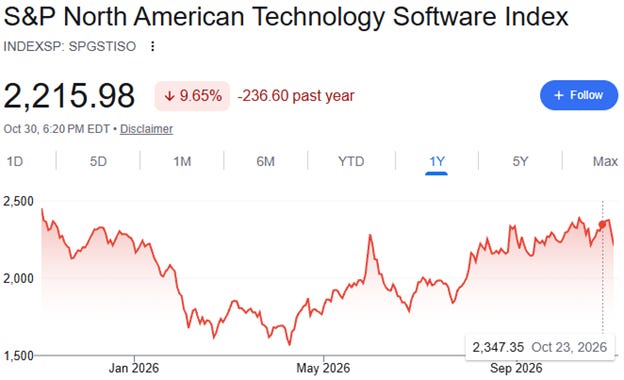
I am unaware of data that shows humanity’s resilience to threat and change. The stock market at times reflects a good proxy to human behavior and sentiment.
If you bought the S&P North American Technology Software Index a year ago, you would have only seen a 10% decline in your holding. If you had sold back in February you might have lost 40% of your position. Software stocks in aggregate largely recovered their value.
Perhaps for the time being we’ve adapted to the new normal.
But…
Bigger picture, companies will become more valuable while employing fewer people. There are many things one can dispute in this piece. This isn’t one of them.
According to market research firm Forrester, by 2030 AI may cause close to 50% of current customer service jobs to disappear. A Forrester analyst also said that AI will displace 6% of US jobs by 2030. That’s more optimistic than consulting firm BCG, which predicted that 10-15% of US jobs could be eliminated in five years. ServiceNow’s CEO said back in March that new college graduate unemployment could reach 30% thanks to AI automation. He said that during the SaaSpocalypse. Maybe he said that in the frenzy of the times.
This AI technology didn’t even exist five years ago. So it’s a bit foolish to offer dour projections of what the labor markets might look like five years from now.
What we do know is that there likely will be a pretty significant dislocation in the labor markets. Workers need to reskill and upskill in this new reality.
Academic institutions have an incredible opportunity to serve as a bridge between the work people know how to do today and the work that they will need to do tomorrow.
I still think AI displacement could drive an enrollment supercycle as workers pursue training for different jobs. But the need for new skills won’t automatically translate into enrollment. Schools will have to offer programs worth the time and money. That adjustment could unfold over years.
The latest search data gives me less confidence that this supercycle is imminent.
Maybe that’s a good thing. The boom / bust education cycles historically included bad actors exploiting the opportunity to profit at the expense of learners.
A gradual adjustment might give schools time to build programs that offer a route to the next job, at a reasonable price point that doesn’t leave the student burdened with debt.
That’s an opportunity worth taking.
H. G. Wells wrote, “Human history becomes more and more a race between education and catastrophe.”
I’m still rooting for education.
Are you rethinking your institution’s strategy? Are you evaluating selling your institution, or thinking of expanding through acquisition?
I want to help. Reach out to me at ariel@kolariconsulting.com.
If you found value in this article, please subscribe to this newsletter.
It’s free.
Subscribing tells me you found the content interesting and that I should write more about this topic.
Disclaimer: This article is for informational purposes only and doesn’t constitute investment advice. I own Coursera (COUR) and UTI.