

TLDR
Conventional wisdom suggests that AI reduces or eliminates the value of academic credentials. I disagree with this broad generalization. As with any major technological disruption, AI will create winners, not just losers.
I argue that AI could increase the value of some credentials in two ways. First, as AI commoditizes academic content, the other components of a credential become more important. Second, AI has changed how learners discover and evaluate credentials. LLMs (large language models) like ChatGPT and Google AI Overviews powered by Gemini could increase demand for credentials that already provide significant value but have historically suffered from limited awareness or distribution.
Harvard’s HBS Online could be one of the winners. It has the strongest brand in higher education and reports attractive learner outcomes. Yet, enrollment has barely grown since 2021. Revenue declined 10% YoY in fiscal 2025. Its problem hasn’t been its brand or product. It’s been student acquisition.
That may now be changing. AI is increasing anxiety about white-collar employment, while LLMs are changing how prospective learners discover and evaluate credentials. Both trends could benefit HBS Online.
My prediction: after several years of sputtering, HBS Online’s revenue may finally stabilize and perhaps return to growth. We’ll find out more in November.
Has AI Destroyed the Value of the Degree/Credential?
The conventional wisdom disseminated by the media over the past year or two was that AI would diminish the value of an academic credential.
We’ve seen this sort of playbook before. Every now and then traditional media outlets question whether college is worth the cost. I last saw this during the Great Recession, back when I worked as a sell-side equity research analyst, when pundits regularly raised questions on return on investment given record unemployment.
What’s different this time? Free content provided by generative AI now allows users to access information on virtually any subject. AI can automate repetitive jobs. Recent college graduates are facing the highest unemployment rate of the decade.
Some of the more recent headlines:
The Washington Post, June 2025: Facing entry-level job crunch, new grads question the value of a degree
Forbes, August 2026: AI’s Quiet Devaluation Of The Degree Has Begun. Is Anyone Noticing?
The Bear Cave, September 2026: 5 Education Stocks in AI’s Blast Radius
Where I take issue is the conflation of free content and a degree/credential. I also take issue with broad generalizations about degrees rather than considering their distinct value propositions in specific industry verticals.
It’s as if an investment analyst said that AI has made all stocks overvalued.
Which stocks? All stocks? Publishing companies in the age of free content? Energy companies that power data centers? Turbine providers like GE Vernova that produce a gas turbine where demand exceeds supply?
The Bear Cave authors suggest that “AI is increasingly calling into question the economic value of a degree.”
Which degree?
Nursing? The kind that leads to a licensed profession where an aging population is driving demand for more nurses? Or liberal arts programs without a clear connection to a career path?
In the free section of their mostly paywalled article, The Bear Cave writers pointed to the collapse of Chegg as evidence of the danger facing education stocks. Chegg’s market capitalization declined from $12B to less than $100M. But Chegg didn’t offer degrees. They didn’t market credentials. They sold content.
And content is precisely what AI commoditizes. Students who previously subscribed to Chegg for “homework help” can now get that information for free from Google AI Overviews. Chegg’s collapse tells us about the risk of companies whose business model centers on content and publishing. The product has clear substitution with no switching cost. It tells us nothing about the value of a nursing degree, an HBS Online credential, or any other credential.
But why let facts get in the way of a good story?
What the media continues to miss in crafting these anxiety-provoking essays, in my opinion, is that a credential consists of much more than content. In the table below I decompose it into five parts: content; assessment; brand; community; and employer access & signaling.
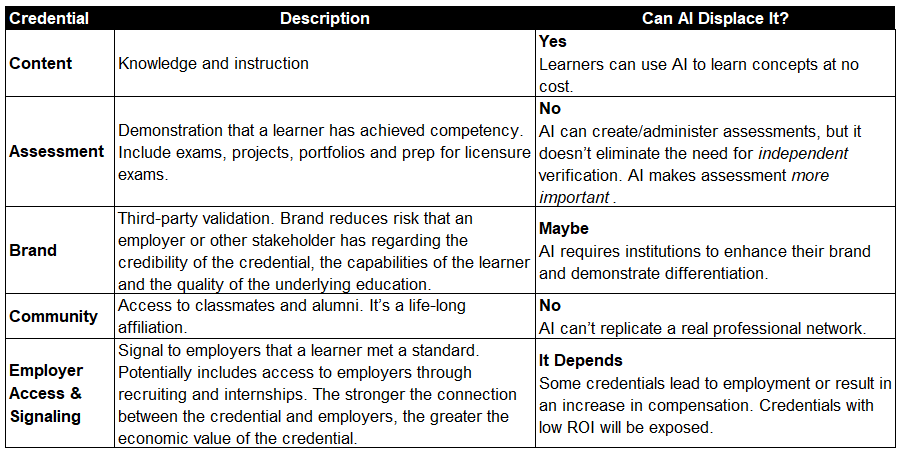
In this piece I attempt to refute the conventional wisdom.
Broad generalizations about AI and its impact on degrees don’t capture the complexity of the education industry or the different verticals served. Like every major technological disruption, AI will create value for some and destroy value for others. Some credentials, institutions, and business models will win. Others will lose.
To win this argument, I need to identify a pre-existing credential that could demonstrably become more valuable because of AI. If I can find one that actually benefits from AI rather than simply survives it, then the conventional wisdom is at minimum too broad.
I think that credential exists with Harvard Business School’s HBS Online certificates.
But first, it’s important to define what I mean by value.
In my opinion, a credential has value in two distinct ways.
First, the credential needs to provide a benefit to both the learner and employer. A program that develops skills, improves career prospects, and generates an attractive return on investment (tuition relative to increased income) clearly has value to the person earning it. If employers recognize those skills when making hiring and promotion decisions, the credential has usefulness to them as well.
But a credential also needs to have perceived economic worth in the broader market. Think about Bitcoin. Its value depends in part on people collectively believing it has value. Credentials obviously don’t have a market price that fluctuates by the minute, but the basic concept isn’t entirely different. Part of a credential’s appeal comes from what other people believe it represents. A credential that nobody recognizes or is even aware of has limited worth, regardless of the quality of the underlying education.
For a traditional institution with a limited number of seats, scarcity increases the value of the credential. Selectivity in admissions becomes the credential’s signal to others.
A scalable online credential works a bit differently. No fixed supply of seats exists. So market adoption becomes an important measure of value. What percentage of the addressable market does the credential have? Is the penetration rate increasing? Has the credential become a recognized standard for the market it serves? For the institution offering the credential, that increased adoption should ultimately show up in enrollment and revenue growth.
This leads to my thesis: AI can increase the value of pre-existing credentials in two ways. First, as AI commoditizes academic content and knowledge becomes ubiquitous, the other aspects of a credential, including assessment, brand, community, and employer signaling, become more important to the learner. Second, AI is changing how learners discover, evaluate, and choose among competing credentials. For credentials that already provide significant value but suffer from limited awareness or distribution, AI may increase demand and adoption.
Case Study - Harvard Business School’s HBS Online
So why do I think HBS Online could be the winner that proves my thesis?
Just to be clear, I’m not referring to the highly selective MBA program that graduates CEOs, CFOs, venture capital executives, and other members of the global economic elite.
Rather, I’m talking about HBS Online, which provides non-degree certificates on an open enrollment basis.
HBS Online extends arguably the strongest brand in higher education to a much broader audience. It provides a global community of learners and a credential designed to signal an affiliation with Harvard Business School to learners and employers. These are attributes not easily displaced by free generative AI. Validation by third parties helps employees stand above the competition.
If HBS Online becomes more valuable in the age of AI, I would expect that value to show up in greater demand, enrollment, and revenue.
So far, it hasn’t.
Some context on HBS Online.
Harvard clearly has the best brand in higher education. For those of you that require data for this sort of assertion, an often-cited publication named Times Higher Education ranked Harvard with the highest brand value in 2025, representing its fourteenth consecutive year at the top. The term they used to describe Harvard’s rank? “Immovable.”
Harvard Business School benefits from the Harvard halo effect. Louis Winthorpe III and Patrick Bateman, in depicting the excesses of 1980s Wall Street, naturally graduated from Harvard Business School. The school accepts only the crème de la crème. Harvard Business School has just a 12% acceptance rate. Of those admitted, 85% enroll at the school.
Harvard launched HBS Online, its “digital learning initiative,” in 2014 (branded at the time as HBX). Their dean suggested at that time that, “HBX will provide a powerful channel for communicating ideas to and engaging with new and wider audiences.” The program was
designed to provide basic business fundamentals to segments of the population we’ve never directly addressed before: undergraduates, graduate students in non-business fields, and people who have just begun their first jobs in business but want a better foundation so they can thrive earlier in their careers.
MOOCs were all the rage at the time. Coursera and edX had recently launched, but low completion rates were already a concern back then. HBS chose to charge for access, attracting learners with some financial commitment to completing the course.
HBS Online doesn’t have anything approaching the admissions selectivity of the MBA. Individual courses priced from $500 to $2K are accessible to anyone willing to pay for them, for the most part. Apparently, some multi-course programs have application or participation requirements. HBS Online does offer a program called CLIMB at a price point of $15K, whose marketing material suggests some selectivity on the front end.
The Harvard Business School MBA derives much of its value from its selectivity. That’s not what HBS Online is selling. Harvard Business School has somehow maintained the exclusivity of the MBA while extending its curriculum, credentials, and brand to a much broader audience.
This branding architecture isn’t unusual among elite universities. MIT and Wharton follow similar strategies. Admission to their degree programs remains extraordinarily selective, while MITx and Wharton Online offer much more accessible online courses and certificates. At least to date, institutions have been able to extend curriculum and brand to a much broader audience without diminishing the scarcity of the underlying degree. Whether elite universities should extend their brands in this way has been controversial and likely will remain so, but that debate is outside the scope of this piece.
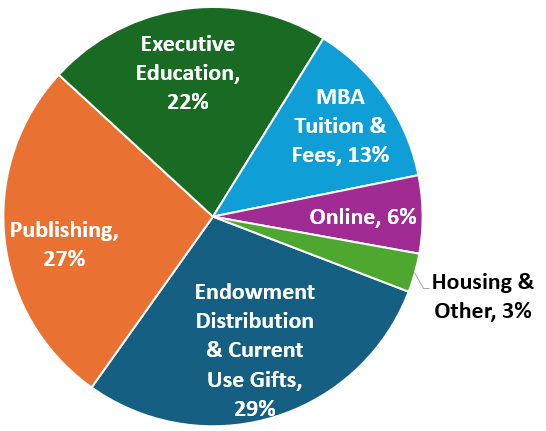
Harvard Business School has already demonstrated that monetizing its brand to a broader audience works financially while maintaining the brand strength of the core MBA program. It accounts for only about 13% of total revenue. Executive Education and Harvard Business Publishing are considerably larger businesses.
HBS Online generated $63M in fiscal 2025, or about 6% of total revenue. If HBS Online were to double from its current revenue base, it would approach the size of MBA tuition and fee revenue.
HBS Online’s Post-Pandemic Revenue Struggles
HBX/HBS Online was an extraordinary success from inception through the pandemic from a revenue and enrollment perspective.
Revenue grew to $43M in fiscal 2019, $58M in 2020, and $76M in 2021.
Since the pandemic, though, growth stalled.
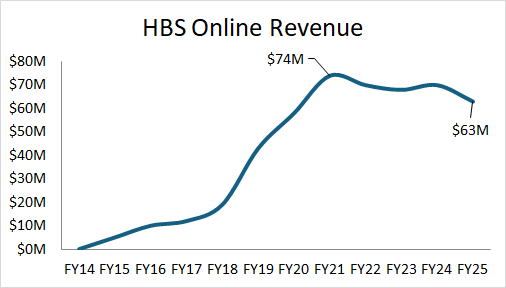
Revenue declined to $74M in 2022, $68M in 2023, recovered slightly to $70M in 2024, and then fell another 10% to $63M in 2025.
Enrollment followed a similar pattern, rising from ~19,500 enrollments in 2019 to almost 39,000 in 2021. By 2025, enrollment was still around 39,000.
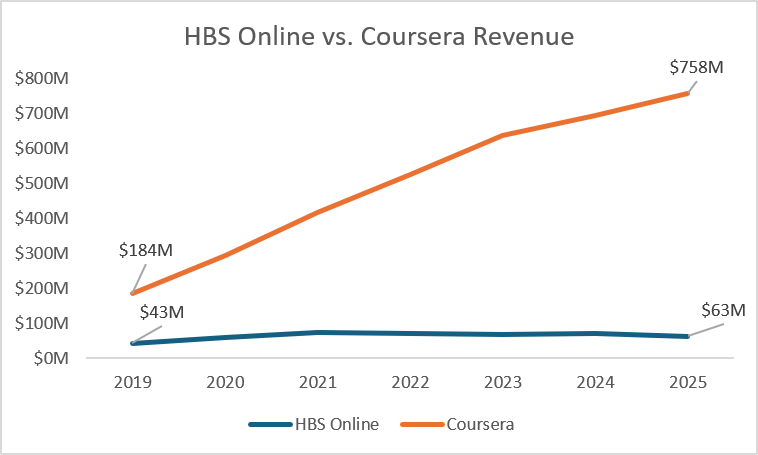
Publicly traded Coursera, with a market capitalization of over $1B, provides a comparison for what HBS Online could have been.
In 2019, HBS Online represented close to 25% of Coursera’s revenue. By 2025, Coursera generated $758M of revenue compared with $63M for HBS Online.
So what happened?
Coursera expanded its catalog, added university and corporate partners like Google and IBM, and built an enterprise sales force. That required significant capital. Cumulative free cash outflow exceeded $120M from 2019 to 2022.
In return for its investments, Coursera became THE destination for learners.
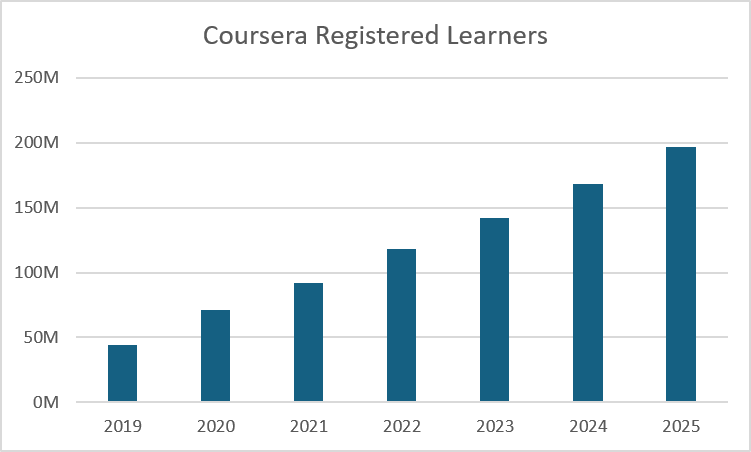
Harvard obviously isn’t Coursera in a number of ways. Most obviously, Harvard is a nonprofit. Its mission isn’t revenue growth or market dominance. HBS Online presumably operated under constraints that made Coursera’s strategy difficult to replicate.
Maybe HBS Online should have broadened beyond its business focus, added courses from other Harvard schools, or sought outside distribution. It’s easy to provide coulda, woulda, and shoulda speculation from the outside without understanding the strategic and operational constraints that HBS Online faced.
What we do know from public disclosures, though, is that Harvard Business School’s leadership has been disappointed with HBS Online’s recent financial performance.
In its 2024 Annual Report, Harvard Business School said that HBS Online revenue was “significantly below our forecast” and noted increased competition and higher costs to acquire learners. Management in 2024 said that they had set “an ambitious revenue goal for fiscal 2025, projecting double-digit growth.”
In 2025 they didn’t exactly grow double digits. Like Bob Uecker said, it was just a bit outside. In its 2025 Annual Report, Harvard Business School reported a 10% YoY decline in HBS Online revenue. They cited higher learner acquisition and marketing costs, intensifying competition, and a growing preference for in-person engagement as reasons for the miss. The first two reasons make sense. The third? Not so much. Coursera, with its 9% YoY revenue growth rate in 2025, suggests that there are plenty of consumers still interested in online as a modality for instruction.
I’ve participated in the edtech market for close to twenty years. First, while serving at several investment banks covering the space. Then at Pearson within its virtual schooling business and lastly as an independent consultant.
In my experience, companies and startups develop great products and see early success, up to around the $50M mark. They then struggle to reach the next level. The challenge typically relates to distribution.
No company in edtech has a better brand than Harvard. But HBS Online’s go-to-market approach hasn’t fully leveraged that advantage. Its full array of courses historically hasn’t been distributed through third-party platforms like Coursera (at least to my knowledge). Instead, HBS has relied on its own website, traditional Internet marketing, and a relatively small institutional sales effort.
Again, I’m just an outside observer, but paid search seems like an inefficient way to monetize a brand as powerful as Harvard. Harvard and lesser-known competitors still have to bid on the same Google keywords. The Harvard name may improve conversion once someone finds HBS Online, but you’re still paying to acquire that person in the first place.
Enterprise sales aren’t much different. Corporate buyers care about cost and measurable outcomes. Well, mostly about cost, with lip service to outcomes.
This is where AI could change the equation. LLMs have and will become how prospective learners discover and evaluate credentials. What the broader Internet says about a credential influences what gets recommended.
This should give HBS Online an advantage it hasn’t fully enjoyed with traditional Internet marketing. Organic discovery through ChatGPT, Google AI Overviews and other LLMs should increase awareness and surface HBS Online to prospective learners without the same expense associated with paid acquisition or distribution through third-party platforms.
The Recent Inflection in User Interest of Academic Keywords
Google search interest in education increased sharply beginning in the summer of 2025, roughly at the same time that concerns about AI’s impact on white-collar employment intensified. I created a heatmap below that shows the YoY change in Google search interest for selected terms.
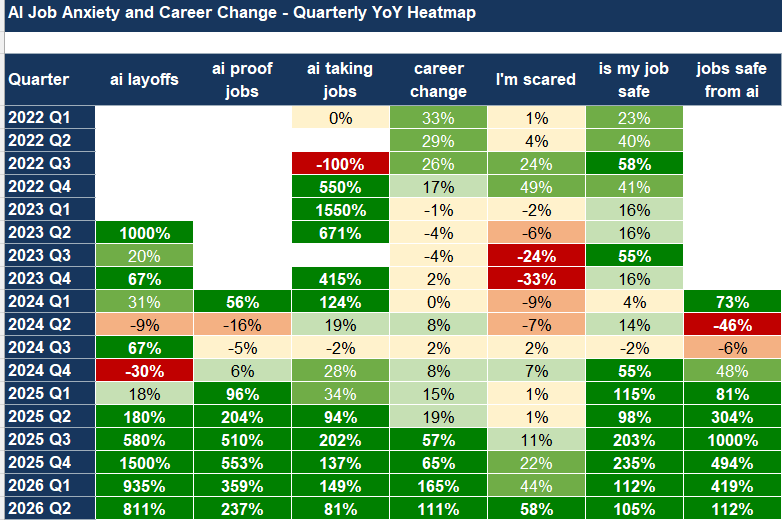
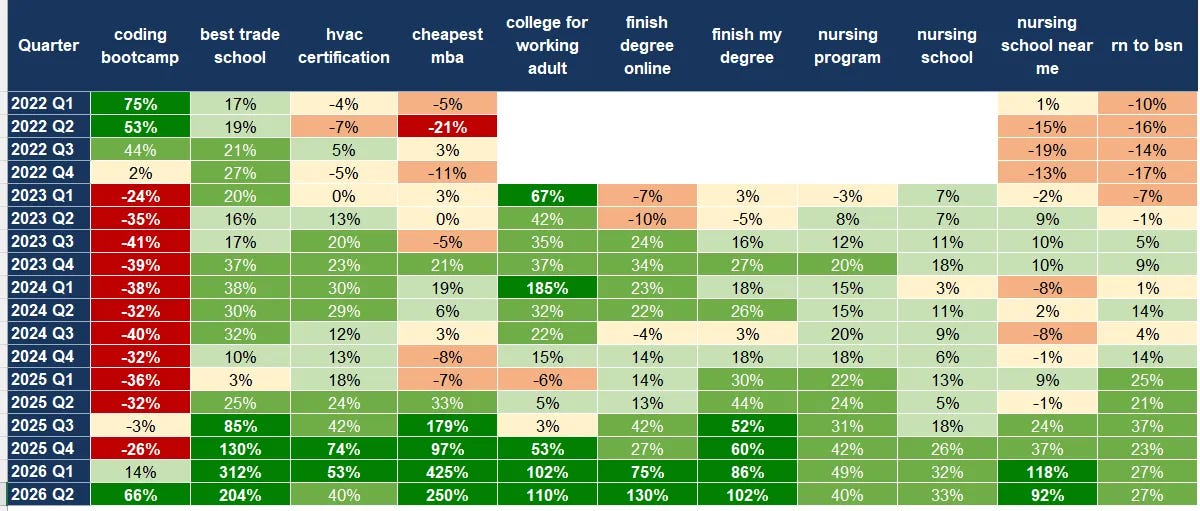
Searches for business schools and online certificates at leading business schools also rose. For those of you who think that this data might reflect a broader increase in Google keyword searches, I added three control search terms: food, Amazon and Netflix. None show anything approaching the magnitude of growth in business school digital offerings.
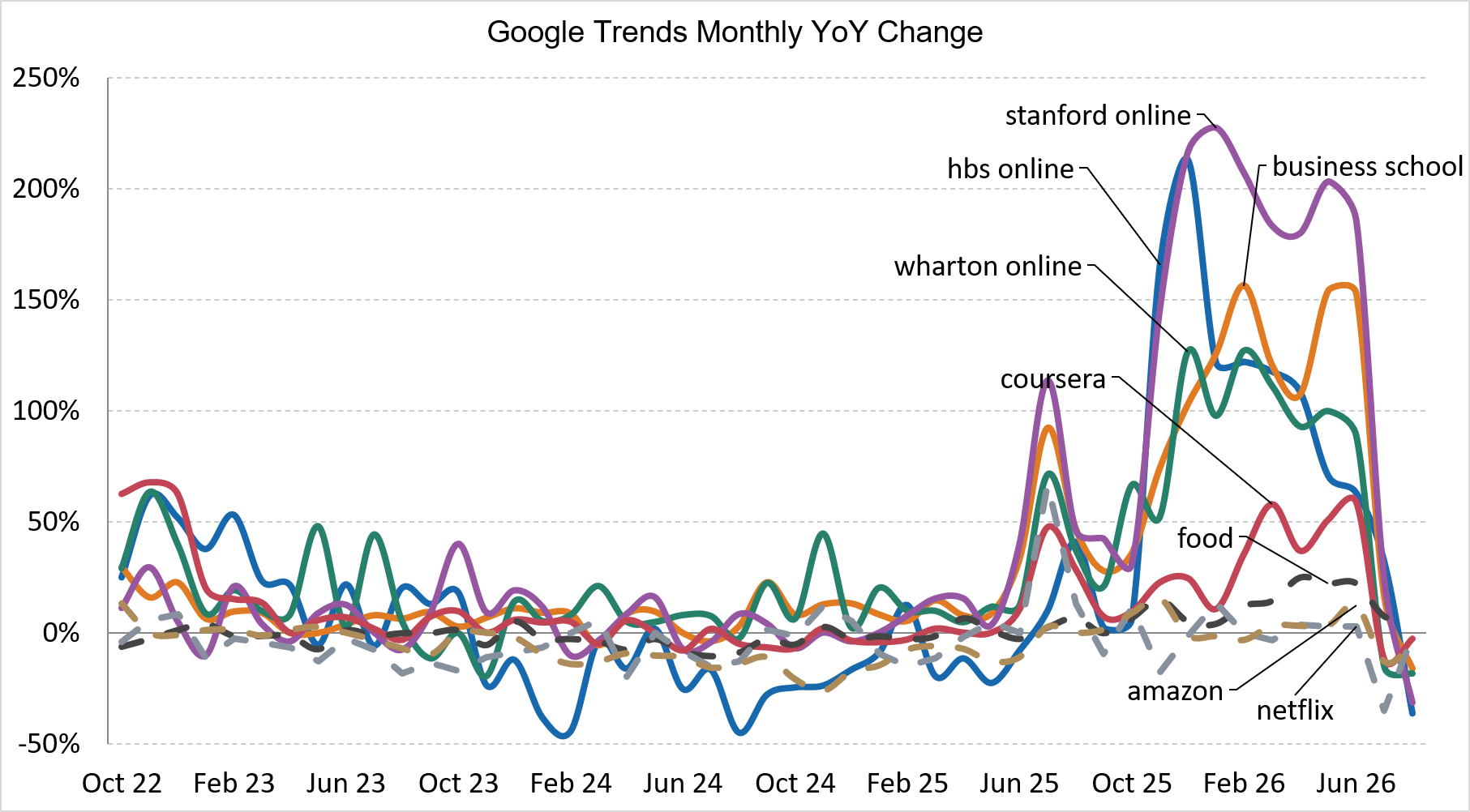
During the Saaspocalypse at the end of 2025, Google search interest in HBS Online and Stanford Online more than tripled from year-earlier levels, while Wharton Online and “business school” more than doubled.
Obviously, we don’t know whether this increased interest translated into additional course enrollments. The data only tells us that as workers became increasingly anxious about AI and employment, Google search interest in credential-related terms increased.
That’s the opposite of what you’d expect if AI were destroying the perceived value of education.
Decomposing the Value of HBS Online’s Credential
By unpacking the HBS Online credential, hopefully you can see that learners are buying far more than just instruction easily duplicated from an LLM.
Assessment
HBS Online does have assignments and requirements that learners must complete to earn a certificate. But there isn’t a universal standard assessment in business that validates competency. No NCLEX exam like in nursing. These courses don’t even satisfy professional continuing education requirements.
Brand
Admission to the MBA provides an enormous selectivity signal that an open-enrollment online certificate simply doesn’t provide. But learners still get an affiliation with the strongest brand in higher education. Who wouldn’t want that? If given the option between a state school certificate and Harvard Business School, which one would you prefer?
Community
HBS Online has made a deliberate effort to create a global community. I have no idea how successful it has been. HBS Online’s community site lists in-person and virtual events. 74% of learners said HBS Online was better at making them feel part of a global community, and 67% said the networking opportunities were better.
Any excuse to become part of an affinity group of like-minded, motivated, and ambitious people helps in life. Generative AI inches us closer every day to the hapless, lonely protagonist of Her, finding companionship and love from an AI chatbot (admittedly voiced by Scarlett Johansson). A real community of people who have gone through a shared academic experience still matters. Especially for professional networking like career advice, recruiting, and business development.
Employer Access & Signaling
In my opinion, this represents the greatest value of the HBS Online credential. It’s not just about learning content. It’s about packaging the credential and signaling it to employers.
HBS Online actively encourages its learners to put their digital badge on LinkedIn. Harvard Business School clearly wants learners to signal their affiliation with the brand to employers.
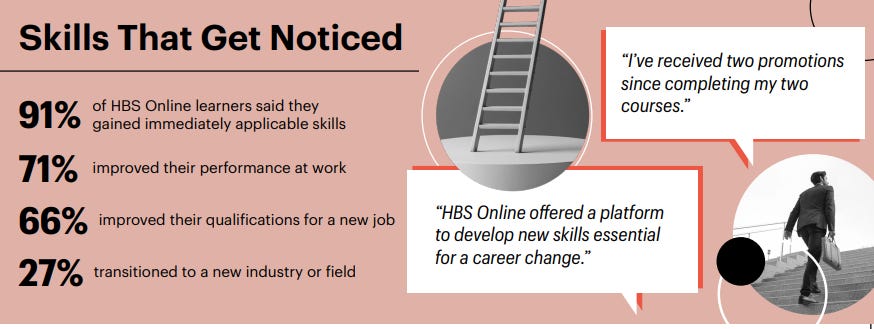
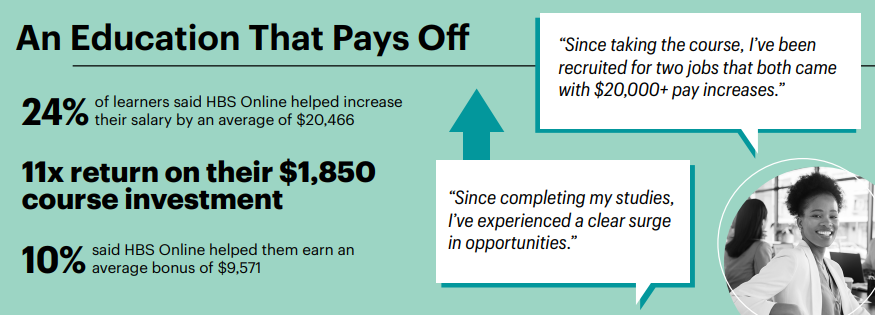
And Harvard Business School argues that there are real career outcomes associated with earning the credential. It reports that 71% of learners say the program improved their performance at work, and 24% say it helped increase their salary, with an average increase of approximately $20K.
How strong is that signal to employers in the scheme of things? No idea. In my opinion, that’s the missing piece of their marketing messaging. HBS Online (to my knowledge) doesn’t provide an employer survey showing what companies actually think the certificate represents.
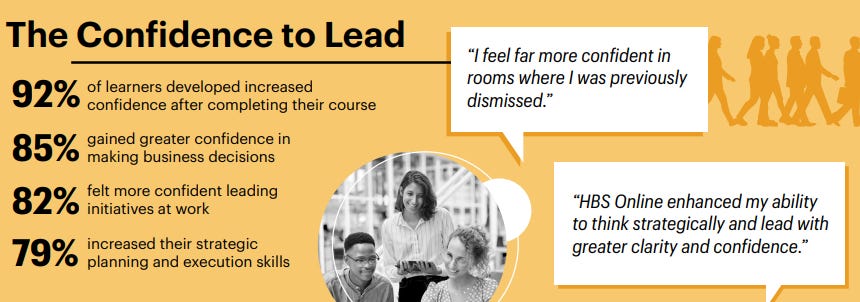
So while we don’t know what employers think of the credential, we do know what learners think. HBS Online’s surveys suggest that learners have enjoyed significant career benefits. See the screenshots below.
HBS Online Favorably Surfacing in LLM Responses
For the past half year, I’ve written about my experiments with LLM queries and implications for universities. Unfortunately, these experiments lack replicability because AI can generate different responses to the same query. So take the results with a grain of salt.
I assumed that HBS Online would show up favorably with LLM searches. I was right, to some degree.
For example, I queried the following on Google:
I’m looking for an online business program to build my resume that would be respected by employers.
In Google AI Overview’s response, HBS Online came in first, above Wharton Online.
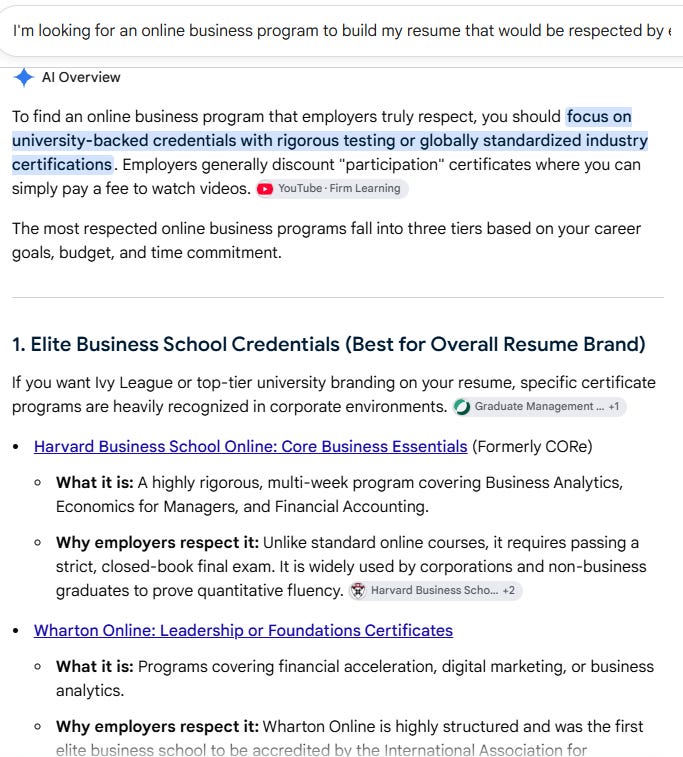
A great brand and differentiated product don’t necessarily matter if prospective learners never find you. With LLMs, users may find HBS Online if it appears in responses like it did for me.
Google still has roughly 90% of the search market, but Google AI Overviews are appearing in an increasing percentage of search results. This shift has occurred only over the past year or so, so any benefit to HBS Online may not yet show up in its financial results.
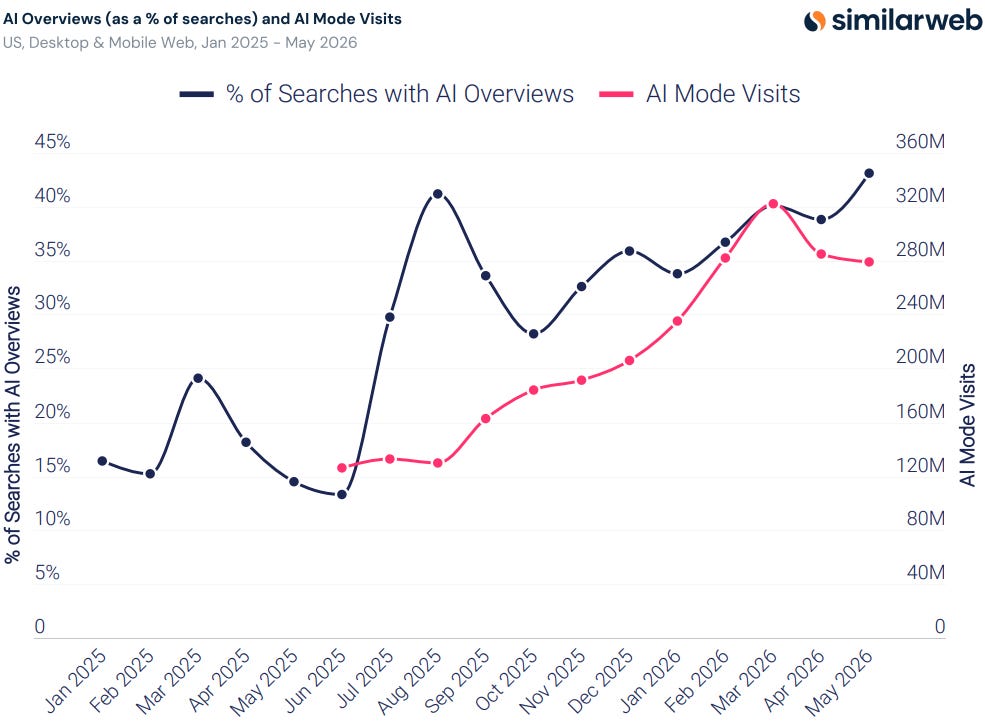
I recently showed a client how his career school appeared in LLM responses for searches related to his programs. He asked the natural question: “So why am I wasting my time with Google Adwords?”
It’s a good question.
Fortunately for HBS Online, it may be unusually well positioned for this shift. That doesn’t mean that their marketing team should sit on their laurels. There’s work to be done.
Answer Engine Optimization is the process of making sure that the information LLMs find about an institution supports the story the institution wants told. Based on what I can see from the outside, I think HBS Online could be doing more.
Reddit provides a good example.
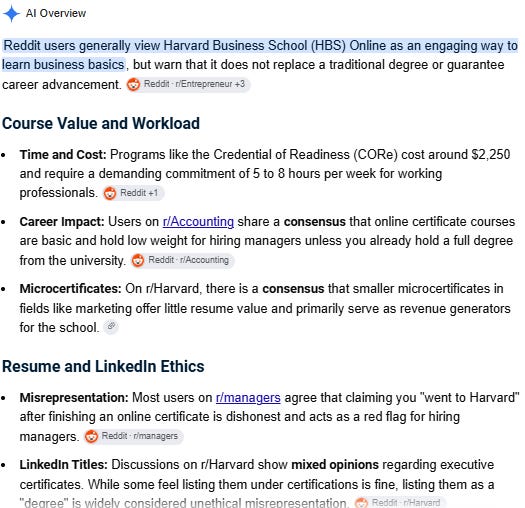
Reddit is the number one most cited source across major AI platforms. But its importance goes beyond what LLMs find on Reddit. People use Reddit to verify what LLMs tell them.
According to Reddit’s 2026 Path to Purchase research, half of U.S. shoppers say they verify AI recommendations on Reddit. Half of Reddit users say they go there looking for the “honest truth” about a product, brand, or service that AI can’t provide, while 41% look for “human consensus.” More than one in five shoppers now include Reddit directly in their search queries.
Yet HBS Online’s visible footprint on Reddit seems surprisingly limited given the platform’s importance. Yes, they have a subreddit that they update monthly. But given the thousands of people who have completed HBS Online courses, I would expect to find far more learners discussing their experiences, along with greater engagement from HBS Online when questions or criticisms arise.
Try Googling “HBS Online and Reddit.” The first Reddit post I see: Is it unethical to list “HBS” on LinkedIn for an online executive certificate?
Presumably that’s not exactly the story HBS Online wants prospective learners or LLMs to find. And it consistently appears first in my Google results.
HBS reports that 91% of learners see a positive impact on their careers. So where are those stories? HBS can’t control what people say on Reddit. But it can encourage former students to discuss their experiences. It can participate when people have questions about what the credential represents. And it can do a better job making sure that its outcomes information is part of the conversation.
Here is a screenshot from Google AI Overview summarizing sentiment on Reddit regarding HBS Online.
From my consulting work, I’ve seen organizations do a lot more to influence what LLMs find and ultimately say about them. To be fair to HBS Online, answer engine optimization is a new field. Everyone is still figuring it out. But HBS Online has tens of thousands of learners, strong reported outcomes, and the best brand in higher education. It has a lot more to work with than most companies. I think this represents a significant opportunity for its marketing team in 2027.
Conclusion - AI May Make Some Credentials More Valuable
I started looking at HBS Online because I thought its post-pandemic struggles demonstrated the limits of brand in online education. With the best brand in higher education, HBS Online struggles with the same problems that plague edtech companies: customer acquisition and distribution.
The more I learned about HBS Online, though, the more I came to a different conclusion. AI may actually make some of the attributes of its credential more valuable while also changing how prospective learners discover it.
For this reason, I think that after several years of sputtering, HBS Online’s revenue may finally stabilize and perhaps return to growth.
Obviously this isn’t a sure thing; HBS Online doesn’t automatically win. Having the Harvard brand is big, but it isn’t enough. HBS Online still has to adapt its marketing and distribution to a world in which prospective learners now use LLMs to discover and evaluate credentials.
There are reasons outside of AI that may have driven revenue stabilization this past year. HBS Online has expanded its course offerings. In September 2025, Harvard Business Publishing signed a deal with Coursera. Perhaps the deal included HBS Online. We know Coursera currently carries HBS Online “specialization” courses. The course website says that they were “updated” in July 2026. Does this reflect a meaningful change in HBS Online’s distribution strategy? No idea.
I mention all of this because internal marketing, distribution, or operational changes could conceivably have improved HBS Online’s financial and enrollment trajectory without AI having much to do with it.
We should get fiscal 2026 results in the coming months and see whether the business has finally turned the corner. If it has, I’ll be particularly interested in what leadership says drove the improvement.
I’ll probably do a follow-up piece once Harvard Business School publishes its 2026 annual report. If I’m wrong in my thesis, I’m reminded of General McAuliffe during World War II when the Germans had completely surrounded his division at Bastogne. When they demanded his surrender, he gave his famous one-word reply:
“Nuts!”
About Me. I run Kolari Consulting, an advisory firm focused on strategy, M&A, and AI. Please reach out or connect with me on LinkedIn.
Disclaimer: I own shares of Coursera. Nothing in this article should be construed as investment advice or a recommendation to buy or sell any security. The views expressed are my own.
Note: This article is based entirely on publicly available information. I reached out to HBS Online leadership, but they declined my request for an interview. Any factual inaccuracies are inadvertent, and I’m happy to correct them.
great work